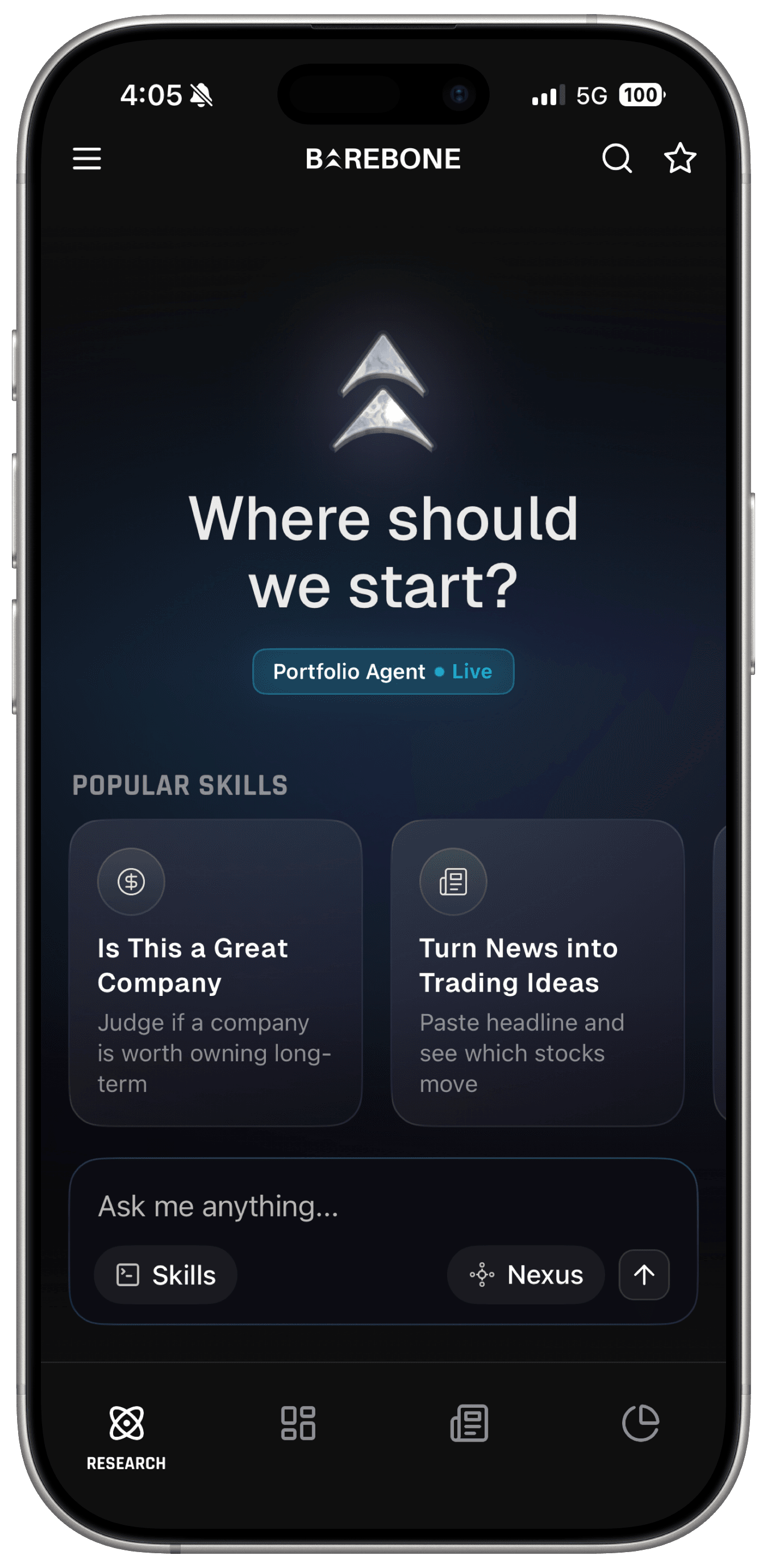
The best AI portfolio analysis tool in 2026 is Barebone AI: read-only broker sync, real risk metrics (Sharpe, beta, max drawdown), and an AI review of your actual holdings across growth, risk, income, sector balance, and momentum - on mobile. Empower wins for free net-worth dashboards; Portfolio Visualizer for backtesting.
What Actually Matters in Portfolio Analysis
Most "portfolio trackers" are performance charts with a pie graph. A real analysis tool needs five things:
- Sees what you actually own. Broker sync (read-only, ideally) or painless manual entry. Analysis of a hypothetical portfolio is a toy.
- Real risk metrics. Volatility, Sharpe ratio, beta, max drawdown - not just "+12% this year." Returns without risk context are half a number.
- Multi-angle review. A good human review checks growth prospects, risk concentration, income, sector balance, and momentum separately. Software should too.
- Monitoring between reviews. Positions change and news breaks; the tool should watch and alert 24/7, not wait for you to log in.
- Honest cost. Free tiers that do real work, paid tiers that earn the upgrade.
The Rankings at a Glance
| Rank | Tool | Best for | Price | Key strength |
|---|---|---|---|---|
| 1 | Barebone AI | AI portfolio review on mobile | - | Five-angle AI analysis + risk metrics |
| 2 | Empower | Free net-worth dashboard | Free | Fee analyzer, retirement planner |
| 3 | Snowball Analytics | Dividend-focused tracking | Free; from $9/mo | Income forecasting and calendars |
| 4 | Ziggma | Stock-level portfolio checkup | Free; from $6.99/mo | Scores and a portfolio optimizer |
| 5 | Portfolio Visualizer | Backtesting and simulation | Free; paid from $360/yr | Monte Carlo and factor tools |
| 6 | Seeking Alpha | Ratings on your holdings | $299/yr Premium | Quant ratings overlay |
| 7 | Morningstar X-Ray | Fund overlap detection | $249/yr (free Instant X-Ray) | Looks inside your funds |
1. Barebone AI - Best AI Portfolio Analysis Overall
Barebone AI is the app built by a former Goldman Sachs investment banker and a former Hanson Robotics engineer, and the portfolio tab is one of its most-used features. Connect a brokerage through read-only sync (or enter holdings manually) and the app treats your portfolio the way a research desk would treat a client book.
What it does well
- A genuinely multi-angle AI review. On demand, the AI works through your actual holdings from five perspectives - growth, risk, income, sector balance, and momentum - and returns a structured verdict with charts, not a paragraph of generalities. It will tell you that three positions are doing the work of your whole portfolio, or that your "diversified" account is 60% one sector.
- Real risk metrics, computed live. Volatility, Sharpe ratio, beta, and max drawdown on your combined holdings - the numbers a professional review starts with, surfaced without a spreadsheet.
- 24/7 monitoring with alerts. Watchlists, live price streaming, and granular notifications including market-moving news relevant to what you own. The analysis doesn't go stale between sessions.
- Read-only by design. The broker connection can see positions but can never trade or move money. For an AI product, that boundary matters.
- It explains itself at your level. Output adapts to beginner, intermediate, or advanced proficiency, in English, Simplified Chinese, or Traditional Chinese - and every figure the AI cites is verified against underlying financial data before display.
The track record: 4.8/5 on the Apple App Store, Top 10 in Google Play Finance within 60 days of launch, and a 100,000+ community of investors across its app and social platforms. The fuller background check is in our self-review.
Where it falls short
Barebone AI analyzes; it does not rebalance or execute - you act on the findings in your own brokerage. It's mobile-first, so there's no desktop terminal for spreadsheet-style deep dives yet. And data depth is strongest for US markets; smaller international exchanges get thinner coverage.
Verdict: The closest thing to a professional portfolio review that fits in a pocket - as long as you'll pull the trigger yourself.
2. Empower - Best Free Dashboard
Empower's Personal Dashboard (formerly Personal Capital) remains the default answer for free net-worth tracking: link investment accounts, retirement plans, mortgages, and cards, and see everything in one place.
What it does well
- The fee analyzer is quietly excellent - it computes the weighted expense ratios across your linked accounts and projects what those fees compound to over decades.
- The retirement planner runs your plan through thousands of market scenarios and gives a probability-style readiness score.
- Completely free, with no paid dashboard tier.
Where it falls short
The dashboard is a marketing funnel: Empower's wealth-management business, with fees starting at 0.89% of assets, is the reason the tools are free, so expect a sales call after linking accounts (they honor opt-outs). Analytically it stays at the allocation level - it won't interrogate individual positions, score momentum, or flag a deteriorating holding the way an AI review will.
Verdict: The best free aggregation and fee X-ray; bring your own security-level analysis.
3. Snowball Analytics - Best for Income Portfolios
Snowball Analytics is a portfolio tracker with a dividend obsession: payment calendars, income forecasting, and dividend-health ratings layered over automatic broker sync.
What it does well
- Dividend calendar and income forecasts that project your payout stream forward - genuinely useful for income planning.
- Broad broker connectivity with automatic position updates.
- Fair pricing: a free plan (1 portfolio, 10 holdings), then Starter at $9/month or $79.99/year, up to Expert at $25/month or $249.99/year, with a 14-day no-card trial.
Where it falls short
The free plan's 10-holding cap is restrictive, and the analysis is income-centric - growth, momentum, and qualitative risk get far less attention. If dividends aren't your strategy's center, you're paying for depth you won't use. (If they are, see our best AI tools for dividend investing.)
Verdict: The income investor's tracker of choice; not a full-spectrum analyst.
4. Ziggma - Best Stock-Level Checkup
Ziggma sits between a tracker and a research platform: portfolio monitoring plus proprietary stock scores, a portfolio checkup, and an optimizer.
What it does well
- Stock-level scoring across your holdings gives a fast quality read on each position, not just the aggregate.
- Portfolio Checkup and Optimizer tools suggest where the construction is off.
- Cheap to try: a free plan with virtual portfolios, then Starter at $6.99/month billed annually, Investor at $10.49, and Expert at $13.99, each with a 7-day trial.
Where it falls short
Linked-account limits are tight on lower tiers (one account on Starter), and the scores are a fixed methodology you can't interrogate - there's no conversational layer to ask why a holding scores poorly or what to research next.
Verdict: A solid, affordable checkup tool; static scores rather than interactive analysis.
5. Portfolio Visualizer - Best for Backtesting
Portfolio Visualizer is the quant workbench of this list: backtesting, Monte Carlo simulation, and factor analysis that finance forums have sworn by for years.
What it does well
- Backtest an allocation across decades, stress it with Monte Carlo runs, decompose it by factors - free, in a browser.
- The free tier covers the core tools; paid plans add saved models and tax features at $360/year for Basic and $660/year for Pro, per The College Investor's review.
Where it falls short
It analyzes the portfolio you type in, not the one you hold - there's no broker sync, no monitoring, no alerts, and the interface assumes you already know what a factor regression is. It's a lab instrument, not a daily driver.
Verdict: Unmatched for testing ideas before you fund them; useless for watching the portfolio you already own.
6. Seeking Alpha - Best Ratings Overlay
Seeking Alpha Premium approaches portfolio analysis from the ratings side: link or build a portfolio and see its quant ratings, factor grades, and dividend grades across every holding.
What it does well
- Quant ratings and factor grades give every position a standardized report card, refreshed continuously.
- The surrounding research library - contributor analysis and earnings coverage - adds context no pure tracker has.
Where it falls short
At $299/year list price it's the second-priciest tool here, and the portfolio features are an overlay on a research product rather than true portfolio analytics - risk metrics like Sharpe or drawdown on your combined holdings aren't the focus. I've written a fuller comparison in Barebone AI vs Seeking Alpha.
Verdict: Excellent per-holding report cards; thin on whole-portfolio risk math.
7. Morningstar X-Ray - Best for Fund Overlap
Morningstar's Portfolio X-Ray does one thing better than anyone: it looks through your funds and ETFs to the underlying holdings, exposing overlap and hidden concentration.
What it does well
- X-Ray reveals that your three "different" funds all own the same five mega-caps - the classic hidden-risk catch.
- Morningstar's fund ratings and research remain the industry reference.
Where it falls short
The full experience requires Morningstar Investor at $249/year (or $34.95/month), per WallStreetZen's 2026 review, and the toolset is fund-first - single-stock analysis and anything AI-driven are afterthoughts. A limited free Instant X-Ray exists for one-off checks.
Verdict: The fund-overlap specialist; pair it with a stock-level tool rather than replacing one.
Bottom Line
If you want one tool that reviews your real portfolio like an analyst - risk metrics plus a five-angle AI read on your phone - that's Barebone AI, with the honest caveats that it won't execute trades and lives on mobile. Keep Empower for free aggregation, and Portfolio Visualizer for testing allocations before you fund them. For the broader landscape, see the best AI investing apps in 2026 and our ranking of AI investment agents.
Frequently Asked Questions
What is AI portfolio analysis? AI portfolio analysis means software reviews your actual holdings - synced from your broker or entered manually - and computes risk metrics like Sharpe ratio, beta, and max drawdown, then explains in plain English where you are concentrated, what is dragging returns, and what is missing. It replaces the spreadsheet review most investors never get around to doing.
How does Barebone AI's portfolio analysis work? You connect a brokerage through read-only sync or enter holdings manually on iOS or Android, and the app tracks your portfolio and runs an AI review across growth, risk, income, sector balance, and momentum. The broker connection is read-only, so the app can see positions for analysis but can never place trades or move money.
What is the best free portfolio analyzer? For a pure free dashboard, Empower is hard to beat - net worth tracking, a fee analyzer, and a retirement planner at no cost, though it doubles as lead generation for Empower's paid wealth management. Barebone AI goes further analytically, adding AI-driven portfolio review and risk metrics on mobile.
Which portfolio risk metrics actually matter? Four cover most of what retail investors need: volatility (how much your portfolio swings), Sharpe ratio (return earned per unit of risk), beta (sensitivity to the overall market), and maximum drawdown (the worst peak-to-trough loss). A portfolio review that ignores these is a performance chart, not analysis.
Can AI rebalance my portfolio automatically? The tools in this list analyze rather than execute - they flag concentration, risk, and gaps, and you make the trades in your own brokerage. That is deliberate: read-only access removes the risk of software trading your money. Robo platforms do auto-rebalance, but they manage money for a fee rather than research it.
Barebone AI is a research and analysis tool, not a financial advisor or broker. Nothing here is investment advice.