TL;DR: Morningstar is still unmatched for fund and ETF ratings - if that's your job, keep it. But at $249 a year its stock research is periodic, fund-first, and blind to technicals and sentiment. For live stock research, Barebone AI leads (AI analysis on demand, on mobile), with Stock Rover, TIKR, Simply Wall St, Zacks, and Value Line covering the DIY lanes.
Why People Look for a Morningstar Alternative
Three complaints come up again and again. First, the price: Morningstar Investor costs $249 per year, or $34.95 monthly, before you've seen much beyond basic content. Second, the DNA: Morningstar has defined fund research since 1984, and the product is still built around that audience - full analyst treatment covers about 1,800 US equities, with funds and ETFs the real franchise. Third, the cadence: ratings and reports update on publication cycles. When a stock moves 12% on earnings, Morningstar's view arrives on Morningstar's schedule - with no technical levels, no sentiment measurement, and no smart-money tracking at all.
One thing said plainly up front: for rating mutual funds and ETFs, Morningstar has no equal on this list or anywhere else. This page is for the stock-research half of the job. The direct head-to-head is at Barebone AI vs Morningstar.
What Actually Matters in a Replacement
- What you own - stock pickers and fund pickers need different tools.
- Cadence - periodic reports versus analysis generated when you ask.
- Breadth per stock - valuation only, or also technicals, sentiment, ownership flows, and news.
- Interaction - standardized reports you read versus questions you ask.
- Cost of entry - a $249 subscription up front, or an app you can start in.
The 6 Best Morningstar Alternatives at a Glance
| Rank | Tool | Best for | Price (2026) | Key strength |
|---|---|---|---|---|
| 1 | Barebone AI | Live AI stock research | Research on mobile | The dimensions Morningstar lacks: technicals, sentiment, smart money |
| 2 | Simply Wall St | Visual long-term snapshots | Free; Premium $10.95/mo; Unlimited $21.50/mo | Infographic company reports |
| 3 | Stock Rover | Screening and portfolio analytics | Free; $79.99 - $279.99/yr | Deep screeners and portfolio tools |
| 4 | TIKR | Raw fundamentals depth | Free; Plus $24.95/mo; Pro $54.95/mo | Institutional-grade financial data |
| 5 | Zacks Premium | Earnings-revision discipline | $249/yr | The Zacks Rank system |
| 6 | Value Line | Classic one-page research reports | ~$598/yr per third-party reviews | A disciplined process older than Morningstar |
1. Barebone AI - Best for Live Stock Research
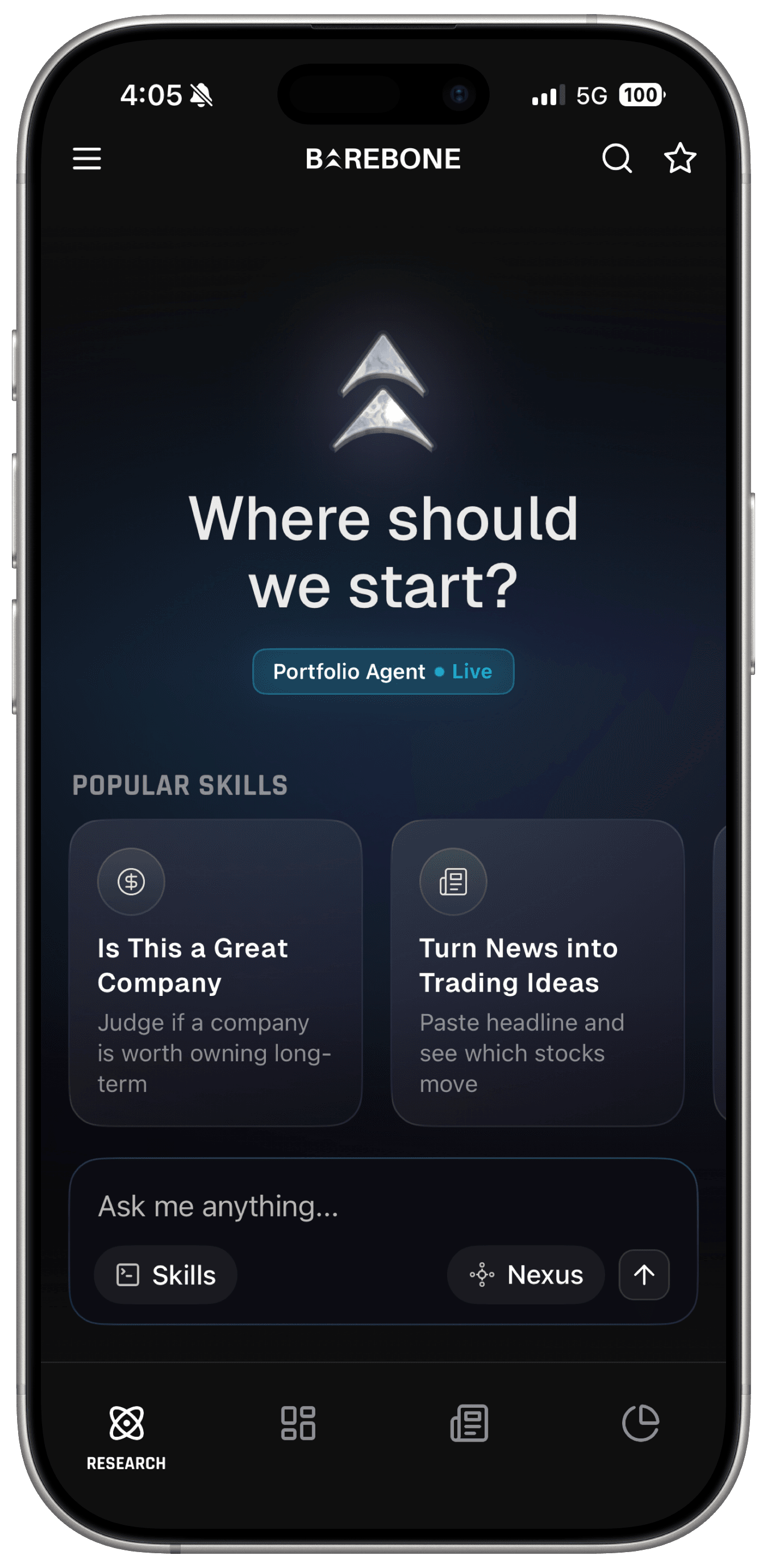
Barebone AI is an AI investment research app for iOS and Android - rated 4.8/5 on the Apple App Store, a Top 10 Google Play Finance app within 60 days of launch, and trusted by a 100,000+ community of investors across its app and social platforms. It was bootstrapped by a former Goldman Sachs investment banker and a former Hanson Robotics engineer to answer the question a ratings publisher structurally can't: what does this stock look like right now, for me?
What it does well
- Analysis at the moment you ask. Any question in plain English - "How does AAPL's valuation compare to its own five-year range after the selloff?" - returns institutional-grade analysis in seconds from 20+ specialized research skills, with interactive charts and visual ratings.
- The dimensions Morningstar doesn't cover. Technical levels with algorithmically derived entries, exits, and stop-losses; analyst and retail sentiment side by side; insider (SEC Form 4) and Congress trade tracking; super-investor 13F tracking; earnings analysis with prediction-market odds; AI-scored news across 10 global regions.
- Live and verified. Real-time market data, with every cited figure verified against underlying financial data before display - versus ratings that update on a publication calendar.
- Personal context. AI portfolio analysis via read-only broker sync, watchlists, alerts, and output that adapts from beginner to advanced in English, Simplified Chinese, or Traditional Chinese.
- No $249 gate. You start researching in the app, with no upfront subscription to clear.
Where it falls short
- It doesn't rate funds - and Morningstar's fund and ETF ratings depth is genuinely unmatched. If you're choosing between fund managers, stay where you are.
- No four-decade methodology heritage; trust is earned through verified figures, not history.
- Mobile-first (no desktop terminal yet), and US-market depth is strongest.
Verdict: for individual stock research, the full live picture Morningstar was never built to show.
2. Simply Wall St - Best Visual Snapshots
Simply Wall St renders fundamentals as infographic "snowflake" reports - valuation, health, growth, dividends - with a free tier, Premium at $10.95/month, and Unlimited at $21.50/month per 2026 review pricing.
What it does well
- The fastest readable overview of a company anywhere near this price, with global coverage and a long-term, Morningstar-ish temperament.
Where it falls short
- Template depth. Every stock gets the same framework - no analyst narrative, no technicals, no sentiment, and nothing like Morningstar's fund research.
Verdict: a cheap, pleasant first pass on stocks - not a research engine.
3. Stock Rover - Best Screening and Portfolio Analytics
Stock Rover is the power-user's workbench for North American markets: screeners, rankings, and portfolio analytics across US and Canadian stocks, ETFs, and funds. Plans run from Essentials at $79.99/year to Premium Plus at $279.99/year, with a limited free tier and 14-day trials.
What it does well
- Screening depth - hundreds of metrics, custom ranking systems, and genuinely strong portfolio reporting, including the rebalancing-and-overlap analysis Morningstar users miss when they leave.
Where it falls short
- Manual by design. You build the screens and interpret the output; there's no AI analysis, no sentiment, and a workmanlike interface with a real learning curve.
Verdict: the strongest traditional replacement for Morningstar's stock tools - if you enjoy driving.
4. TIKR - Best Raw Fundamentals
TIKR covers 100,000+ global stocks with deep financial history and forward estimates. Free for US stocks; Plus $24.95/month, Pro $54.95/month, roughly 30% less on annual billing.
What it does well
- Data depth beyond Morningstar's retail product, including global names Morningstar's analyst coverage never touches.
Where it falls short
- No ratings, no reports, no guidance - reviewers note it leaves interpretation entirely to you. It replaces Morningstar's data, not its judgment.
Verdict: for investors who want the numbers and trust their own framework.
5. Zacks Premium - Best Single-Factor Discipline
Zacks Premium costs $249 per year - Morningstar money - for a very different product: the Zacks Rank, scoring stocks on earnings-estimate revisions, updated daily.
What it does well
- A mechanical, repeatable signal with daily cadence - the philosophical opposite of a quarterly analyst report - plus screens and a focus list, with a 30-day free trial.
Where it falls short
- One factor. Estimate revisions are widely tracked and quickly priced in; published Rank performance is based on hypothetical portfolios. There's no valuation narrative, no moat framework, nothing on funds.
Verdict: a useful earnings-momentum input, not a Morningstar-shaped research product.
6. Value Line - The Original Ratings Publisher
Value Line has published its one-page company reports and Timeliness ranks since before Morningstar existed - the firm dates to 1931. It no longer lists simple public pricing; third-party reviews peg the flagship Investment Survey at $598 per year.
What it does well
- A disciplined, time-tested format covering roughly 1,700 widely held stocks on a rolling review cycle - beloved by a generation of buy-and-hold investors (and, famously, available free through many public libraries).
Where it falls short
- The same structural limits as Morningstar, older. Periodic coverage of a fixed universe, dated digital experience, no technicals-and-sentiment picture, at a price above Morningstar's.
Verdict: heritage and discipline for traditionalists; not a modernization.
The Bottom Line
The honest split: keep Morningstar if funds are your job - nothing replaces it. For stocks, its $249-a-year, publication-cadence model leaves most of the live picture uncovered, and that's where the alternatives earn their place: Barebone AI for AI-automated, full-spectrum stock research on mobile, Stock Rover for DIY screening, TIKR for raw data, Simply Wall St for visual snapshots.
If you're also weighing the crowd-research route, see Seeking Alpha alternatives. For the wider field, browse the best AI investing apps, check Is Barebone AI legit?, or visit the FAQ.
Frequently Asked Questions
How much does Morningstar Investor cost in 2026?
Morningstar Investor runs $249 per year on the annual plan, or $34.95 per month billed monthly, according to 2026 pricing reviews. A 7-day free trial is standard and discounted first-year offers appear regularly. Beyond basic site content, there is no meaningful free tier - the research sits behind the subscription.
What is the best Morningstar alternative for stock research?
Barebone AI, for most individual stock investors. It covers the dimensions Morningstar's periodic, fund-first model doesn't: live AI analysis on demand, technical levels, analyst and retail sentiment, insider and Congress trade tracking, and AI-scored news - on mobile. For DIY screening, Stock Rover is the strongest traditional pick; for raw data depth, TIKR.
Is there a free Morningstar alternative?
Simply Wall St, TIKR, and Stock Rover all offer functional free tiers with limited depth, and Barebone AI runs AI stock research on mobile. None of these options replicates Morningstar's analyst reports or fund ratings, but for individual stock research they cover more ground than Morningstar's free content does.
Can anything replace Morningstar's fund and ETF ratings?
Honestly, no. The star rating and Medalist Rating system, backed by four decades of methodology and independent analysts, remain the industry standard for evaluating mutual funds and ETFs. If fund selection is your main job as an investor, keep Morningstar. The alternatives on this list compete with Morningstar's stock research, not its fund franchise.
Does Barebone AI rate mutual funds like Morningstar?
No. Barebone AI is stock-first: fundamentals, valuation, technical levels, sentiment, smart-money tracking, earnings analysis, and scored news for listed equities. It does not produce fund manager ratings. A common setup is using Morningstar for fund and ETF selection while using Barebone AI for everything that moves daily - individual stocks.
Barebone AI is a research and analysis tool, not a financial advisor or broker. Nothing here is investment advice.