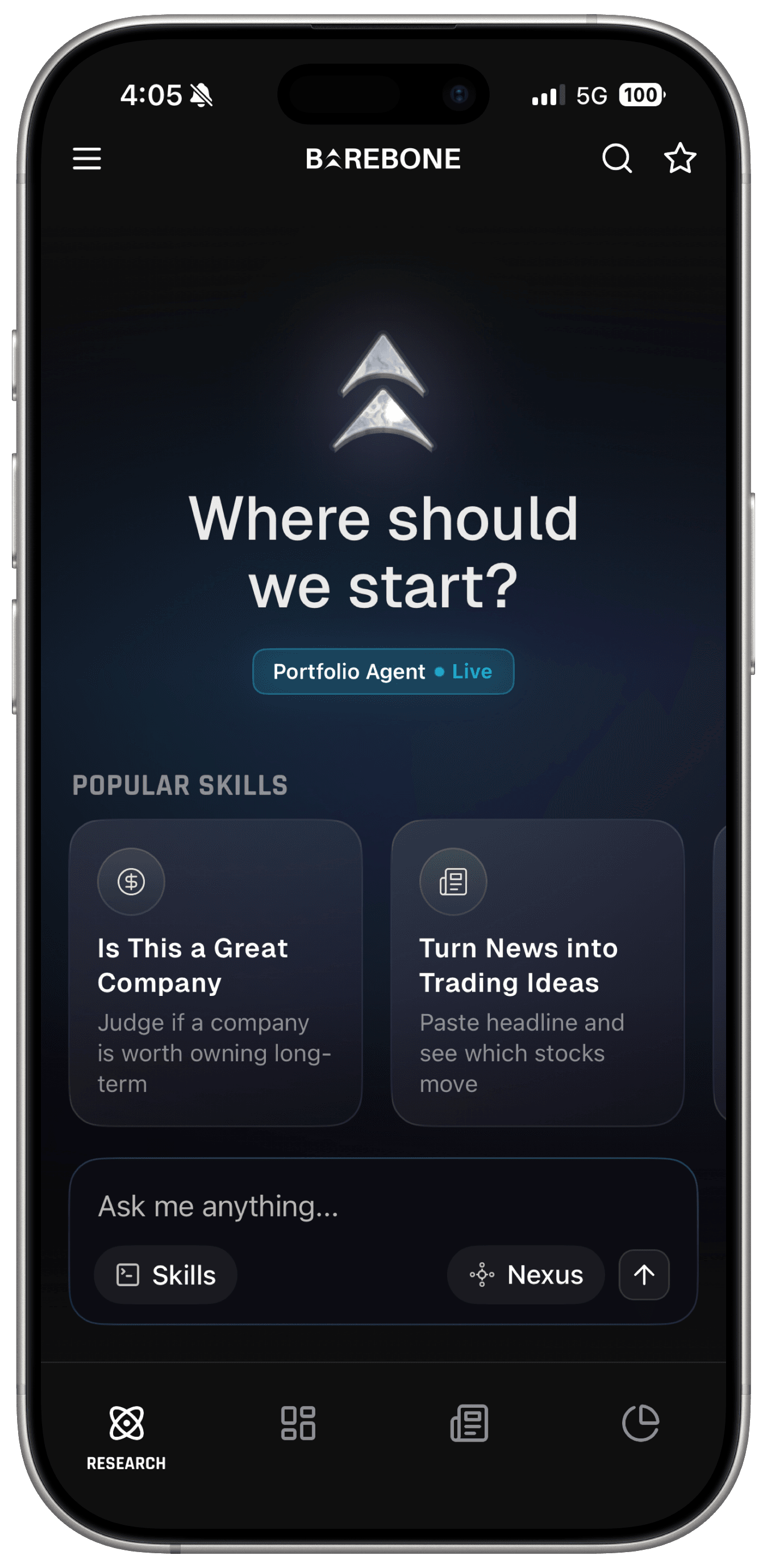
The best AI investing app in 2026 depends on the job: Barebone AI for full-depth research on mobile (4.8/5 App Store), Fiscal.ai for desktop fundamentals, Danelfin for explainable stock scores, and TrendSpider or Trade Ideas for active traders. We tested ten - here's what each actually delivers.
Three Kinds of "AI Investing App"
Most ranking lists mix tools that do completely different jobs. Sort the category first and the choice gets easy:
- Research platforms investigate questions: fundamentals, valuation, technicals, sentiment, ownership. Output is a thesis. (Barebone AI, Fiscal.ai, Seeking Alpha, Magnifi, AInvest)
- Signal and scoring tools compress everything into a number or a flag: a 1 - 10 score, a daily pick, a probability. Output is a shortcut. (Danelfin, Prospero.ai, Tickeron)
- Trader platforms serve active traders: charting automation, scanning, alerts. Output is a setup. (TrendSpider, Trade Ideas)
Know which job you're hiring for. A day trader doesn't need 13F tracking; a long-term investor doesn't need a momentum scanner firing at 9:31am.
The Rankings at a Glance
| Rank | App | Category | Price | Key strength |
|---|---|---|---|---|
| 1 | Barebone AI | Research | - | Verified, full-stack research on mobile |
| 2 | Fiscal.ai | Research | Free; $39+/mo | Deepest fundamental data |
| 3 | Seeking Alpha | Research | Free; $299/yr | Quant ratings + analyst volume |
| 4 | Danelfin | Signals | Free; $19+/mo | Explainable AI scores |
| 5 | TrendSpider | Trader | From $54/mo | Automated technical analysis |
| 6 | Trade Ideas | Trader | ~$1,068+/yr | Real-time AI scanning |
| 7 | Magnifi | Research | Free; $14/mo | Multi-brokerage portfolio Q&A |
| 8 | AInvest | Research | Free; $12.99+/mo | AI screening lists |
| 9 | Prospero.ai | Signals | Free | Hedge-fund-style signals, $0 |
| 10 | Tickeron | Signals | $60 - $250/mo | AI bot variety |
1. Barebone AI - Best Overall
Barebone AI is the research platform built by a former Goldman Sachs investment banker and a former Hanson Robotics engineer: ask any financial question in plain English, get institutional-grade analysis in seconds, with every figure verified against the underlying financial data before it's displayed.
What it does well
- 20+ specialized research skills: fundamentals, valuation, technical levels with algorithmically derived entries, exits and stop-losses, analyst plus retail sentiment, insider (SEC Form 4) and Congress trade tracking, super-investor 13F positions, earnings analysis with prediction-market odds, and AI-scored news across 10 regions.
- Real-time data, interactive charts and visual ratings - built for a phone screen, not ported to one.
- Portfolio analysis via read-only broker sync, watchlists, and alerts; output adapts to beginner, intermediate, or advanced proficiency in English or Chinese.
- 4.8/5 on the Apple App Store, Top 10 Google Play Finance within 60 days of launch, and a 100,000+ community of investors across its app and social platforms.
Where it falls short
No trade execution - it's research-only by design. No desktop terminal yet, which multi-monitor users will miss. US-market data is deepest; smaller international exchanges get thinner coverage.
Verdict: The most complete AI research stack you can carry in your pocket - pair it with the brokerage you already trust.
2. Fiscal.ai - Best Desktop Fundamentals Platform
Fiscal.ai (formerly FinChat) is what a fundamentals nerd wants: long financial histories, segment-level KPIs, and an AI copilot that answers from filings.
What it does well
- Up to 20+ years of financials and 15+ years of company KPIs on the Max tier, with click-through to the underlying filing.
- Honest freemium: free plan with 10 years of annual financials; Pro at $39/month billed annually, Max at $79/month.
Where it falls short
It's a web-first terminal, not a native mobile app - fine at a desk, clunky on a phone. No technical analysis to speak of, and no sentiment or insider layers. It's a fundamentals library with AI on top, not a full research desk.
Verdict: Best-in-class fundamental data; bring your own everything else.
3. Seeking Alpha - Best for Analyst Volume
Seeking Alpha remains the biggest library of retail-facing equity analysis, with quant ratings layered over thousands of contributor articles.
What it does well
- Quant ratings give a fast, factor-based read on almost any ticker, and the contributor base surfaces bull and bear cases you won't find elsewhere.
- Mature apps (4.8/5 from 125K App Store ratings) and a usable free tier.
Where it falls short
Premium costs $299/year, up from $239 in 2023, and contributor quality varies wildly - writers are paid for engagement, not for being right. The AI layer summarizes content; it doesn't run independent analysis on live data.
Verdict: A reading platform with ratings, not an analysis engine - valuable if you'll actually read.
4. Danelfin - Best Explainable AI Scores
Danelfin scores stocks 1 - 10 on AI-assessed probability of beating the market, with the feature breakdown visible - you can see which technical, fundamental, and sentiment inputs drove the score.
What it does well
- Transparent scoring beats black-box signals; the free plan shows top picks, and Plus runs $19/month, Pro $52/month, billed annually with a 14-day trial.
Where it falls short
There's no mobile app - it's web-only, and a score is a starting point, not a thesis: you still need somewhere to do the actual research. US and European coverage only.
Verdict: The most honest signal tool here; treat the score as a screen, not a decision.
5. TrendSpider - Best for Technical Automation
TrendSpider automates the drudgery of technical analysis: trendline detection, analysis across several chart timeframes, dynamic alerts, and strategy testing.
What it does well
- Genuinely powerful automation for chart-driven traders, with plans from $54/month (Standard) and a mobile companion app for monitoring on the go.
Where it falls short
Plans climb fast - Enhanced at $122/month, Advanced at $399/month - and fundamentals barely exist on the platform. The mobile app is a companion, not the product: complex setups still happen on desktop.
Verdict: Excellent if charts are your edge; irrelevant if they aren't.
6. Trade Ideas - Best Real-Time Scanner for Day Traders
Trade Ideas is the veteran AI scanning platform - its Holly AI runs dozens of strategies overnight and surfaces live setups during market hours.
What it does well
- The deepest real-time scanning engine retail money can buy, with broker integration for automated execution on Premium.
Where it falls short
It's priced like the pro tool it is: Standard around $1,068/year and Premium - the tier that includes Holly - about $2,136/year on annual billing. There's no mobile app; it's Windows desktop plus a web version. Total overkill for long-term investors.
Verdict: A serious day-trading instrument with a serious invoice - buy it for the scanner or not at all.
7. Magnifi - Best Multi-Brokerage Assistant
Magnifi connects your existing brokerage accounts (Fidelity, Robinhood, Schwab) and answers questions about the whole picture in plain English.
What it does well
- Cross-account visibility is its real product, and pricing is fair: $14/month, or $8.25/month billed annually.
Where it falls short
A 3.9/5 App Store rating (377 ratings) reflects rough edges, and the analysis depth is overview-grade - light on technicals, ownership data, and valuation work.
Verdict: Useful AI glue across your accounts; not a research desk.
8. AInvest - Best for AI-Curated Stock Lists
AInvest pairs its Aime assistant with screeners and themed stock lists, synced to major brokerages.
What it does well
- Fast list-building across themes (dividend payers, analyst favorites, momentum names) with portfolio-aware chat; 4.3/5 from 173 US App Store ratings.
Where it falls short
The push toward paid tiers at $12.99 - $19.99/month is constant, and depth is uneven - strong screening, thinner valuation and technical work.
Verdict: A competent screener-with-a-chatbot; verify anything it tells you before acting.
9. Prospero.ai - Best Free Signals
Prospero.ai distills institutional-style data into a handful of plain-number signals and pushes them to your phone for free.
What it does well
- Actually free - the app costs nothing, and the optional newsletter is $10/month. Simple enough to check in two minutes a day.
Where it falls short
Small footprint (4.4/5 from 57 US App Store ratings), and its outperformance claims are self-reported rather than independently audited. Signals come with limited explanation - you won't learn why from the app alone.
Verdict: The best zero-cost signal feed; size your trust to the evidence.
10. Tickeron - Widest Bot Menu, Weakest Value
Tickeron sells AI "robots" - pattern recognition, trend forecasts, and bot portfolios across stocks, ETFs, and crypto.
What it does well
- Enormous variety: screeners, pattern search, and dozens of bot strategies under one roof.
Where it falls short
Pricing stacks up quickly - tiers run $60 to $250 per month - and the sheer volume of bots makes it hard to know what you're actually paying for. Win-rate marketing deserves the same skepticism as every unaudited claim in this industry.
Verdict: Breadth without clarity; most investors will get more from one good tool than fifty bots.
Bottom Line
Match the tool to the job. Research: Barebone AI on mobile, Fiscal.ai at a desk, Seeking Alpha if you read. Signals: Danelfin for transparency, Prospero for free. Trading: TrendSpider for charts, Trade Ideas for scanning. If you specifically want agent-style tools that work from plain-English requests, see the best AI investment agents; for per-stock depth on your phone, see the best AI stock analysis apps. We also maintain head-to-head breakdowns at /compare and a deeper tools landscape in best AI tools for stock research.
Frequently Asked Questions
What is the best AI investing app in 2026? For research depth on mobile, Barebone AI leads in 2026 - 4.8/5 on the Apple App Store, with verified figures and 20+ research skills. The honest caveats: it doesn't execute trades and has no desktop terminal. Fiscal.ai is the strongest web-based fundamentals platform, and Danelfin is the best pure scoring tool.
What's the difference between an AI research app and an AI signal tool? A research app investigates a question - pulling fundamentals, technicals, sentiment, and ownership data into a thesis you can interrogate. A signal tool outputs a score or a buy/sell flag with limited explanation. Signals are faster; research builds conviction. Most expensive mistakes happen when people trade signals they don't understand.
Are AI investing apps accurate? It varies enormously. Purpose-built platforms verify figures against underlying financial data; general chatbots gave wrong or misleading answers to roughly 35% of finance questions in independent testing. For any tool claiming a win rate or backtested return, remember backtests are not live performance and few claims are independently audited.
Do any of these apps trade for me? Of the ten ranked here, none executes trades automatically - they research, score, screen, or chart. Trade Ideas offers brokerage integration for automated execution on its desktop platform, and trading apps with built-in AI agents exist (see our AI investment agents guide). Research tools deliberately leave the final decision and the order to you.
How much should I pay for an AI investing app? Pay for what you'll actually use. Strong free tiers exist (Prospero.ai, Danelfin's free plan). Research platforms run roughly $9 to $49 per month, signal tools $12 to $90, and pro trader software like Trade Ideas Premium about $2,136 per year. Start with a free tier, upgrade only when you hit a real limit.
Barebone AI is a research and analysis tool, not a financial advisor or broker. Nothing here is investment advice.