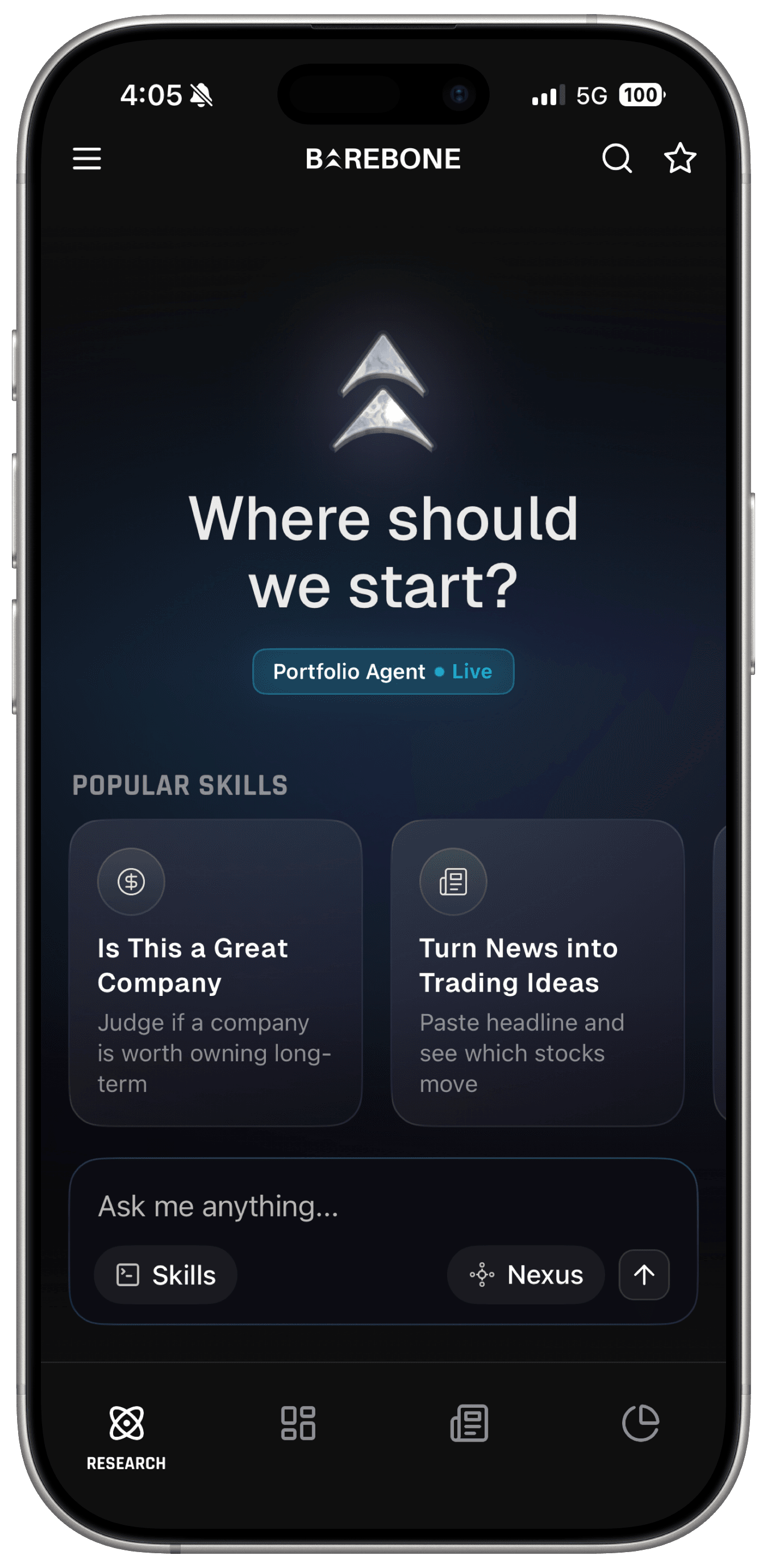
TL;DR: Morningstar is still the gold standard for fund and ETF ratings - four decades of methodology for $249 a year. But its research is periodic and fund-first. Barebone AI gives stock investors live, conversational analysis - fundamentals, technicals, sentiment, news - in seconds, on mobile. Fund pickers: Morningstar. Stock researchers: Barebone AI.
What Actually Matters in This Comparison
- What you own - fund pickers and stock pickers need different tools.
- Cadence - ratings updated on a publication cycle versus analysis generated the moment you ask.
- Breadth per security - does the tool see valuation only, or also technicals, sentiment, ownership flows, and news?
- Interaction model - standardized reports you read versus questions you ask.
- Who it adapts to - one report written for everyone versus output matched to your proficiency level.
Barebone AI vs Morningstar at a Glance
| Dimension | Morningstar Investor | Barebone AI |
|---|---|---|
| Price (2026) | $249/yr (or $34.95/mo); 7-day trial | Consumer app for individual investors |
| Core model | Periodic ratings and analyst reports | Conversational AI research on demand |
| Heritage | Founded 1984; defined fund ratings | Founded by ex-Goldman Sachs and ex-Hanson Robotics builders |
| Fund & ETF ratings | Industry standard - stars, Medalist Ratings | Not a fund-rating service |
| Stock research | ~1,800 US equities with moat + fair value | Any listed stock, on demand (US depth strongest) |
| Technical analysis | None | Algorithmically derived entries, exits, stop-losses |
| Sentiment | None | Analyst and retail sentiment, side by side |
| Smart-money tracking | Ownership data, limited | Insider (SEC Form 4), Congress trades, 13F tracking |
| News | Editorial articles | AI-scored news across 10 global regions |
| Real-time data | No - quotes and reports on cycles | Yes - live market data, figures verified |
| Asks-your-question | No - standardized reports | Yes - plain English, adapts beginner to advanced |
| Platform | Web-first, mobile app | iOS and Android |
| Best for | Fund and ETF investors | Stock investors who want live, full-picture research |
Morningstar: The Ratings Institution
Morningstar has been the reference point for fund research since 1984, and its retail subscription - Morningstar Investor - packages that research for individuals at $249 per year, or $34.95 monthly.
What it does well
- Fund and ETF ratings methodology. The star rating and the forward-looking Medalist Rating are the industry's common language for fund quality. No other consumer product comes close on funds - full stop.
- Research heritage and independence. Four decades of published methodology, transparent rating criteria, and analysts who aren't paid by the funds they rate. Per Fidelity's research-firm profile, Morningstar provides independent, analyst-driven research on over 1,800 mutual funds, roughly 300 ETFs, and about 1,800 US equities.
- A coherent stock framework. Economic moat ratings and fair value estimates give long-term investors a disciplined, repeatable valuation lens.
- Portfolio X-Ray. Still one of the best tools anywhere for seeing overlap and true allocation across funds you already own.
Where it falls short
- It's periodic, not live. Ratings and reports update on publication cycles. When PLTR moves 12% on earnings, Morningstar's view of the company arrives on Morningstar's schedule - not when you need it.
- It's fund-first by DNA. Stock coverage is real but bounded (~1,800 US names with full analyst treatment), and the toolkit reflects a buy-and-hold fund audience.
- Whole dimensions are missing. No technical analysis. No sentiment measurement. No insider or Congressional trade tracking. No AI-scored news flow. For a stock investor, that's most of the live picture, as 2026 reviews of the product note when comparing it against trading-oriented platforms.
- You read; you can't ask. A standardized report answers the average subscriber's question. It can't answer yours - "how does AAPL's current valuation compare to its own five-year range, and what does sentiment look like after the selloff?"
- $249 before it's useful. Beyond limited free content, the product starts at $249/year after a 7-day trial.
Verdict: The best fund-rating institution in the business - operating at publishing cadence in a market that moves in real time.
Barebone AI: Live Research You Can Question
Barebone AI is an AI investment research app for iOS and Android, co-founded by a former Goldman Sachs investment banker and a former Hanson Robotics engineer who worked on Sophia the Robot. It's 100% bootstrapped, grown organically, rated 4.8/5 on the Apple App Store, reached the Top 10 of Google Play Finance within 60 days of launch, and is trusted by a 100,000+ community of investors across its app and social platforms.
What it does well
- Analysis at the moment of the question. Ask anything in plain English and 20+ specialized research skills return institutional-grade analysis in seconds - with interactive charts and visual ratings rather than a PDF-style report.
- The dimensions Morningstar doesn't cover. Technical levels with algorithmically derived entries, exits, and stop-losses; analyst and retail sentiment side by side; insider (SEC Form 4) and Congress trade tracking; super-investor 13F tracking; earnings analysis with prediction-market odds; AI-scored news across 10 global regions.
- Live and verified. Real-time market data, and every figure the AI cites is verified against underlying financial data before display. A rating published last month can't tell you about this morning.
- Portfolio context. AI portfolio analysis through read-only broker sync, plus watchlists and alerts.
- Meets you at your level. Beginner, intermediate, or advanced output, in English, Simplified Chinese, or Traditional Chinese. A Morningstar report is written once for everyone; Barebone AI adapts the same analysis to the person asking.
- Built for individual investors. A consumer app on iOS and Android, with deeper research available on top.
Where it falls short
- It doesn't rate funds. There's no star-rating equivalent for picking between mutual fund managers. If that's your main job as an investor, Morningstar is simply the right tool.
- No four-decade track record. Morningstar's methodology has been public since the 1980s; Barebone AI earns trust through verified figures and output quality, not heritage.
- Mobile-first. No desktop terminal yet.
- US-market depth is strongest. Coverage is deepest for US-listed equities.
Verdict: For stock investors, the full live picture - fundamentals through sentiment - conversationally, on mobile.
When Morningstar Is the Better Choice
- Your portfolio is mostly mutual funds and ETFs. Choosing between fund managers is Morningstar's home turf, and nothing else matches its ratings infrastructure.
- You're a buy-and-hold investor who rebalances quarterly. Publication-cadence research may be all the cadence you need.
- You want Portfolio X-Ray-style fund overlap analysis. It remains best-in-class.
- You value institutional heritage - a methodology with forty years of public scrutiny behind it.
The Bottom Line
Morningstar and Barebone AI aren't really fighting over the same investor. Morningstar is a ratings institution: methodical, periodic, fund-first, $249 a year. Barebone AI is a live research layer: conversational, real-time, stock-first, on mobile - covering the technicals, sentiment, smart-money flows, and scored news that sit entirely outside Morningstar's model.
If you hold funds and stocks, the honest answer is a split: Morningstar's methodology for the funds, Barebone AI for everything that moves daily. See how Barebone compares to the opinion-driven incumbent in Barebone AI vs Seeking Alpha, read an independent-minded breakdown in our Barebone AI review, browse the comparison hub, or check the FAQ for common questions.
Frequently Asked Questions
How much does Morningstar Investor cost in 2026? Morningstar Investor runs $249 per year on the annual plan, or $34.95 per month if billed monthly - roughly $419 a year - according to multiple 2026 pricing reviews. A 7-day free trial is standard, and discounted first-year offers around $199 appear regularly. There is no meaningful free tier beyond basic site content.
What is the main difference between Barebone AI and Morningstar? Morningstar is a ratings publisher: analysts and methodology produce star ratings, Medalist Ratings, moat assessments, and fair value estimates on a periodic cycle, with funds and ETFs as its heritage. Barebone AI is a live AI research tool: you ask any question in plain English and get analysis built on real-time data in seconds, on mobile.
Does Barebone AI rate mutual funds like Morningstar? No. Barebone AI is stock-first - fundamentals, valuation, technical levels, sentiment, smart-money tracking, earnings, and news for listed equities. If your portfolio is mostly mutual funds and you choose between fund managers, Morningstar's four decades of fund-rating methodology is the better fit. Many investors use Morningstar for funds and Barebone AI for stocks.
Are Morningstar's star ratings forward-looking? No - and Morningstar itself is explicit about this. The star rating measures past risk-adjusted performance against category peers. The separate Medalist Rating expresses analysts' forward-looking conviction. Both are periodic, standardized outputs. Neither answers a specific, current question like how a stock's valuation and technical picture look after today's move.
Can I use Barebone AI and Morningstar together? Yes, and the split is natural. Use Morningstar to evaluate and monitor funds and ETFs - expense ratios, manager quality, category ratings. Use Barebone AI for everything that moves daily: individual stock research, technical levels, analyst and retail sentiment, insider and Congress trades, earnings setups, and AI-scored market news.
Barebone AI is a research and analysis tool, not a financial advisor or broker. Nothing here is investment advice.