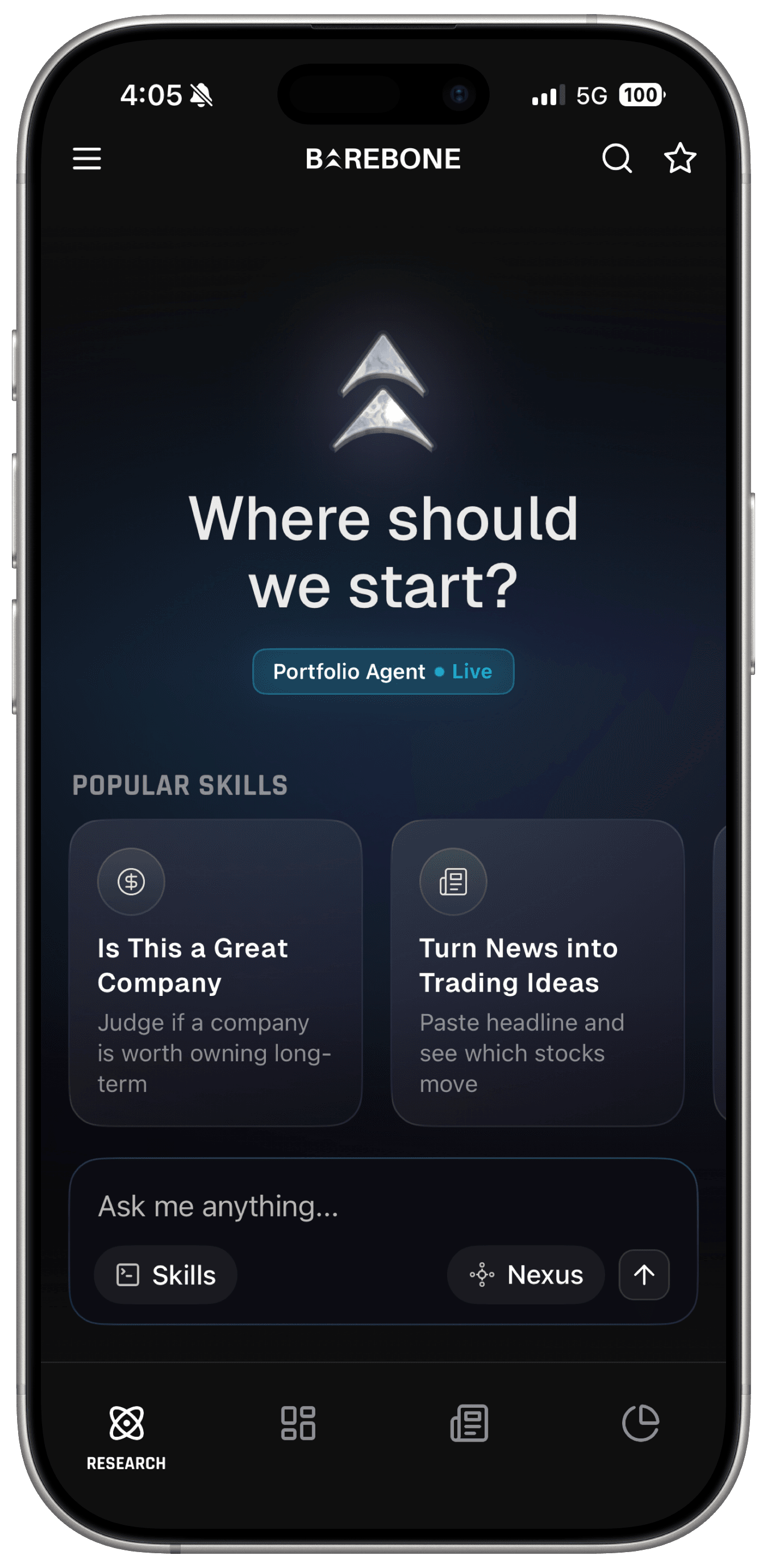
AI portfolio analysis reviews your actual holdings the way an institutional team would - growth, risk, income, sector balance, and momentum, all at once - on top of live tracking, real P&L, and risk metrics like Sharpe ratio and maximum drawdown. Barebone AI does this from your phone.
Your Portfolio Deserves More Than a Pie Chart
Most investment apps show you a pie chart of your holdings and call it "portfolio analysis." That's not analysis. That's data visualization.
Real portfolio analysis is what happens on institutional desks. At Goldman Sachs, when a portfolio manager presents their book, they don't show a pie chart - they face a room of specialists interrogating the portfolio from every angle at once: growth prospects, risk exposure, income durability, sector tilt, and momentum. No single perspective gets to dominate, because every one of them has blind spots the others catch.
That multi-angle review is what AI portfolio analysis now makes available for a personal portfolio. Here's what the category actually includes in 2026, using Barebone AI as the working example.
What AI Portfolio Analysis Includes in 2026
| Capability | What you actually get |
|---|---|
| Live tracking | Real-time portfolio value with daily and total P&L |
| Holdings setup | Manual entry or secure, read-only broker sync |
| Risk metrics | Volatility, Sharpe ratio, beta, maximum drawdown |
| AI review | Growth, risk, income, sector balance, and momentum - simultaneously |
| Findings | Concentration, hidden correlation, and diversification gaps |
| Monitoring | 24/7, with alerts when news is likely to move your holdings |
Live Tracking: Your Real Numbers, Not a Snapshot
The foundation is a live view of what you actually own. Barebone AI tracks your portfolio's value in real time - total value, today's P&L, and lifetime P&L in dollars and percent, plus per-holding performance with current prices and the portfolio's path over time. This matters more than it sounds: analysis run on stale positions or outdated prices is analysis of a portfolio you no longer own.
Two Ways to Get Your Holdings In
Manual entry. Search any ticker, enter quantity and cost basis, done. Best if you hold a handful of positions or want to model a hypothetical portfolio before committing money.
Secure, read-only broker sync. Connect your brokerage account and your holdings import automatically and stay current. Two properties make this safe enough to rely on: the connection is read-only - it can see positions and balances but cannot place trades or move money - and you authenticate through a secure connection flow rather than handing the app your brokerage password. You can disconnect at any time.
Either way, the analysis runs on your actual positions, not a hypothetical.
The Risk Metrics That Matter
Four numbers tell you most of what an institutional risk review would, and Barebone AI computes all of them from your holdings:
- Portfolio volatility - how violently your portfolio's value swings. High volatility isn't automatically bad, but it should be a choice, not a surprise.
- Sharpe ratio - the return you earn per unit of risk you take. A portfolio can be up and still have a poor Sharpe ratio, which means the market paid you badly for the rollercoaster.
- Beta - sensitivity to the overall market. A beta of 1.4 means a 10% market drop tends to hit you for roughly 14%.
- Maximum drawdown - the worst peak-to-trough decline. This is the gut-check number: if you can't stomach seeing it again, your allocation is wrong.
Each metric comes with a plain-English status label, so you don't need a statistics background to know whether 1.3 is a good Sharpe ratio. (It is.)
One Review, Every Angle at Once
The centerpiece is the AI portfolio analysis itself. Instead of evaluating your portfolio from one angle, it reviews growth, risk, income, sector balance, and momentum simultaneously - the same set of perspectives an institutional review covers - and synthesizes them into a single report on your actual holdings.
That simultaneity is the point. A portfolio that looks fine through a growth lens can be quietly dangerous through a risk lens; a sector tilt that made sense when you built it may have drifted as winners grew. Reviewing every angle at once is how those contradictions get caught, and it's the kind of work an AI investment agent exists to compress - hours of cross-checking into one pass.
The Findings That Actually Change Behavior
Concentration and diversification findings are where this earns its keep, because they're specific to what you own. Composite examples of the patterns this kind of review surfaces:
- Hidden correlation. You hold 15 stocks and feel diversified - but 11 of them move with the tech sector, so you effectively own one large bet wearing 15 costumes.
- Sector drift. Your portfolio started at 28% tech and is now 45%, not because you decided that, but because your winners grew and you never rebalanced.
- Income at risk. A "safe" dividend holding is paying out more than it earns - a payout ratio above 100% is a dividend funded by debt, and those get cut.
- Momentum divergence. Three positions sit in established downtrends while their fundamentals look unchanged - worth knowing before the market finishes the argument.
None of these findings tells you what to do. All of them change the quality of the decision you make next.
Monitoring That Doesn't Sleep
Markets move while you're in meetings, asleep, or living your life. Once your portfolio is in the app, monitoring runs 24/7: market-moving news is scored for impact and matched against your holdings, and you get an alert when something breaks that's likely to move a position you own - rather than finding out at the close.
What This Costs on Wall Street
At an asset manager, a review covering these angles takes a team of analysts days, sitting on terminals that cost real money - a single Bloomberg seat runs about $31,980 per year as of 2026, and the Terminal's roughly 325,000 subscribers are overwhelmingly institutions, not individuals (whether an individual needs one at all is a separate question). Barebone AI puts the same multi-angle portfolio review on your phone. The economics of this category have simply changed.
Where It Falls Short
Honesty section, because every tool has one:
- It's research, not execution. Barebone AI won't rebalance for you or place trades - you act in your own brokerage account.
- No AI predicts markets. The analysis tells you what your portfolio is - concentrated, high-beta, income-fragile - not what markets will do next. Regulators explicitly warn about AI pitches claiming otherwise; treat prediction claims as a red flag everywhere, including from us. For a data-driven look at what AI gets right and wrong, see How Accurate Is AI Stock Analysis?
- US-market depth is strongest. Coverage is deepest for US-listed equities; some international holdings get lighter treatment.
- Manual entries age. If you enter holdings by hand and then trade elsewhere, the analysis inherits your stale inputs - broker sync exists precisely to fix this.
How to Get Started
- Open the Portfolio tab in Barebone AI (on iOS and Android)
- Add holdings manually or connect your brokerage via secure, read-only sync
- Check your live value, P&L, and the four risk metrics
- Run the AI portfolio analysis and read the full multi-angle report
- Leave monitoring on - the alerts are the part you'll thank yourself for later
Your portfolio is the sum of every investment decision you've made. It deserves to be reviewed from every angle at once - and that no longer requires a floor full of analysts.