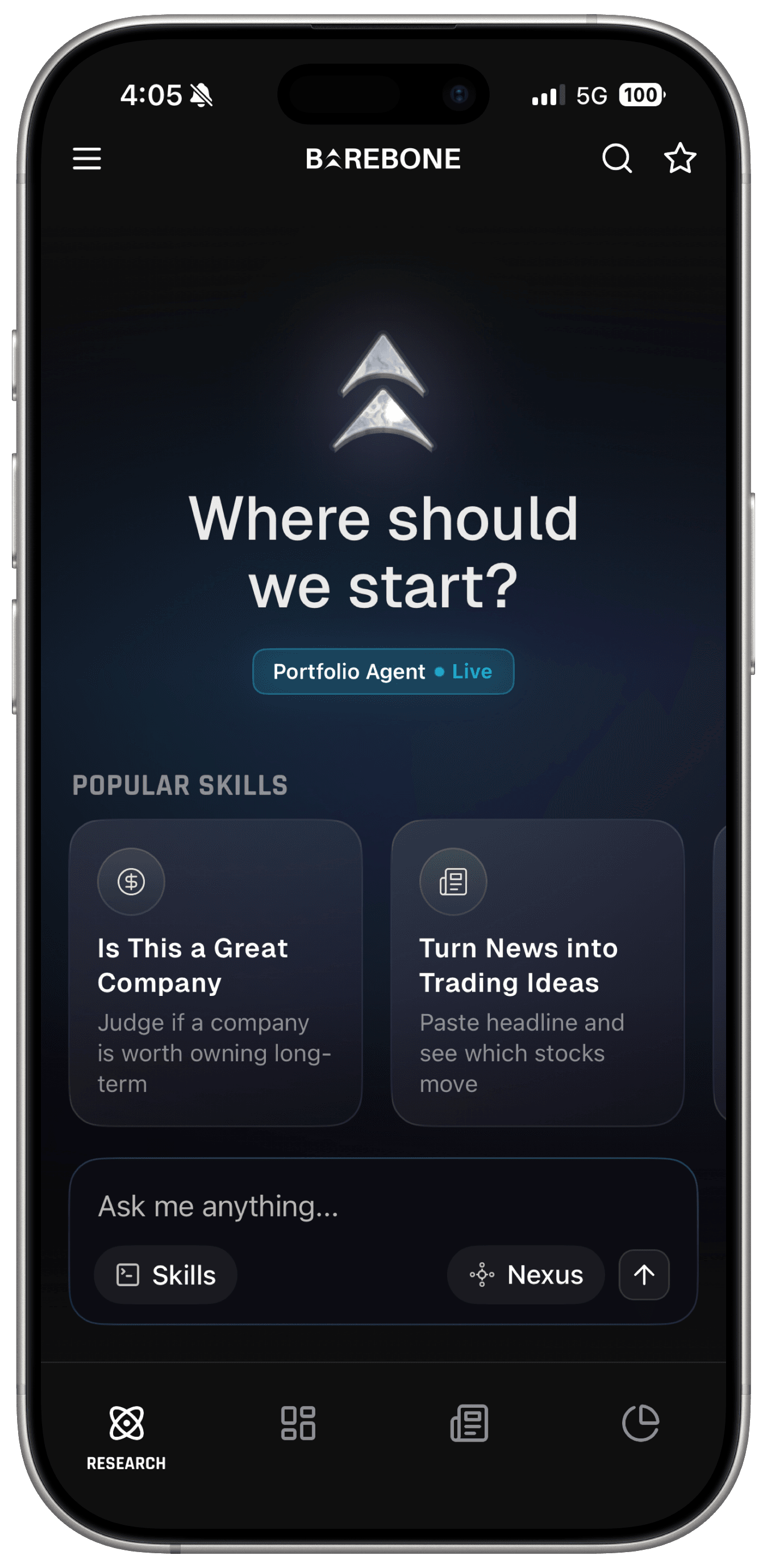
TL;DR: If ChatGPT keeps handing you stale quotes and confident wrong numbers, the fix isn't better prompting - it's purpose-built tooling. Barebone AI leads for dedicated research: live market data, verified figures, charts, portfolio context, on mobile. Perplexity is the best cited-search alternative, Claude the best document analyst, Gemini the Google-ecosystem play.
Why People Outgrow ChatGPT for Stocks
Most investors try ChatGPT first - it's the most-used AI product on earth. Then a familiar sequence plays out: a quote that's hours or days stale, a P/E that doesn't match the filing, an essay where a chart should be. The pattern is documented, not anecdotal. UK consumer group Which? tested six AI tools on 40 consumer questions and ChatGPT scored 64% - fifth of six - missing a deliberately planted error in a savings question entirely. Research coordinated by the BBC and the European Broadcasting Union found 45% of AI assistant answers contained at least one significant issue. And on the independent Vals AI Finance Agent benchmark, no frontier model clears 58% on entry-level financial analyst tasks as of the June 2026 run.
Every tool here is held to the desk standard: are the numbers right, and would you put money behind them? The full head-to-head is at Barebone AI vs ChatGPT.
What Actually Matters in a Replacement
- Live, verified market data - built into the analysis, not fetched as a web snapshot.
- Analysis, not prose - charts, ratings, and levels you can act on.
- A verification layer - figures checked against source financial data before you read them.
- Portfolio context - research that knows what you own.
- Honest cost - what the free tier actually does.
The 5 Best ChatGPT Alternatives at a Glance
| Rank | Tool | Best for | Price (2026) | Key strength |
|---|---|---|---|---|
| 1 | Barebone AI | Dedicated stock research | Research on mobile | Live data + every figure verified before display |
| 2 | Perplexity | Cited discovery and market news | Free; Pro $20/mo; Max $200/mo | Citations by default, real Finance pages |
| 3 | Claude | Deep document analysis | Free; Pro $20/mo ($17 annual); Max $100 - $200/mo | Best long-document reasoning |
| 4 | Gemini (Deep Research) | Google-ecosystem research | Free; AI Plus $7.99/mo; AI Pro $19.99/mo; AI Ultra from $99.99/mo | Multimodal + autonomous research reports |
| 5 | Any chatbot + manual data | Tinkerers and learners | Chatbot subscription only | Total flexibility, zero infrastructure |
For reference, ChatGPT itself runs free, with Go at about $8/month, Plus at $20, and Pro at $200.
1. Barebone AI - Best Purpose-Built Research Tool
Barebone AI is an AI investment research app for iOS and Android - rated 4.8/5 on the Apple App Store, a Top 10 Google Play Finance app within 60 days of launch, and trusted by a 100,000+ community of investors across its app and social platforms. It was bootstrapped by a former Goldman Sachs investment banker and a former Hanson Robotics engineer after watching chatbots confidently hand people wrong numbers.
What it does well
- The architecture fixes ChatGPT's failure mode. Real-time market data is built into every analysis, and every figure the AI cites is verified against underlying financial data before it reaches your screen - a verification layer general chatbots simply don't have.
- Analysis, not essays. Ask any question in plain English and 20+ specialized research skills return institutional-grade analysis in seconds: fundamentals, valuation, technical levels with algorithmically derived entries, exits, and stop-losses, analyst and retail sentiment, insider (SEC Form 4) and Congress trades, super-investor 13F tracking, earnings with prediction-market odds, and AI-scored news across 10 regions - delivered as interactive charts and visual ratings.
- It knows what you own. AI portfolio analysis via read-only broker sync, plus watchlists and alerts.
- It meets you at your level. Beginner, intermediate, or advanced output, in English, Simplified Chinese, or Traditional Chinese.
Where it falls short
- It's not a general assistant. It won't draft your emails, write code, or plan your vacation - ChatGPT's generality is real and Barebone doesn't pretend to match it.
- Mobile-first - no desktop terminal yet - and US-market depth is strongest.
- Research only. It will never execute a trade; you decide and act at your broker.
Verdict: if the job is researching actual positions with numbers you can trust, this is the purpose-built answer.
2. Perplexity - Best Cited Search for Markets
Perplexity (free; Pro $20/month; Max $200/month) is the strongest chatbot-style alternative for investors, because it actually invested in finance.
What it does well
- Citations by default - the single most important safety feature among general AI tools, and why it scored highest (71%) of the six tools in Which?'s consumer test.
- Perplexity Finance adds live quotes, watchlists, and an earnings hub with real-time transcripts - better market infrastructure than ChatGPT ships.
Where it falls short
- It summarizes the web; it doesn't compute analysis. If coverage of a stock is thin or stale, the answer inherits that. Its own CEO publicly acknowledged stale-data failures on financial queries in 2025, and a GPTZero investigation found users are about three queries from hitting an AI-generated source. No verified figures, no technical levels, no broker-synced portfolio. Full comparison: Barebone AI vs Perplexity.
Verdict: the best discovery layer of the chatbots - still search, not analysis.
3. Claude - Best for Documents and Reasoning
Claude (free; Pro $20/month, $17 annual; Max $100 - $200/month) is the thinking person's chatbot, and Anthropic is taking finance seriously - for institutions.
What it does well
- The best long-document analyst. Upload a 10-K or transcript and Claude dissects it with genuine skill; Anthropic reports it passed five of seven levels of the Financial Modeling World Cup and scored 83% on complex Excel tasks, and Claude models sit near the top of the Vals AI Finance Agent benchmark.
- Superb for stress-testing a thesis in long-form argument, drafting memos, and writing analysis code.
Where it falls short
- The finance push isn't for consumers. Claude for Financial Services wires institutional data into the enterprise product; the $20 consumer app has no live market data experience, no charts or ratings, no portfolio sync - and even the top benchmark models score below 58% on entry-level analyst tasks. Full comparison: Barebone AI vs Claude.
Verdict: hand it documents and hard questions; don't make it your market data source.
4. Gemini Deep Research - Best for Google-Ecosystem Research
Gemini (free; AI Plus $7.99/month; AI Pro $19.99/month; AI Ultra from $99.99/month) pairs capable models with Google's reach, and its Deep Research agent - recently upgraded - autonomously compiles long, multi-source research reports.
What it does well
- Deep Research reports are a real step beyond chat for background work - an hour of tab-hopping condensed into one document.
- Ecosystem and multimodal strength, plus an AI-overhauled Google Finance with Deep Search, prediction-market data, and live earnings tracking - at the lowest paid-tier pricing of the majors.
Where it falls short
- Accuracy is the documented weak spot. In the BBC/EBU study, Gemini was the weakest assistant tested, with significant issues in 76% of responses, mostly sourcing failures. The investing experience is fragmented across the Gemini app and Google Finance, with no verified figures, technical levels, or broker-synced portfolio analysis. Full comparison: Barebone AI vs Gemini.
Verdict: impressive research reports that still require you to check every number.
5. Any Chatbot + Manual Data - The DIY Workflow
The fifth alternative is a workflow, not a product: keep whatever chatbot you like and feed it the data yourself - filings, broker exports, spreadsheets - then ask for analysis.
What it does well
- Maximum flexibility at no extra cost. Grounding a strong model in source documents you supply sidesteps stale training data, and it's a genuinely good way to learn analysis.
Where it falls short
- You are the data pipeline. Every session starts with twenty minutes of collection; nothing verifies the model's arithmetic; nothing alerts you when conditions change; skip the manual prep once and you're back to unverified chatbot output. It works until the day you're busy - which is the day it matters.
Verdict: educational and free - but infrastructure, done by hand, every time.
The Bottom Line
ChatGPT taught a hundred million people to expect answers from a text box. Investment research punishes that habit unless the box is wired to live data and verification - that's the line separating purpose-built tools from chatbots. Use Perplexity to discover, Claude to dissect documents, Gemini for ecosystem research - and for the decision-grade layer, a tool built for the job. That's the category Barebone AI competes in.
Skeptical? Good - read Is Barebone AI legit?, browse the best AI investing apps, or check the FAQ.
Frequently Asked Questions
Why isn't ChatGPT good enough for stock research?
Documented accuracy. UK consumer group Which? found ChatGPT missed a deliberately planted error in a savings question and scored 64% across 40 consumer-finance questions, and on the independent Vals AI Finance Agent benchmark no frontier model clears 58% on entry-level analyst tasks. Add no live market data foundation, no charts, and no portfolio context.
What is the best ChatGPT alternative for investment research?
For dedicated stock research, Barebone AI - it's purpose-built: real-time market data in every analysis, every cited figure verified against underlying financial data, charts and ratings instead of prose, and portfolio-aware research via read-only broker sync, on mobile. For general research with citations, Perplexity is the strongest chatbot-style alternative.
Is Perplexity better than ChatGPT for investing?
For market questions, generally yes. Perplexity scored highest of six tools in Which?'s consumer test, cites sources by default, and its Finance pages add live quotes and an earnings hub. It remains search-and-summarize rather than computed analysis, and its CEO publicly acknowledged stale-data failures on financial queries in 2025 - so verify figures before acting.
Can Claude or Gemini do stock research?
Both reason well, and Claude is arguably the best AI for dissecting documents you upload. But as consumer apps, neither ships a live market data foundation, verified figures, native price charts, or broker-synced portfolio analysis. Claude's financial data connectors live in its enterprise product; Gemini's finance features live in Google Finance, a separate site.
Do any of these tools tell you what to buy?
No - and be wary of any AI that claims to. Investment advice is a regulated activity. General chatbots typically deflect to disclaimers, and Barebone AI is explicitly a research and analysis tool: it gives you verified data, ratings, technical levels, and sentiment so you can make your own decision at your broker.
Is there a free AI for investment research?
Yes - the major chatbots all offer free tiers: ChatGPT, Perplexity, Claude, and Gemini. Barebone AI is the purpose-built research option, with live data and verified figures on mobile. The practical test costs nothing: run the same ticker through each on the same day and compare the depth, freshness, and verifiability of what comes back.
Barebone AI is a research and analysis tool, not a financial advisor or broker. Nothing here is investment advice.