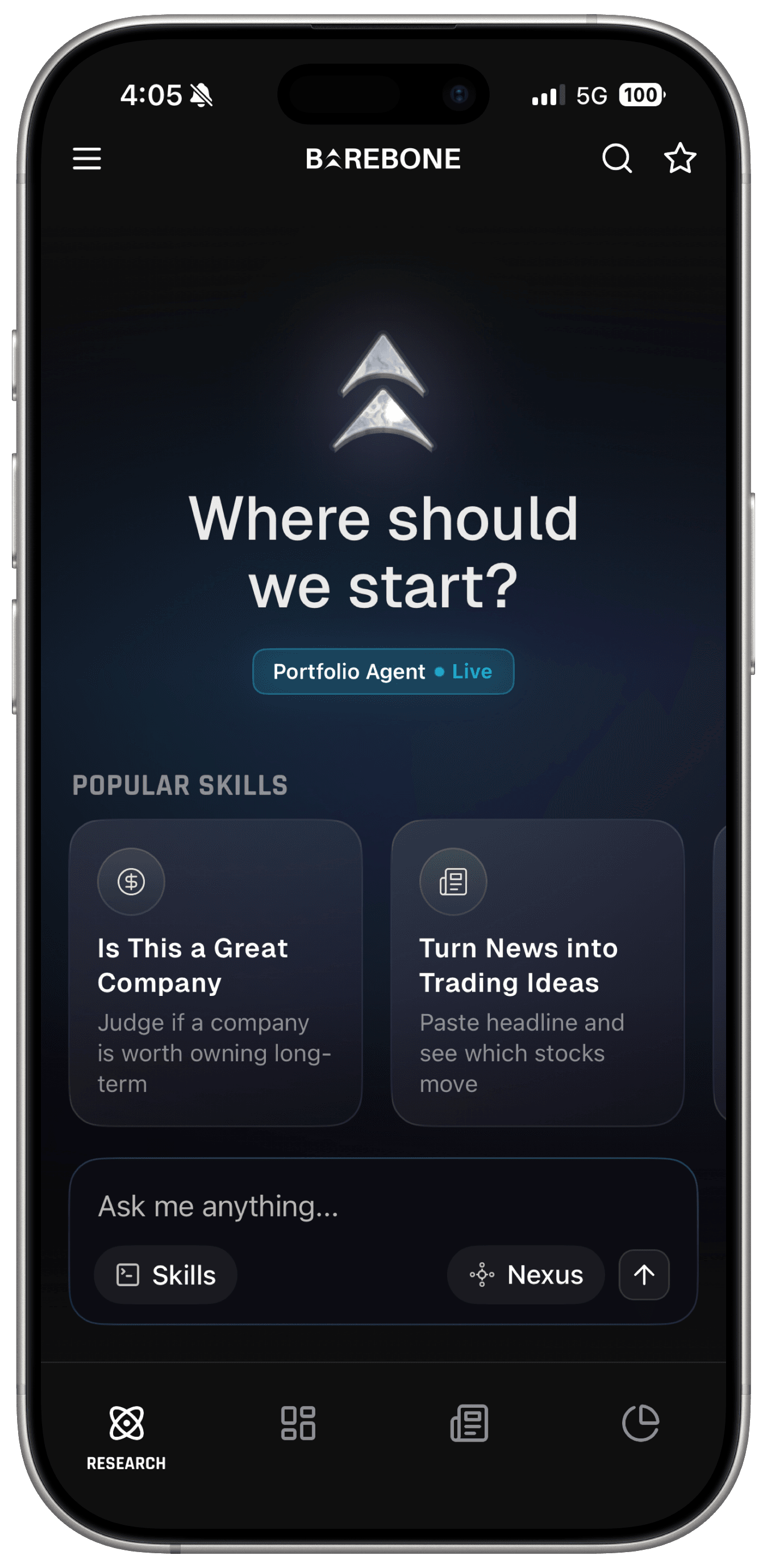
TL;DR: Gemini brings Google's entire ecosystem - Search grounding, Workspace, multimodal - and Google Finance now has real AI features. But independent studies still flag Gemini's accuracy, and neither product verifies figures, computes technical levels, or analyzes your portfolio. Barebone AI is the dedicated research engine; Gemini is the everything-assistant attached to Google.
What Actually Matters in an AI Stock Research Tool
- Live, verified market data - built into the analysis, not fetched as a search result.
- Accuracy you can audit - figures checked against source data, with documented reliability.
- Structured output - charts, ratings, and levels, not paragraphs.
- Portfolio context - research that knows what you own.
- Adaptation - depth matched to your experience level.
The Quick Comparison
| Dimension | Barebone AI | Gemini |
|---|---|---|
| Built for | Investment research and analysis | General assistance across Google's ecosystem |
| Market data | Real-time, built into every analysis | Search grounding in the app; live data lives in Google Finance, a separate product |
| Figure accuracy | Every cited figure verified against underlying financial data | Model-generated; weakest assistant in BBC/EBU news-accuracy testing |
| Output | Interactive charts, visual ratings, technical levels | Prose and summaries; quote charts on Google Finance |
| Portfolio awareness | AI portfolio analysis via read-only broker sync | Manual watchlists on Google Finance; no broker-synced AI analysis |
| Insider, Congress, 13F tracking | Built in | Not available |
| Proficiency adaptation | Beginner / intermediate / advanced | One-size-fits-all |
| Ecosystem | Focused: markets only | Gmail, Docs, Drive, YouTube, Android, multimodal |
| Price | Dedicated investment research app | Free; AI Plus $7.99/mo; AI Pro $19.99/mo; AI Ultra from $99.99/mo (Google) |
Gemini for Stock Research
What it does well
- Ecosystem reach nobody matches. Gemini lives inside Gmail, Docs, Sheets, Drive, Android, and Chrome. If your notes, statements, and research live in Google's world, Gemini can reason across all of it.
- Google Finance got a real AI upgrade. In late 2025 Google shipped an AI-powered Google Finance with Deep Search for financial questions, prediction-market data from Kalshi and Polymarket, and live earnings audio with real-time transcripts. For a free quotes site, that's genuinely useful - and it signals how seriously Google takes this space.
- Multimodal strength. Gemini reads images, charts, PDFs, and video better than most rivals. Screenshot a chart and ask what it shows; that workflow actually works.
- Capable underlying models. Credit where due: on the independent Vals AI Finance Agent benchmark, a Gemini model currently tops the leaderboard at 57.86% as of the June 2026 run.
- Cheap entry. At $7.99/month for AI Plus, Google has the lowest-priced paid tier of the major assistants, and I/O 2026 cut AI Ultra from $249.99 to $99.99.
Where it falls short
Accuracy is its documented weak spot. In research coordinated by the BBC and the European Broadcasting Union - professional journalists in 18 countries grading thousands of assistant answers - Gemini was the weakest tool tested, with significant issues in 76% of its responses, mostly sourcing failures, roughly double the rate of the other assistants. In Which?'s 40-question consumer study, Gemini scored 69% and its AI Overviews 70% - better than ChatGPT's 64%, still well short of decision-grade. And note the ceiling: even the leaderboard-topping model clears only 57.86% on entry-level analyst tasks.
Strong models, scattered product. The model is capable; the investing experience is fragmented. Quotes and the new AI features live on Google Finance. The Gemini app answers market questions as a general assistant via search grounding. Nothing ties it together into a research workflow: no verified figures, no visual investment ratings, no algorithmically derived entry, exit, and stop-loss levels, no sentiment gauges, no insider or Congress trade tracking.
It doesn't know your portfolio. Google Finance supports manually maintained watchlists, but there's no read-only broker sync and no AI that analyzes your actual holdings, concentration, or exposure to this week's earnings.
Same answer for everyone. Gemini explains NVDA identically to a first-week beginner and a 20-year veteran. There's no proficiency adaptation, which in practice means beginners get jargon and veterans get filler.
Verdict: the best AI for living inside Google's ecosystem - still a general assistant plus a quotes site, not an investment research engine.
Barebone AI
What it does well
Barebone AI is an AI investment research app for iOS and Android - rated 4.8/5 on the Apple App Store, Top 100 in Apple Finance on day one, and Top 10 in Google Play Finance within 60 days of launch. One job: turn any plain-English question into institutional-grade analysis in seconds.
- Live market data in every analysis - not a search result, the foundation.
- Verified figures. Every number the AI cites is checked against the underlying financial data before display. This is the direct answer to the accuracy problem the BBC/EBU and Which? studies document in general assistants.
- 20+ specialized research skills: deep fundamentals, valuation, algorithmically derived technical levels (entries, exits, stop-losses), analyst and retail sentiment, insider (SEC Form 4) and Congress trade tracking, super-investor 13F tracking, earnings analysis with prediction-market odds, and AI-scored global news across 10 regions.
- Charts and ratings, not essays - interactive, readable in seconds.
- Portfolio-aware. Read-only broker sync, watchlists, and alerts on what you actually own.
- Adapts to you. Beginner, intermediate, and advanced modes, in English, Simplified Chinese, and Traditional Chinese.
100% bootstrapped, and trusted by a 100,000+ community of investors across its app and social platforms.
Where it falls short
- No ecosystem. Barebone won't read your email, summarize your Drive, or analyze a vacation photo. Outside markets and investing, it's the wrong app.
- Research-only. No trade execution - your broker handles orders.
- Mobile-first. No desktop terminal yet.
- US-market depth is strongest; global coverage is real but still deepening.
Verdict: the purpose-built choice when the job is researching markets - and only then.
The Honest Verdict
If you want one AI woven through your digital life - email, documents, photos, search - use Gemini. Google's ecosystem advantage is real, the price is right, and Google Finance is a solid free quotes site that keeps getting smarter.
If you want investment research, this is the difference: Gemini gives you a general assistant's answer about a stock; Barebone AI runs dedicated analysis on live data, verifies every figure, draws the charts, computes the levels, and reads it all against your actual portfolio and experience level. The accuracy studies above are exactly why that architecture exists.
Compare the same trade-off against the other assistants in Barebone AI vs Perplexity and Barebone AI vs ChatGPT, see the wider field in the best AI investing apps, or read Is Barebone AI legit? if you're sizing us up.
Frequently Asked Questions
Can Gemini track stock prices in real time?
Indirectly. The Gemini app can ground answers in Google Search, and Google Finance - a separate product - now offers AI features with live data, including Deep Search and real-time earnings transcripts. But there's no streaming market data inside your Gemini conversations, no alerts on your positions, and no broker-synced portfolio the AI analyzes for you.
Is Google Finance's AI the same as Gemini?
They're related but distinct. Google Finance is a quotes-and-news site that added Gemini-powered features in 2025 - Deep Search for financial questions, prediction-market data, and live earnings tracking. The Gemini app is a general assistant. Neither is a dedicated research engine that verifies figures, scores sentiment, computes technical levels, or analyzes your actual portfolio.
How accurate is Gemini for financial questions?
Mixed, per independent testing. In Which?'s 40-question consumer study Gemini scored 69% - mid-pack. In BBC and EBU research on news questions, Gemini was the weakest assistant tested, with significant issues in 76% of responses, mostly sourcing failures. Its underlying models are genuinely capable; the consumer experience still produces too many unsourced or wrong specifics to act on unverified.
What does Barebone AI do that Gemini doesn't?
Barebone AI is built only for investment research: real-time market data in every analysis, every figure verified against underlying financial data, interactive charts and visual ratings, algorithmically derived technical levels, insider and Congress trade tracking, 13F tracking, earnings analysis with prediction-market odds, AI-scored global news, and portfolio analysis via read-only broker sync - adapted to your proficiency.
When is Gemini the better choice?
When you live in Google's ecosystem or need breadth: drafting in Gmail and Docs, reasoning across your Drive, analyzing images and video, or replacing search for everyday questions. Multimodal work - like reading a chart screenshot - is a genuine Gemini strength. For everything that isn't dedicated market research, Gemini is the more versatile assistant.
How much does Gemini cost, and how does Barebone AI compare?
Gemini has a free tier, Google AI Plus at $7.99 per month, AI Pro at $19.99, and AI Ultra from $99.99 after Google cut its price at I/O 2026. Barebone AI is a dedicated investment research app. The real comparison is what each delivers: a general assistant versus purpose-built market analysis.
Barebone AI is a research and analysis tool, not a financial advisor or broker. Nothing here is investment advice.