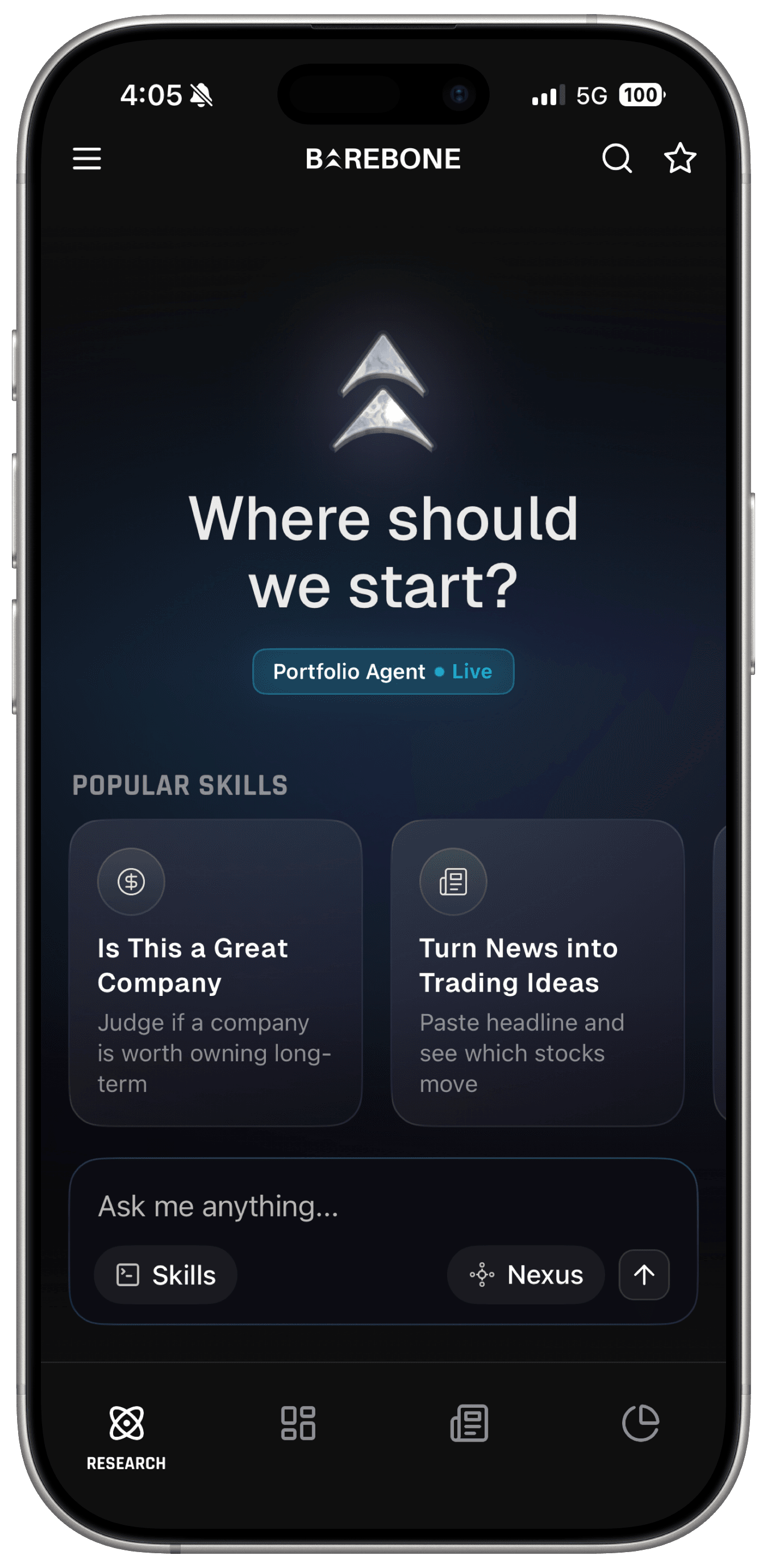
An AI investment agent is software that takes a plain-English question about markets, pulls live financial data, runs real analysis - valuation, technicals, sentiment, portfolio review - and returns structured research you can verify. Chatbots generate text from training data; an investment agent computes answers from current numbers. Barebone AI is a defining mobile example.
What Is an AI Investment Agent?
If you've asked ChatGPT about a stock, you've used a general-purpose AI for a finance question. It probably gave you a paragraph of generic information with a disclaimer attached.
That's a chatbot answering a finance question. It's not an AI investment agent.
An AI investment agent - you'll also see the category called an AI financial research agent; same thing - is a system designed specifically for investment research, with:
- Dedicated real-time data feeds (not training data from last year)
- Purpose-built financial analysis engines (not generic language processing)
- Structured analytical frameworks for specific types of investment research
- Visualization that produces charts, ratings, and interactive displays
- Memory and personalization that adapts to your investing style and proficiency
The distinction matters because the quality of output is dramatically different - and because the failure modes are different in ways that cost real money.
How an AI Investment Agent Works
The Data Layer
An AI investment agent maintains live connections to institutional-grade financial data. Barebone AI, for example, works from:
- Company fundamentals - financials, ratios, analyst ratings, SEC filings, earnings data
- Real-time pricing - live prices for stocks, ETFs, crypto, and forex
- News - real-time financial news across 10 global regions, scored by AI for market impact
- Sentiment - Wall Street analyst consensus alongside retail sentiment from communities like Reddit
- SEC EDGAR - insider trading (Form 4), Congressional stock disclosures, and super-investor 13F filings
- Economic data - Fed decisions, CPI, GDP, employment, and other macro indicators
This layer is the foundation. Without live, verified data, AI financial analysis is just sophisticated guessing.
The Analysis Layer
On top of the data, specialized engines perform the actual analysis:
- Valuation models - fair-value estimates built from the company's actual financials, DCF among the methods
- Algorithmic technical analysis - support and resistance levels with algorithmically derived entries, exits, and stop-losses
- Sentiment aggregation - cross-referencing institutional analyst consensus with retail sentiment and insider trading behavior
- Event-driven discovery - mapping any event to the stocks it affects, sorted by how directly each is exposed
- Portfolio analysis - reviewing your actual holdings across growth, risk, income, sector balance, and momentum simultaneously (full breakdown here)
These aren't prompts handed to a language model. They're dedicated analytical engines that produce specific, verifiable outputs.
The Intelligence Layer
The language model sits on top, synthesizing those outputs into readable analysis. It interprets the quantitative results in context, surfaces the findings that matter most, adapts language and depth to your proficiency level (beginner, intermediate, or advanced), and suggests follow-up questions. In Barebone AI's case it does this in English, Simplified Chinese, or Traditional Chinese - analysis included, not just the interface.
This layered design - data, then analysis, then language - is what makes an agent fundamentally different from asking a chatbot about stocks. Crucially, the strongest implementations add verification: every figure the AI cites is checked against the underlying financial data before it reaches your screen.
AI Investment Agent vs. Chatbot: The Key Differences
The gap isn't theoretical. When Investing in the Web had finance professionals grade ChatGPT's answers to 100 finance questions, 35% were judged wrong or misleading. UK consumer group Which? scored ChatGPT second-lowest of six AI tools on consumer questions including personal finance. Fluency and accuracy are different properties.
| Feature | Chatbot (ChatGPT, etc.) | AI investment agent (Barebone AI) |
|---|---|---|
| Data source | Training data + web browsing | Live institutional-grade market data |
| Financial analysis | None built in | Valuation, technical levels, sentiment aggregation, screening |
| Real-time prices | No (or slow web lookup) | Yes |
| Charts & visualizations | No | Interactive charts, ratings, gauges, tables |
| Portfolio awareness | No | Yes - analyzes your actual holdings |
| Personalization | Limited conversation memory | Investor profile: risk tolerance, strategy, proficiency |
| Insider/Congress data | No | Real-time SEC filings and Congressional disclosures |
| Figure verification | None | Cited figures verified against underlying data before display |
| Specialized analysis modes | One mode (answer the question) | 20+ specialized research skills |
There's a deeper data point worth knowing: on the independent Vals AI Finance Agent benchmark, which tests whether frontier models can do entry-level financial analyst work on real filings, no model clears 58% as of the June 2026 run - even with generous partial-credit scoring. The lesson isn't that AI is useless for finance; it's that raw language models need grounding, verification, and purpose-built analysis wrapped around them. That wrapper is precisely what an agent is. (The full head-to-head is in Barebone AI vs ChatGPT.)
20+ Specialized Skills, Each Built for One Job
Where a chatbot has one mode - answer the question - a purpose-built agent platform offers specialized research modes. Barebone AI ships 20+ research skills, each built for a specific job:
- Fundamentals: deep fundamental analysis, valuation check, price-target context, long-term outlook, scenario analysis
- Technicals: algorithmically derived entry and exit levels, support/resistance mapping, stop-loss placement
- Market intelligence: event-driven stock discovery, sentiment aggregation, earnings analysis with prediction-market odds, AI-scored news impact
- Portfolio: AI portfolio analysis reviewing growth, risk, income, sector balance, and momentum across your actual holdings
- Discovery: dividend stock screening, ETF research, market-movers identification
Each skill works from the data that matters for its job. The when-to-buy-and-sell skill runs technical analysis that a fundamentals review doesn't need; the sentiment skill pulls retail discussion data that a valuation check doesn't use. Each research question gets the tools and data optimized for answering it.
How You Actually Use One
Plain-English questions
Type any financial question in plain English (or Simplified/Traditional Chinese): "Is Tesla overvalued right now?" "What stocks benefit from rising interest rates?" "Compare the top 3 cloud computing stocks." The agent identifies intent, extracts tickers, selects the right analytical framework, and returns structured analysis in seconds.
Picking a skill directly
Alternatively, choose a specific skill from the library for full control over which analysis runs. Pick the entry/exit skill and you know you're getting technical levels; pick valuation and you know you're getting a fair-value model.
Conversational follow-up
After every analysis, the agent suggests follow-ups and you can ask your own. Context carries across the session, so research builds progressively instead of restarting each time.
Portfolio integration
Your actual holdings are available to the portfolio skills, so analysis is grounded in what you actually own - not hypothetical examples.
Why 2026 Is the Inflection Point
Four converging trends made 2026 the year AI investment agents became genuinely useful:
- Data maturity. Institutional-grade financial data became accessible enough for consumer platforms to build on, narrowing the raw-data gap with professional terminals.
- Model capability. Language models can now reliably interpret complex financial data and hold an analytical frame - a marked improvement over 2023-2024, when hallucination rates made finance use cases untenable without heavy guardrails.
- Cost collapse. Real-time data pipelines plus AI inference became economically viable at consumer price points.
- Adoption. Barebone AI is trusted by a 100,000+ community of investors across its app and social platforms - a feedback loop that compounds analytical quality.
How to Choose an AI Investment Agent
Seven questions to ask of any tool:
- What data does it access? Live institutional-grade feeds, or training data with a cutoff?
- Does it run real financial analysis? Valuation models, technical levels, sentiment aggregation - or just prose?
- Is output structured and checkable? Charts, ratings, and source data - or paragraphs you have to take on faith?
- Are there multiple specialized modes? Or one generic model for every question?
- Does it personalize? Risk tolerance, strategy, proficiency level?
- Does it integrate your portfolio? Can it analyze what you actually own?
- Is it mobile-accessible? Research happens everywhere, not just at a desk.
The more "yes" answers, the more likely you're looking at a genuine AI investment agent rather than a chatbot with financial window dressing. We tested and ranked the downloadable options in The 7 Best AI Investment Agents on Mobile in 2026.
What an AI Investment Agent Can't Do
Three permanent limits, stated plainly:
- It cannot predict markets. Prices move on new information, which by definition isn't in any dataset. The SEC, NASAA, and FINRA jointly warn investors about AI pitches promising guaranteed returns - that warning exists because "our AI predicts stocks" is a recurring fraud pattern, not a product category.
- It cannot make your decisions. Research tells you what a company earns and what the market thinks. Whether a position fits your risk tolerance and time horizon is a human judgment - yours.
- It cannot remove uncertainty. Good research narrows the range of honest opinions; it never narrows it to one.
And where Barebone AI specifically falls short: it's research-only (no trade execution - you act in your own brokerage), mobile-first (no desktop terminal yet), and deepest on US-listed markets.
The Bottom Line
The shift from chatbots to AI investment agents is the same shift every professional domain makes - from general tools to purpose-built ones. The general model answers your question; the agent does the research job: live data in, real analysis run, verified figures out, your context applied.
Barebone AI is what that looks like on a phone - built by people who did this work at institutions, for everyone who can't expense a terminal. Try it against your own holdings, which is the correct way to evaluate any claim in this article.