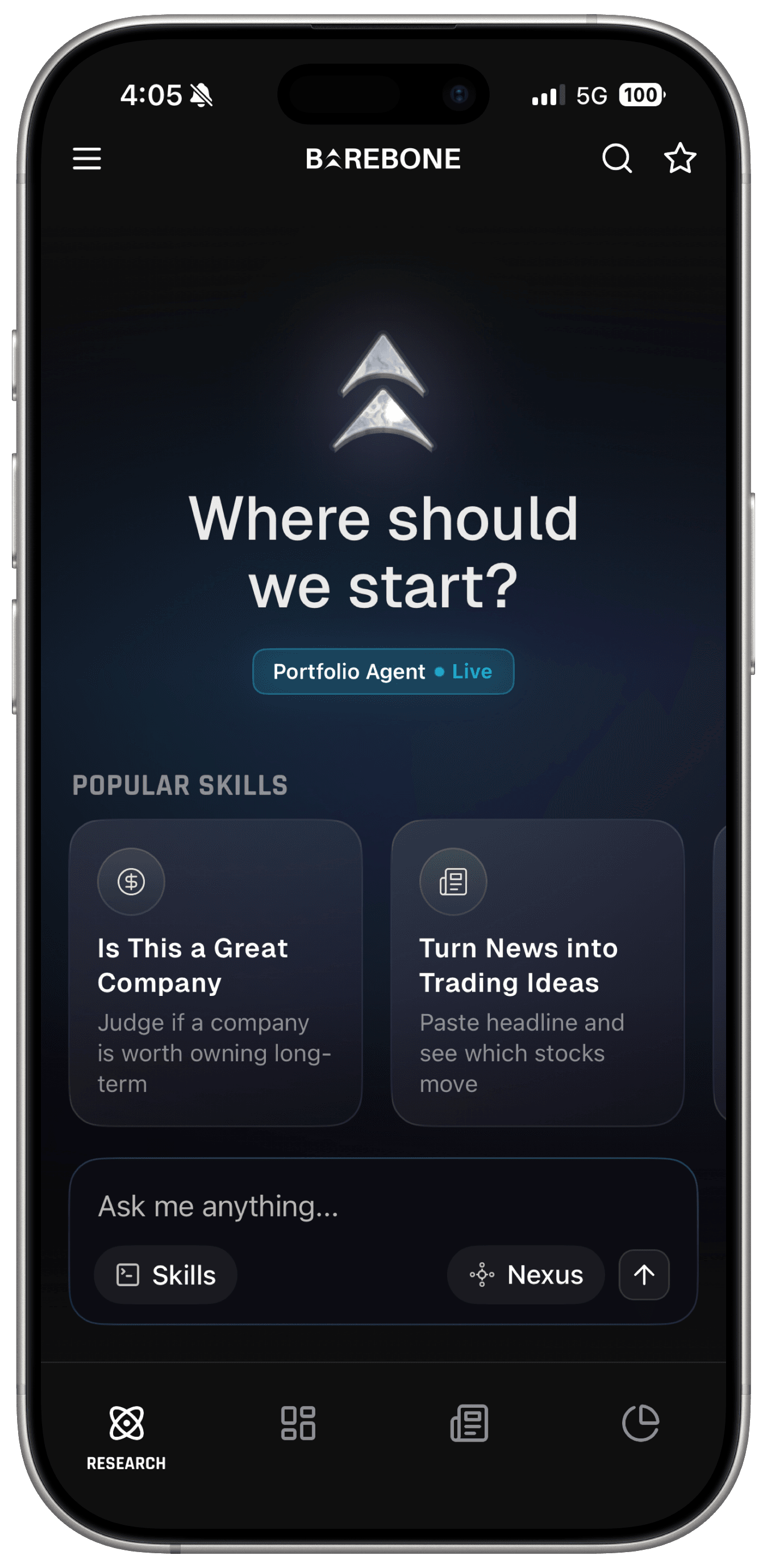
It depends on which AI. Independent tests found general chatbots answer roughly one in three finance questions incorrectly or misleadingly. Tools grounded in live financial data, with figures verified against the source numbers, are categorically more reliable for research - but no AI predicts markets or replaces your judgment. Trust architecture, not promises.
Why This Question Deserves Rigor
Barebone AI is an AI investment research platform built by the team behind this article - which is exactly why this piece leans on independent, citable data, treats the failures honestly, and spells out what no AI can do, including ours.
The question deserves that rigor, because the stakes are asymmetric: a chatbot inventing a movie quote is funny; a chatbot inventing a debt-to-equity ratio can cost you real money. Here is what the published evidence actually shows.
What Do Independent Tests Say About AI and Money Questions?
The error-rate literature on general-purpose chatbots is consistent, and worth reading unfiltered:
- 35% of finance answers wrong or misleading. Investing in the Web had finance professionals grade ChatGPT's answers to 100 questions about investing, savings, and personal finance: 65% were judged correct, 29% incomplete or misleading, and 6% flatly wrong. One in three answers had a problem.
- Second-lowest score in a six-tool consumer test. UK consumer group Which? tested ChatGPT, Gemini, Copilot, Meta AI, and Perplexity on dozens of consumer questions including personal finance. ChatGPT scored 64%, second-lowest. Notably, when researchers planted a deliberate error - asking how to invest a "£25,000 ISA allowance" when the real allowance is £20,000 - ChatGPT and Copilot both missed it and answered anyway, advice that could have breached UK tax rules.
- Fabricated citations at scale. A peer-reviewed study in Scientific Reports found 55% of the bibliographic citations generated by ChatGPT-3.5 - and 18% of ChatGPT-4's - referred to works that simply do not exist. The models invented plausible-looking sources rather than saying "I don't know."
- An 83% fail rate on news accuracy. When NewsGuard audited DeepSeek, the chatbot repeated false claims 30% of the time and gave non-answers 53% of the time on news-related prompts - debunking provably false claims only 17% of the time.
- Reasoning models can hallucinate more, not less. Vectara's evaluation measured a 14.3% hallucination rate for DeepSeek's R1 reasoning model on simple document-summarization tasks - nearly four times its own predecessor. "Smarter" does not automatically mean "more factual."
A fair caveat: these studies measure different things - consumer finance answers, news claims, citations, summarization - under different methodologies. None of them proves a precise universal error rate. But the direction is unanimous, replicated, and matches what any heavy chatbot user has experienced: fluency and accuracy are different properties, and general chatbots optimize for the first.
Why Do General Chatbots Get Financial Facts Wrong?
Not because they're badly made - because of what they are. Three structural reasons:
- They generate plausible text, not verified facts. A language model's core skill is producing what a correct answer sounds like. Most of the time that overlaps with truth; in precision domains like finance, "most of the time" is the problem.
- Their knowledge has a cutoff; markets don't. Prices, earnings, rates, and filings change daily. A chatbot recalling a P/E ratio from its training data may be quoting a number from a different market regime entirely - with complete confidence and no timestamp.
- Nothing forces a data check. When a human analyst cites revenue growth, someone eventually reconciles it against the filing. A chatbot faces no such gate: ask for a number and it will produce one, sourced or not.
None of this makes chatbots useless. For learning concepts - "explain how a DCF works," "what is dilution?" - they're genuinely good. The failure mode is using a text generator as a data source. That distinction, not brand loyalty, should drive which tool you reach for; we walk through the categories in Is There an AI That Analyzes Stocks for You?
What Changes When AI Is Grounded in Live Data?
A different architecture produces a different trust profile. Purpose-built AI research platforms differ from chatbots in three specific, checkable ways:
- They fetch live data at question time. Ask about NVDA and the price, financials, analyst estimates, and filings are pulled from market data sources at that moment - there is no training-data staleness to inherit.
- They compute rather than recall. Valuation, technical levels, and sentiment scores are calculated from the actual numbers, not reconstructed from internet text about the numbers.
- They verify before displaying. The strongest implementations add a verification layer that checks every figure the AI cites against the underlying financial data before it reaches the screen - and show the charts and source numbers so you can audit the work yourself.
This is the category Barebone AI was built in - and it's one example you can verify rather than take on faith: you can check its work against your own broker, its background and ratings are publicly checkable, and a direct comparison against the most popular chatbot is in Barebone AI vs ChatGPT. Grounding doesn't make AI infallible - data feeds can lag, models can misread context - but it converts "trust me" into "check me," which is the only kind of trust worth having in finance.
What Can't AI Do, No Matter How Good the Data?
Three permanent limits, stated plainly:
- It cannot predict markets. Not chatbots, not grounded platforms, not anyone's proprietary model. Prices move on new information; new information is, by definition, not in any dataset. The SEC, NASAA, and FINRA jointly warn investors about AI-themed pitches promising guaranteed or outsized returns - that warning exists because "our AI predicts stocks" is a recurring fraud pattern, not a product category.
- It cannot replace your judgment. Research tells you what a company earns, what it might be worth, and what the market thinks. Whether the position fits your risk tolerance, time horizon, and life is a human call - yours, or a licensed professional's if you choose to work with one.
- It cannot remove uncertainty. The best research narrows the range of honest opinions; it never narrows it to one. Any tool that presents certainty is misrepresenting how markets work.
How Do You Evaluate Any AI Research Tool? A Practical Checklist
Apply this to anything - including Barebone AI:
- Data freshness. Ask for a current price or the latest quarter's revenue, and compare against your brokerage. Stale or evasive answers end the evaluation.
- Source verification. Does the tool verify figures against underlying data, or just write prose? Ask where a number came from and see if the answer is checkable.
- An auditable trail. You should see the actual numbers, charts, and filings behind a conclusion - not just a confident paragraph. If you can't check the work, you can't trust the work.
- Honest disclosure. A legitimate research tool says clearly that it is not a broker, does not give personalized advice, and cannot promise returns. Missing or mealy-mouthed disclosure is disqualifying.
- A verifiable team and track record. Real names, checkable backgrounds, public app-store ratings with real reviews. Anonymous teams plus return promises is the classic fraud signature.
So - Can You Trust It?
Trust AI the way you trust a calculator, not the way you'd trust an oracle. A calculator is enormously reliable at what it's built for, useless at questions outside its design, and still requires you to know what you're asking and why.
Applied to 2026's tools: trust general chatbots to explain, not to report figures. Trust grounded, verification-layer research platforms to compress hours of data work into seconds - and spot-check them until they've earned it. Trust nothing that predicts, promises, or hides its work. The investors who get this right won't be the ones who avoided AI, or the ones who believed it blindly - they'll be the ones who used it as an instrument and kept the judgment for themselves.