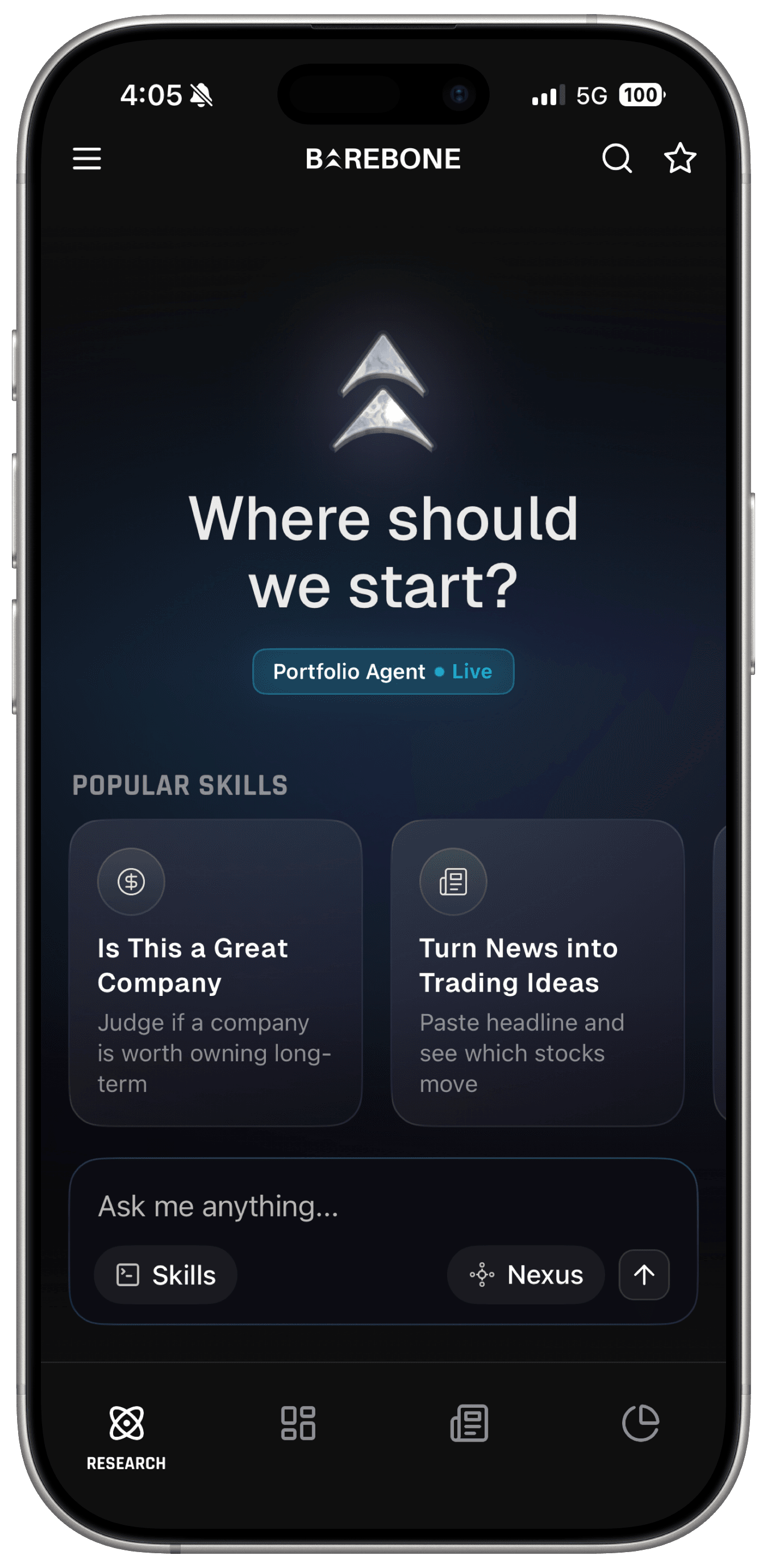
For AI-native ETF research, Barebone AI leads - plain-English fund analysis, side-by-side comparisons, and a dedicated long-term ETF skill, on mobile with verified figures. But honest scope: Morningstar remains the fund-ratings king, and the best overlap and screening tools (ETF Research Center, ETF.com, justETF) aren't AI at all. The right stack uses both.
What Actually Matters in ETF Research
ETFs invert the stock-research problem: instead of one company to understand deeply, you have a basket to understand precisely. Four criteria do most of the work:
- Expense ratio. Costs compound forever and are one of the few things you fully control. This logic is brutal for expensive active management - 79% of active large-cap US funds underperformed the S&P 500 in 2025 alone, per S&P's SPIVA scorecard.
- Holdings transparency. "Innovation ETF" tells you nothing; the top-25 holdings table tells you everything. Always read what the fund owns, not what it's named.
- Overlap with what you already hold. The most common DIY portfolio error is buying three "different" funds that share the same ten mega-caps.
- Index methodology and tracking. How the index selects and weights decides how the fund behaves when markets turn.
Every tool below earns its slot against those four jobs.
The Field at a Glance
| Rank | Tool | Best for | Price | Key strength |
|---|---|---|---|---|
| 1 | Barebone AI | AI-native ETF analysis on mobile | - | Plain-English analysis, verified figures |
| 2 | Morningstar | Fund ratings and editorial research | $34.95/mo or $249/yr | Medalist Ratings - the standard |
| 3 | ETF.com (VettaFi) | Free screening and fund data | Free | 4,300+ ETF database |
| 4 | ETF Research Center | Overlap analysis | Free tools; $29/mo full | Best-in-class overlap tool |
| 5 | justETF | European (UCITS) investors | Free; Premium €9.90/mo | The UCITS database |
| 6 | Koyfin | ETF data inside a market terminal | Free; Plus $39/mo | Holdings + analytics breadth |
1. Barebone AI - Best AI-Native ETF Research
Barebone AI treats ETFs the way it treats stocks: ask in plain English, get structured, verified analysis in seconds, on iOS or Android.
What it does well
- Analyze any major ETF conversationally. "Break down QQQ's concentration risk" or "How has SCHD's dividend grown?" returns charts, visual ratings, and the underlying numbers - every cited figure verified against the source financial data before display.
- Compare funds side by side. Cost, holdings, performance, and profile across two or more tickers in one query - the work of five browser tabs in one answer.
- A dedicated long-term ETF skill. One of its 20+ research skills builds a researched shortlist of candidate funds for long-horizon portfolios, with the data and reasoning shown. It's research you interrogate, not advice you follow - you stay the decision-maker.
- Context the specialists lack. The same app runs the stock-level stack - sentiment, news scoring across 10 global regions, earnings analysis - so you can research a fund and its biggest holdings in one place.
Where it falls short
Barebone AI is not a fund-rating agency: it has no analyst-driven rating system like Morningstar's, and fund coverage is deepest for US-listed ETFs - European UCITS investors will still want justETF. It's also research-only and mobile-first: no trade execution, no desktop terminal yet.
Verdict: The fastest way to genuinely understand an ETF in 2026 - keep Morningstar's ratings in the loop for fund-quality second opinions.
2. Morningstar - The Fund-Ratings King, Plainly
Let's say it without hedging: Morningstar is the institution in fund research, and if ETFs are the core of your portfolio, it's the one subscription that's easiest to justify.
What it does well
- Medalist Ratings - forward-looking Gold/Silver/Bronze/Neutral/Negative assessments built on People, Process, and Parent pillars plus a fee assessment - alongside the famous star ratings on past risk-adjusted performance.
- Editorial discipline: real analysts, real methodology documents, decades of consistency, plus portfolio X-ray tools on web and native apps.
Where it falls short
It's not AI-driven and it's not fast - it's a library. At $34.95/month or $249/year, index-fund-only investors are paying for depth they may not use, and ratings are still opinions: a Gold medal is an informed forecast, not a guarantee.
Verdict: The standard for fund quality assessment. We compare it head-to-head with our approach in Barebone AI vs Morningstar.
3. ETF.com (VettaFi) - Best Free ETF Database
ETF.com, run by VettaFi (a TMX Group company), is the free reference desk: a screener covering 4,300+ US-listed ETFs, fund pages with expense ratios, holdings, flows, and a comparison tool.
What it does well
- Free, comprehensive, and current - the quickest way to shortlist by asset class, cost, and size, with solid editorial coverage of fund launches and flows.
Where it falls short
US-listed focus, no portfolio-level analysis, and no AI layer - it answers "what exists and what does it cost?" not "what should I look at next?" Depth beyond the fund page means exporting your shortlist to other tools.
Verdict: Bookmark it as your free ETF encyclopedia; bring your own analysis.
4. ETF Research Center - Best Overlap Analysis
ETF Research Center is a niche specialist that solves the single most underrated ETF problem: overlap. Enter two funds and its Fund Overlap tool shows shared holdings and overlap by weight - the fastest way to discover that your three "diversified" funds are the same trade in different wrappers.
What it does well
- The overlap tool delivers full results free, per the official subscription page, alongside free charting and research notes.
- Paid tiers (Individual $29/month, Professional $99/month) add complete holdings data, full screening, and portfolio builders.
Where it falls short
It's a single-purpose station, not a research home: dated interface, no mobile app, and $29/month is steep if overlap checks are all you need - for most retail investors, the free tool is the product.
Verdict: Use the free overlap tool before every ETF purchase; pay only if you're building multi-fund portfolios professionally.
5. justETF - Best for European Investors
justETF is the reference database for Europe: thousands of UCITS ETFs, screened by domicile, replication method, distribution policy, and TER - the exact fields European investors need and US-centric tools ignore.
What it does well
- A genuinely useful free tier (screener, fund profiles, one portfolio and watchlist) and fair Premium pricing at €9.90/month billed annually (€118.80/year), with iOS and Android apps.
- Practical European specifics: accumulating vs distributing share classes, currency hedging, and listing exchanges.
Where it falls short
Europe-only by design - US investors need nothing here - and analysis stays at the data-and-screening level; there's no AI layer and no fund-quality opinion.
Verdict: If you buy UCITS ETFs, this is your database; pair it with an analysis tool for the thinking.
6. Koyfin - Best ETF Data Inside a Market Terminal
Koyfin covers ETFs as part of its Bloomberg-style workspace: fund profiles, performance, and valuations on the free tier, with ETF screening and the full holdings library unlocked at Plus ($39/month).
What it does well
- ETF research in context - compare a fund's chart against macro series, sectors, or single stocks in one dashboard, on web or its native mobile apps.
Where it falls short
Free-tier ETF holdings data is limited, the platform rewards configuration time, and there's no fund-rating opinion - it's a terminal, not a judge.
Verdict: The right choice if ETFs are one tab of a broader market workflow rather than the whole job.
The Honest Stack
Run the four-criteria check (cost, holdings, overlap, methodology) with free tools - ETF.com for screening, ETF Research Center for overlap - then use Barebone AI to interrogate the finalists in plain English, and Morningstar if you want an institutional rating as a second opinion. Whatever tool you use, verify what it tells you - our evidence review on whether you can trust AI for investment research applies doubly to long-horizon decisions. For the broader tool landscape, see the best stock research apps of 2026 and the best AI investment agents.