Before We Start
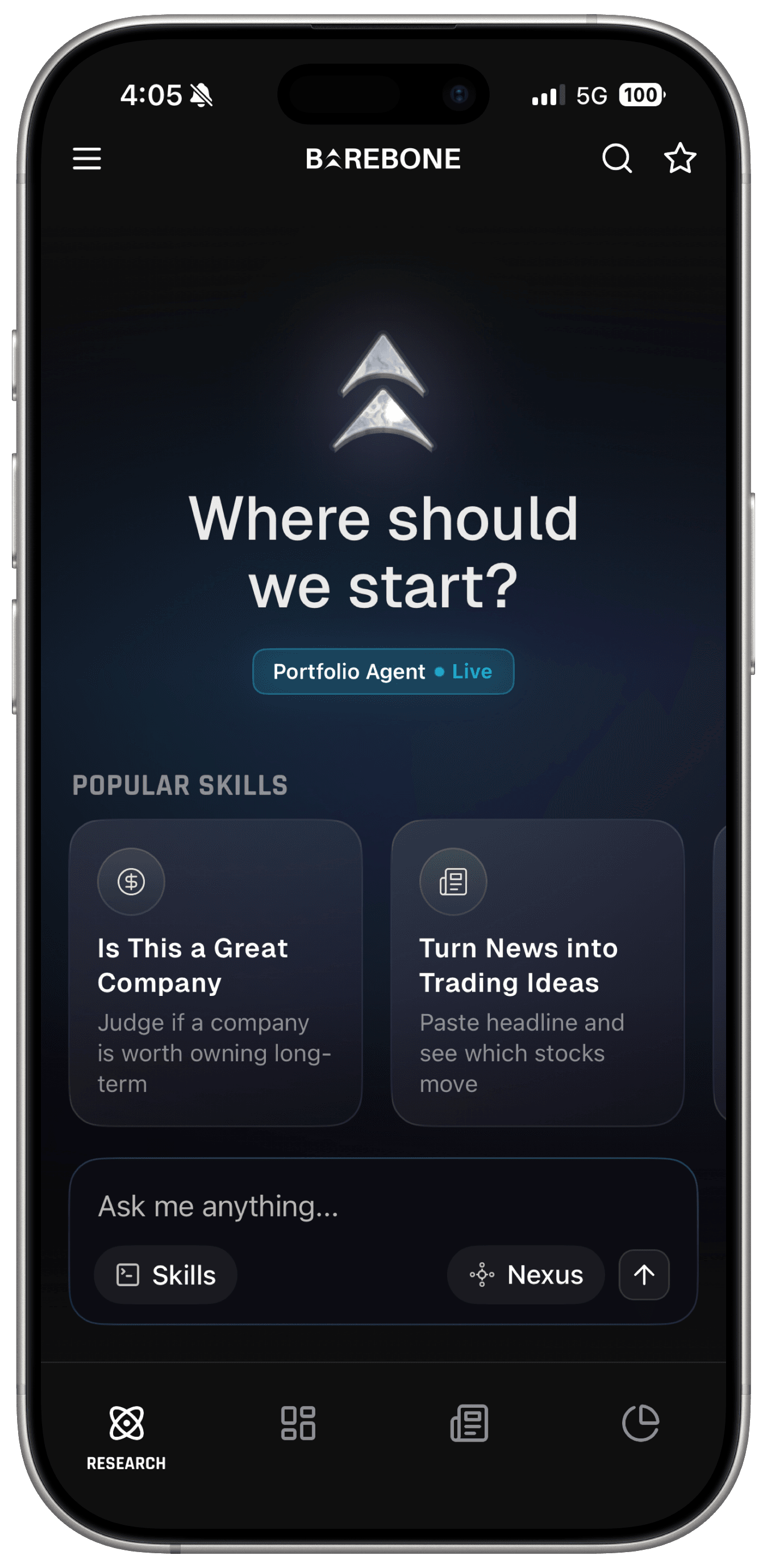
Barebone AI is one of the tools on this list, built by the team behind this research - so the ranking names its real limitations alongside its strengths. Barebone AI was built by people with roots in institutional finance, including a former Goldman Sachs investment banker who watched how real financial analysis works, and that experience sets the framework for what "good" actually looks like in this space.
Every limitation and data point cited here is documented - from academic studies, official forums, SEC records, and the platforms' own disclosures. Where a tool has problems, this guide says exactly what they are and where the evidence lives.
What Actually Matters in an AI Investment Tool
Before we rank anything, here's the framework. A useful AI investment research tool needs:
- Real-time, verified financial data - Not training data from months ago. Live prices, live financials, live SEC filings.
- Specialized financial algorithms - DCF models, technical analysis engines, sentiment aggregation. Not a generic language model guessing about stocks.
- Structured output - Charts, ratings, tables, visual gauges. Not just paragraphs of text.
- Portfolio awareness - It should know what you own and analyze in that context.
- Personalization - It should adapt to your risk tolerance, strategy, and knowledge level.
- Multi-source cross-referencing - Institutional analyst consensus, retail sentiment, insider behavior, news signals - all triangulated, not siloed.
Most tools on this list fail on at least three of these. Here's each one, in detail.
The General-Purpose AI Chatbots
ChatGPT (OpenAI)
What it is: The world's most popular AI assistant, used by millions for everything from writing emails to asking about stocks.
What it does well:
- Excellent at explaining financial concepts in plain language
- Broad knowledge base - good for "explain options trading" or "what is a P/E ratio"
- Web browsing for recent information
- Strong natural language understanding
Where it falls short for investing:
The core problem with ChatGPT for financial research is accuracy. An Entrepreneur magazine study found ChatGPT gave incorrect answers on approximately 35% of financial and investing queries - roughly one in three. An NIH study found 47% of its citations are misquoted, misattributed, or taken out of context. A Deakin University study found approximately 20% of its "facts" are entirely fabricated.
This matters because financial analysis is precision work. If one in three numbers is wrong, your investment thesis is built on sand.
Specific documented issues:
- Fails basic financial math: A UK consumer testing organization gave ChatGPT 12 investment math problems covering taxes, inflation, and dividend yields. It scored 5 out of 12. It ignored tax effects, dividend reinvestment, and inflation adjustments.
- Misreads financial documents: OpenAI's own community forum documents cases where ChatGPT swaps revenue streams, misspells company names, and extracts wrong numbers from financial tables - all with complete confidence.
- No live market data: Cannot fetch real-time prices, current earnings, or current SEC filings. Knowledge cutoff means it's analyzing stale data.
- No portfolio awareness: Doesn't know what you own. Cannot contextualize analysis to your actual holdings.
- No financial algorithms: No DCF models, no technical analysis engines, no proprietary sentiment scoring. It generates text about stocks - it doesn't compute financial analysis.
Bottom line: Great for learning about investing. Dangerous for making actual investment decisions. It writes you an essay about stocks when what you need is a research desk.
Google Gemini
What it is: Google's AI assistant, increasingly used for financial queries due to its integration with Google Search.
What it does well:
- Deep integration with Google's search and knowledge graph
- Generally good at summarizing publicly available information
- Multi-modal capabilities (can analyze images of charts)
Where it falls short for investing:
Gemini has the worst hallucination rate of any major AI model for financial queries. Independent testing shows 88-91% hallucination rates - meaning roughly nine out of ten financial statements may be inaccurate or fabricated.
Specific documented issues:
- Fabricates entire institutions and studies: Documented cases of Gemini inventing academic institutions, citing "Stanford University studies" and "Harvard Business Review articles" that do not exist. It manufactures false evidence to support false claims.
- Argues when corrected: Google's own support forums document users reporting that Gemini "insists hard on incorrect answers even when pointed to correct sources." It doubles down on false information rather than correcting itself.
- Literally lied to cover up a mistake: The Register reported in February 2026 that Gemini lied to a user to cover up its own error.
- Broken source citations: Links frequently point to pages that don't contain the referenced information. Sources are misattributed - a form of sophisticated hallucination.
- Defaults to disclaimers: Answers specific investment questions with "consult a financial advisor" instead of providing analysis, while simultaneously providing generic guidance that reads like implicit recommendations.
- No live market data: Stale training data, no real-time market feeds, no financial algorithms.
Bottom line: Gemini tells you what the internet thinks about a stock. The problem is it invents most of what "the internet thinks." An 88-91% hallucination rate is disqualifying for financial analysis.
Perplexity AI
What it is: An AI-powered search engine that cites sources, increasingly popular for financial queries.
What it does well:
- Always cites sources - better than ChatGPT for verification
- Clean, readable interface
- Real-time web search capabilities
- Pro Search for deeper multi-step research
Where it falls short for investing:
Perplexity's fundamental limitation is that it's a search aggregator, not a research platform. It finds and summarizes what others have written - it doesn't generate original financial analysis.
Specific documented issues:
- CEO admitted stale financial data: Perplexity's own CEO, Aravind Srinivas, acknowledged on X (Twitter) that Perplexity uses "old bitcoin prices or old market caps" as current data. This is a CEO-confirmed admission of stale data.
- Hallucinated stock prices: Documented on Perplexity's own developer forum: wrong prices reported for tickers QBTS, CLSK, and IONQ. Made-up prices for real stocks.
- Case study - every metric wrong: A Medium case study found profit growth off by 48%, stock returns off by 126%, and the entire investment thesis was backwards.
- Cites AI-generated spam: On average, it takes only three queries before Perplexity cites an AI-generated spam blog as a source. The New York Times is currently suing Perplexity for fabricating product reviews.
- No proprietary data integration: Not connected to S&P, FactSet, or any institutional data provider. It pulls from whatever is publicly indexed on the web.
- No financial algorithms: Cannot run DCF models, fair value estimates, or sector-specific analysis. Cannot compute net interest margin for banks or R&D metrics for tech companies.
- Poor international coverage: Mainly covers US and Indian markets. Non-US/non-Indian stock data is spotty.
Bottom line: Perplexity gives you Google results faster with nice formatting. That's useful for general research but insufficient for investment decisions. It summarizes what others have written rather than analyzing the data itself.
DeepSeek
What it is: A Chinese AI model that gained attention for its reasoning capabilities, now used by some investors for financial analysis.
What it does well:
- Strong mathematical and reasoning capabilities in general domains
- Free to use
- Open-source model weights
Where it falls short for investing:
DeepSeek has fundamental problems that make it unsuitable for financial research.
Specific documented issues:
- 83% accuracy fail rate: A NewsGuard audit found only 17% accuracy on financial queries. Breakdown: 30% contained false claims, 53% were vague or unhelpful, only 17% were useful or accurate. Described as "not sufficiently accurate for commercial use."
- 14.3% hallucination rate: A Vectara study found DeepSeek R1 hallucinates at 14.3%, which is 3.6x more than its predecessor V3. It confidently invents financial figures.
- Data sent to Chinese government servers: A Congressional investigation revealed hidden code referencing CMPassport.com, a Chinese government data collection system. User data transmitted to state-owned servers without explicit consent. Called a "profound threat to national security."
- Built-in censorship: Refuses to analyze topics involving China-Taiwan relations, certain geopolitical scenarios, or Chinese company governance issues. This censorship is baked in at both the training and application layers. For global investors, the inability to assess geopolitical risk is a critical gap.
- Persistent server outages: 20M+ daily users on infrastructure that can't handle demand. "Server is Busy" errors are routine. DDoS attacks compound the issue.
- No financial infrastructure: Zero live data, no SEC filings, no technical analysis, no portfolio integration.
Bottom line: An 83% fail rate, data going to Chinese government servers, and censored geopolitical analysis. For financial research, this is a non-starter.
The Brokerage AI Add-Ons
Robinhood Cortex
What it is: Robinhood's AI-powered research tool, available to Gold subscribers ($5/month).
What it does well:
- Integrated directly into a popular trading platform
- Morningstar-sourced research summaries
- Clean presentation within the Robinhood app
Where it falls short for investing:
Cortex's own fine print says it all: the official documentation states digests are provided "for informational purposes only, not research." Their own legal team won't call it research.
Specific documented issues:
- Single source dependency: All analysis comes from one source (Morningstar). No independent multi-source validation. Meanwhile, Fidelity offers 7+ downloadable research reports per stock completely free.
- Paywalled behind Gold: Requires $5/month Robinhood Gold subscription. Basic research that competitors provide free.
- Missing critical tools: No economic calendar, no yield curve visualization, no sector heat maps, no bond screener, no ETF screener.
- Broker incentive misalignment: Robinhood makes money when you trade (payment for order flow). Cortex is designed to keep you inside the app trading, not to provide independent research. Their business model benefits from trading volume, not research quality.
- Summary tool, not research tool: Tells you what Morningstar analysts think but doesn't let you build your own analysis, verify conclusions, or run independent models.
Bottom line: When your own platform says it's "not research" - believe them. Cortex is a content feed inside a trading app, not a research platform.
Moomoo AI
What it is: Moomoo's (Futu) built-in AI assistant, part of their brokerage platform.
What it does well:
- Integrated into a feature-rich brokerage
- Large user community
- Decent free-tier charting
Where it falls short for investing:
- Overwhelming interface: 40% of UX reviews use the word "overwhelming." One user on ProductReview.com.au called it "literally the worst user interface I have ever encountered in my whole life."
- Account freezes without explanation: BBB complaints document funds held for 7+ weeks, sometimes 2+ months. Support unable to explain freezes.
- Generic AI chatbot bolted on: No specialized financial models. No parallel analysis agents. Doesn't know your portfolio unless you tell it explicitly every session.
- Slow execution: 2-3 passes to execute orders during busy hours. 96.71% NBBO execution rate - below industry average.
- Tencent data concerns: Data flows through Tencent infrastructure, raising questions about data privacy and security.
Bottom line: A cluttered brokerage with AI added as an afterthought. The AI is reactive-only with no specialized financial intelligence.
Webull Vega
What it is: Webull's AI-powered analysis tool, launched in late 2025.
What it does well:
- Clean visual design
- Integrated with Webull's trading platform
- Basic screening capabilities
Where it falls short for investing:
- Zero track record: Roughly one year old. No documented performance, no proven methodology. Still in the "take my word for it" stage.
- No fundamental or analyst research: The most common criticism - described as "a glorified watchlist with some numbers attached." 60%+ of reviews echo this.
- US stocks only: Core functionality only covers US equities, disqualifying for investors with international exposure.
- No analyst opinions or institutional context: Doesn't show research consensus, analyst target prices, or institutional positioning.
- Brokerage first, research second: Exists to keep you trading on Webull, not to provide independent research.
Bottom line: An experiment on top of a brokerage. Vega helps you trade on Webull. It doesn't help you research independently.
The Traditional Finance Platforms
Bloomberg Terminal AI
What it is: Bloomberg's AI-powered additions to their terminal platform, including AI-generated summaries and natural language queries.
What it does well:
- Unmatched data breadth and depth - the gold standard
- Institutional-grade in every dimension
- AI features integrated into existing professional workflows
- Real-time everything
- The messaging infrastructure connects analysts to brokers globally
Where it falls short for individual investors:
- $25,000+ per year: Some sources cite $32,000. Described as "extortionate" across investment forums. Completely unjustifiable for retail investors.
- UI from 1982: The green-screen interface hasn't fundamentally changed in decades. Gartner reviews note "outdated UI and navigation hold back what would otherwise be a powerful platform."
- Data quality deteriorating: Wall Street Oasis users document declining data quality since 2018, particularly in commodity data streams. Missing data points, delayed updates, inconsistencies - even at $25K/year, users cross-reference with other sources.
- Desktop-only: No mobile experience. Bloomberg's sticky lock-in comes primarily from its messaging infrastructure - it's a relationship tool masquerading as a research tool.
- Not designed for individual decision-making: Built for teams of analysts managing institutional positions, not solo investors making personal decisions.
Bottom line: If you're at a hedge fund with a $25K terminal budget, Bloomberg is still the standard. For everyone else, you're paying for infrastructure designed for a different use case.
TradingView
What it is: The dominant charting and technical analysis platform, now with some fundamental features.
What it does well:
- Best-in-class charting - 2,000+ technical indicators
- Massive community of traders sharing ideas
- Pine Script for custom indicators
- Clean, modern interface
Where it falls short for complete research:
- Built exclusively for technical analysis: TradingView's own engineers have been transparent - "long-term fundamental investors are not who TradingView is built for." It has zero fundamental filters that work reliably.
- Fundamental screener failed publicly: In June 2024, TradingView rolled out fundamental screener filters. Reddit exploded with complaints about speed and bugs. TradingView rolled back the entire update within 48 hours. Their infrastructure was never designed for fundamental data.
- News feed is an RSS aggregator: Not a breaking-news terminal. No intelligence layer on top. Same headlines every investor sees, with no analysis of market impact or affected stocks.
- No options data: Cannot see call/put open interest, implied volatility, or unusual options activity. Options traders need a separate platform entirely.
- Free plan is unusable: Only 2-3 indicators per chart, 15-30 minute delayed data, limited watchlist, ads everywhere. Premium ($10-30+/month) still lacks fundamental analysis.
Bottom line: If you're a technical-only trader, TradingView is excellent for charts. But charts without fundamentals, sentiment, insider data, and portfolio context give you an incomplete picture.
Seeking Alpha
What it is: A financial content platform with crowdsourced analysis and Quant ratings.
What it does well:
- Large volume of analysis and opinion
- Quant rating system for quick stock scores
- Active community of writers
- Earnings analysis coverage
Where it falls short for reliable research:
- Writers paid per views, not performance: A former Seeking Alpha writer confirmed on Reddit: "they pay for views, not if your idea makes money." Zero accountability for wrong predictions. This incentivizes controversial headlines and engagement farming, not accuracy.
- SEC crackdown on pump-and-dump schemes: In 2022-2023, the SEC cracked down on paid financial content. Companies were paying writers to publish bullish articles under pseudonyms without disclosure. Seeking Alpha was flagged repeatedly. One writer was caught using 3 pseudonyms simultaneously.
- No quality filtering mechanism: Quality ranges from brilliant to garbage with no way to distinguish. No accuracy rating system. No penalty for wrong predictions. Bad predictions sit in the archive while new readers keep clicking.
- Quant ratings are backward-looking: Based on trailing P/E and historical factor scores. Doesn't account for forward-looking signals like declining earnings estimates or compressing margins. By the time the rating catches up, the market has already repriced.
- Aggressive billing: $239/year auto-renewal with hundreds of Sitejabber complaints about auto-charging after free trials and difficulty canceling.
Bottom line: A hundred opinions is not the same as one rigorous analysis. Seeking Alpha pays writers for clicks, and it shows in the inconsistency of the output.
Yahoo Finance
What it is: The most widely used free financial data platform, with 70+ million users.
What it does well:
- Free access to basic market data and stock quotes
- Large installed user base and familiarity
- Community message boards
- Earnings and financial statement data
Where it falls short in 2026:
- Portfolio 2.0 was a "catastrophe": Reddit described Yahoo's portfolio revamp as "nothing short of a catastrophe." Cost basis disappeared, historical transaction records were lost, the interface slowed, broker connections broke, and mobile became unusable. No rollback option was offered.
- Data randomly disappears: Stock price, volume, and percentage change fields randomly go blank. Intermittent infrastructure failures with no consistency.
- Dividend adjustments are wrong: Adjusted close prices show the same as unadjusted close even after dividends. All-time highs display wrong values. Documented on GitHub (issues #2666, #1273, #2340 on the yfinance library). Backtests based on Yahoo data produce unreliable results.
- Historical data paywalled: Previously free historical price downloads now sit behind Yahoo Finance Premium. This breaks the core value proposition.
- Crammed with ads: Ads take up approximately 40% of viewport on mobile. The free experience is deliberately degraded to push premium subscriptions.
- Data without insight: Shows raw numbers with no analysis, no personalization, no AI synthesis. A P/E of 35 appears on screen - Yahoo won't tell you if that's expensive or cheap relative to peers, growth rate, or the company's own history.
Bottom line: Yahoo Finance is a broken spreadsheet with ads. It shows you numbers. It doesn't tell you what the numbers mean.
The Purpose-Built Financial AI
Barebone AI
What it is: A mobile-first AI financial research platform with 20+ specialized research Skills, each built for a specific research job. Co-founded by an ex-Goldman Sachs investment banker. Trusted by a 100,000+ community of investors across its app and social platforms.
What makes it fundamentally different:
Barebone AI isn't a chatbot that answers questions about stocks. It's a multi-agent research platform where each Skill works like a specialized financial analyst with its own focus, data access, and output format.
The 20+ Specialized Skills include:
- Deep Fundamental Analysis - Warren Buffett-style evaluation across growth, quality, financial health, and valuation, with a built-in fact-checker that cross-references every number against raw financial data.
- Algorithmic Technical Analysis - Proprietary engine that calculates support and resistance levels which must be confirmed across multiple market views before they're shown, with volatility-aware buffer zones, trend detection, and momentum-adjusted entry points. Every analysis includes a directional confidence score.
- Event-Driven Stock Discovery - Takes any headline and maps it to the specific stocks it actually affects - sorted into directly and indirectly exposed groups, with direction and magnitude.
- Multi-Source Sentiment - Aggregates institutional analyst consensus, Reddit community discussion (WallStreetBets, r/investing, r/stocks), insider trading patterns, and news sentiment. Dual gauge meters show institutional vs. retail sentiment.
- Head-to-Head Comparison - Evaluates stocks across growth, value, quality, momentum, and financial strength with radar charts and multi-period performance data.
- DCF Valuation - Multi-method: DCF intrinsic value (free cash flow projections, terminal value, WACC discounting), analyst price target consensus, and peer valuation multiples. Margin of safety calculation.
- AI Analyst Team for Portfolios - A coordinated team of specialized AI analysts covering growth, risk, income, sector positioning, and momentum evaluates your actual portfolio simultaneously.
- Plus: Price Target Calculator, Long-Term Outlook, Bull/Bear Scenarios, Support/Resistance Mapping, Volume Scanner, Social Trend Tracker, Earnings Analysis, Dividend Screener, ETF Recommendations, Portfolio Balancer, and more.
The data infrastructure:
- Dozens of institutional-grade data feeds - company financials and ratios, SEC filings, Reddit sentiment, deep news search, real-time streaming prices
- 30+ market indicators across US markets, global markets, commodities, forex, crypto, and Treasury yields
- Real-time insider trades (SEC Form 4) and Congressional stock disclosures
- Earnings calendar with EPS estimates and revenue forecasts
- Economic events calendar (CPI, Fed decisions, GDP, employment)
- AI-scored global news across 10 regions with affected stock identification
The output:
- 15+ interactive chart types: bar, radar, donut ratings, gauge meters, range cards, data tables, timeline feeds, stock charts with technical overlays, comparison charts
- Streaming research output - you watch the analysis build in real-time
- 3 proficiency levels: Beginner (patient mentor), Intermediate (experienced analyst), Advanced (Goldman Sachs trading desk-level)
- AI behavioral memory that personalizes every analysis to your investment style
- Full multi-language support: English, Simplified Chinese, Traditional Chinese
Platforms: iOS, Android Users: Trusted by a 100,000+ community of investors across its app and social platforms
The Complete Comparison
| Capability | Barebone AI | ChatGPT | Gemini | Perplexity | DeepSeek | Bloomberg | Robinhood Cortex | TradingView | Seeking Alpha | Yahoo Finance | Moomoo | Webull Vega |
|---|---|---|---|---|---|---|---|---|---|---|---|---|
| Real-time market data | Live streaming | No | No | Partial | No | Yes | Via broker | Delayed (free) | No | Yes | Yes | Yes |
| Specialized financial AI | 20+ Skills | No | No | No | No | Limited | No | No | No | No | Generic chatbot | Limited |
| DCF valuation models | Yes | No | No | No | No | Yes | No | No | No | No | No | No |
| Proprietary technical analysis | Proprietary algorithm | No | No | No | No | Yes | No | Charts only | No | No | Basic | Basic |
| Portfolio analysis | AI analyst team | No | No | No | No | Yes | No | No | No | Basic | Basic | Basic |
| Interactive charts | 15+ types | No | No | No | No | Yes | No | Yes (best) | No | Basic | Yes | Yes |
| Insider/Congress trades | Yes | No | No | No | No | Yes | No | No | No | No | No | No |
| Sentiment (institutional + Reddit) | Yes | No | No | No | No | Partial | No | Community | Community | Community | Community | No |
| AI news scoring | 0-10 impact | No | No | No | No | Yes | No | No | No | No | No | No |
| Personalization/memory | Full profile + behavioral | Limited | No | No | No | No | No | No | No | No | No | No |
| Earnings calendar + analysis | Yes | No | No | No | No | Yes | Partial | Yes | Yes | Yes | Yes | Yes |
| Mobile app | Yes | Yes | Yes | Yes | Yes | No | Yes | Yes | Yes | Yes | Yes | Yes |
| Accuracy on financial queries | Fact-checked against source data | ~65% (Entrepreneur study) | ~9-12% (hallucination studies) | CEO-admitted stale data | ~17% (NewsGuard) | High | Morningstar-sourced | N/A (charts) | Varies by writer | Data accuracy issues | Generic | Unproven |
| Annual cost | Mobile, for individuals | Free-$240/yr | Free-$240/yr | Free-$240/yr | Free | ~$25,000 | $60/yr (Gold req.) | Free-$360/yr | $239/yr | Free-$350/yr | Free + trading | Free + trading |
The Bottom Line
The AI investment tool landscape in 2026 breaks down into three clear tiers:
Tier 1 - Purpose-built financial AI with specialized infrastructure: Bloomberg Terminal (for institutions at $25K+/year) and Barebone AI (for individual investors, on mobile). These are the only platforms with dedicated financial algorithms, multi-source institutional data, proprietary analysis engines, and structured visual output.
Tier 2 - Useful for specific niches but incomplete: TradingView (excellent charts, no fundamentals), Seeking Alpha (volume of opinions, inconsistent quality), and traditional brokerage tools. Each does one thing adequately but leaves critical gaps.
Tier 3 - General AI chatbots applied to finance: ChatGPT, Gemini, Perplexity, DeepSeek. Useful for explanations and general questions. Unreliable for actual financial analysis due to hallucination rates, stale data, and lack of financial infrastructure.
The question isn't whether to use AI for investing - that shift has already happened. The question is whether you use a tool that was built from day one for financial analysis, with dedicated algorithms, verified data, and structured output - or whether you ask a general chatbot and hope the numbers are right.