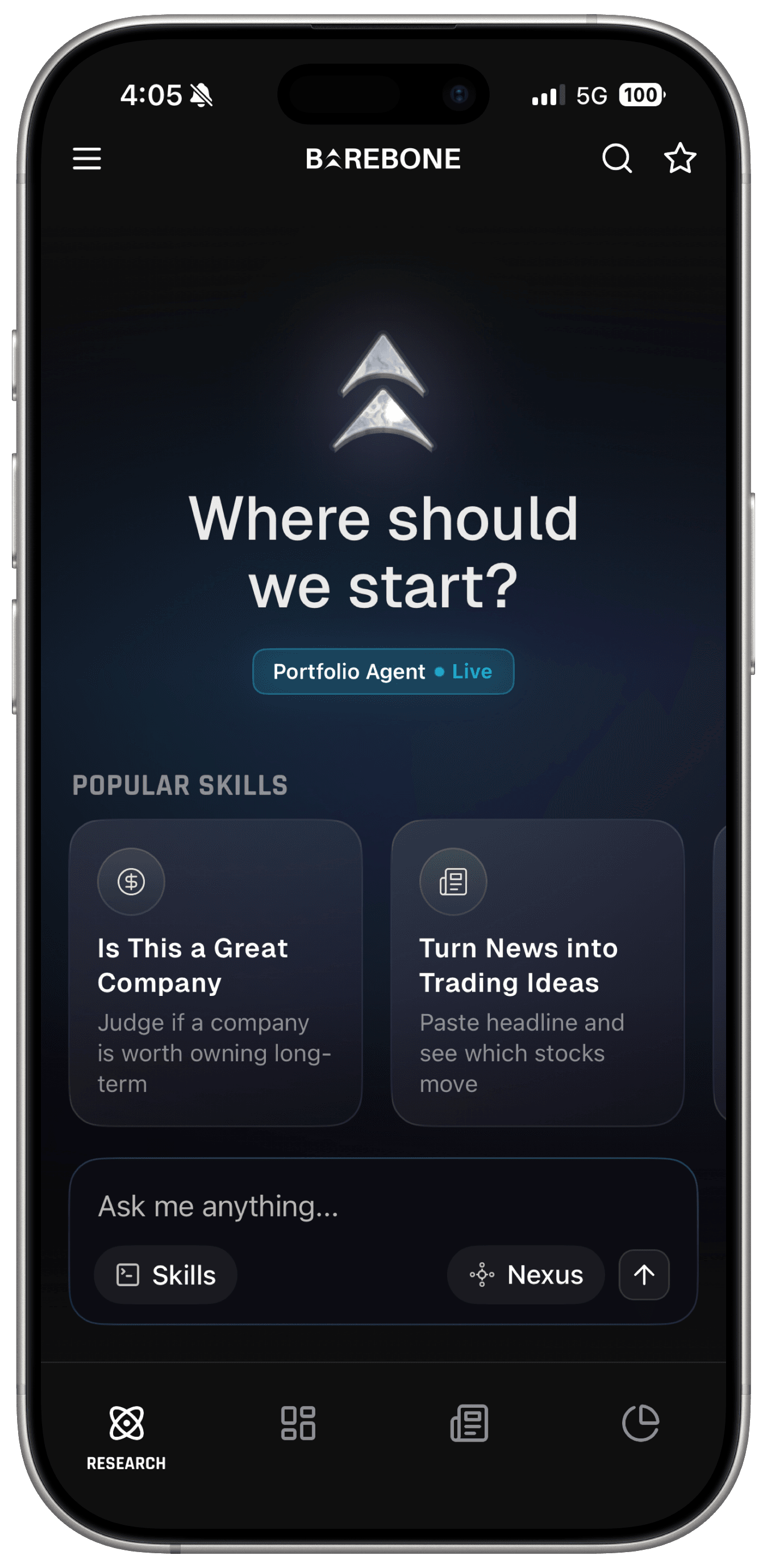
Most retail investors hear about a stock after the move. Professionals watch four signals that show up before the story exists: supply constraints on Big Tech earnings calls, executives buying shares with their own cash, funds and politicians opening new positions, and social chatter that is still a debate rather than a consensus. This guide explains each signal, how to read it properly, and the exact taps to run it inside Barebone in under two minutes.
Most retail investors find stocks the same way: a headline, a friend, a post that already has 10,000 likes. By then the move has happened and you are buying the story after the setup is gone.
Professionals watch for signals that show up before the story exists: what CEOs complain about on earnings calls, what executives do with their own cash, where funds and politicians are moving, and where the internet is still arguing instead of agreeing.
This guide covers four of those signals, ranked from most obvious to most niche. For each one you get why it works, how to read it properly, and the exact taps to run it inside Barebone.
1. Read Big Tech Earnings Calls and Find Their Suppliers
Why earnings calls work as an early signal
The largest companies on earth tell you what they are short of every quarter. It is right there in the transcript. When Microsoft, Meta, and Amazon all say the same thing is constraining their growth, that thing is about to get a lot of money thrown at it, and the trade is whoever supplies it.
Months before AI memory stocks like Micron had a generational rally, Microsoft, Meta, and Amazon had already flagged memory as a bottleneck on their calls. Anyone reading the transcripts saw the demand signal before the price moved. We wrote up that exact chain in Big Tech's $700 billion AI capex and the memory bottleneck.
How to read an earnings call properly
Ignore the headline numbers. Whether they beat or missed on EPS is already priced in by the time the call starts. What you want is the language around constraints.
Listen for phrases like "supply constrained," "capacity limited," "we could not get enough," "lead times," "we are investing heavily in." Then ask who sells that.
One CEO saying it is a data point. Three CEOs in the same quarter saying it is a signal.
How to do it in Barebone: earnings transcripts
Option A: read the transcript yourself
- Tap the search icon (top right) and type any company. Try MSFT, META, or AMZN.
- Open the stock page and go to the Earnings tab.
- You will see two toggles: Past and Upcoming. Under Upcoming you get the next earnings date, the Wall Street EPS and revenue estimates, and the Polymarket odds on whether they beat. Under Past you get the last four quarters with actual vs estimate and the beat percentage for each.
- Open the Earnings Transcript. There is a search bar at the top. Type "supply," "constraint," "capacity," or "shortage" and jump straight to those lines.
Option B: let the AI read it for you
Head to the Home tab and ask a prompt. Templates that work:
- "Read [Company]'s latest earnings call. List every supply constraint, bottleneck, or capacity limitation management mentioned, and name the public companies that supply each one."
- "Compare the latest earnings calls of Microsoft, Meta, and Amazon. What problems or constraints did all three mention? Which suppliers benefit?"
- "What did [Company] say it is spending more on this year? Which companies receive that spend?"
Swap in any company. The AI pulls the transcript, extracts the constraints, and maps them to suppliers. What takes an analyst an afternoon takes you about thirty seconds.
2. CEOs Buying Shares With Their Own Money
Why insider buying works as an early signal
Executives sell for a hundred reasons. Taxes, a house, diversification, a divorce. They buy for one reason: they think the stock is going up.
A CEO has better information about their company than anyone else alive. When they take cash out of their own bank account and put it into their own stock on the open market, that is the closest thing to legal insider information you will ever see.
How to read insider buying properly
Not every insider "buy" counts. Most shares executives receive come from stock compensation, which is pay. A CEO getting $5M in shares as part of their package tells you nothing about conviction.
What you want is open-market purchases: the executive wiring their own cash to a broker and buying at the same price you would.
Three things make an insider buy stronger:
- It is cash, not compensation. Barebone already filters for this. Everything you see under Insider is open-market Form 4 activity, no grants or options.
- Multiple insiders bought at once. One director buying could be anything. Four insiders buying the same stock in the same month means they are seeing the same thing.
- They bought after a drop. An insider buying 45% below the 90-day high is telling you they think the sell-off is wrong. See how Wall Street actually buys the dip for the framework behind that read.
How to do it in Barebone: insider trades
Market-wide: see every insider buy happening right now
- Go to the Explore tab.
- Tap the Insider sub-tab at the top.
- You get three sections:
- Cluster Buys. Multiple insiders buying the same stock at once, with the number of insiders and total dollars over 30 days. This is the highest-conviction list in the app.
- Notable Buy The Dip Trades. Insiders buying right after a sharp price drop, with how far below the 90-day peak they bought.
- Most Recent Insider Trades. Every recent open-market Form 4 filing. Use the filters at the top: Recent, Buys, CEO, $1M+. That combination gives you only CEOs putting seven figures of their own cash in.
- Tap See all on any section for the full list. Tap any trade to open the stock page.
Single stock: check insider activity on anything you are already looking at
- Search the ticker (top right).
- On the stock page, open the Smart Money tab.
- You get the most recent insider trades for that stock: who bought or sold, their role, the disclosed value, average price, and date. Green is a buy, red is a sell.
Or ask the AI:
- "Which insiders bought [Ticker] in the last 90 days with their own money? Were any of them buying after a price drop?"
- "Show me stocks where three or more insiders bought on the open market this month."
3. Follow the Funds and the Politicians Into New Positions
Why 13F filings and Congress trades work as an early signal
Hedge funds have research teams. Politicians have committee briefings. Both groups have to disclose their trades: funds through quarterly 13F filings, members of Congress through the STOCK Act.
One fund or one politician buying a stock is noise. When different people with different information sources are moving into the same industry at the same time, something is pulling them there, and that something is what you are looking for.
How to read fund and Congress trades properly
Focus on new positions. A fund that has owned Apple for ten years adding 2% is rebalancing. A fund that has never owned a semiconductor company suddenly opening three semiconductor positions has a thesis.
Same with politicians. Look for the ones buying into sectors they did not own before, especially ahead of policy that touches that sector.
Then zoom out. Instead of asking whether to buy the same stock, ask what is attracting all of them to this industry. That question usually leads you to a better entry than copying the trade.
How to do it in Barebone: Super-Investors and Congress
Funds
- Go to the Explore tab.
- Tap Super-Investors.
- Browse the aggregated view to see what the biggest funds are buying, selling, and sizing across all filings, or open a specific investor for their full portfolio and activity feed.
- Look for the activity badges. New Position and Increased are what you want. Reduced and Exited tell you where conviction is leaving.
Politicians
- Go to the Explore tab.
- Tap Congress.
- You get trades disclosed by US Senators and Representatives with party, trade type, and estimated value. Filter for buys and look for tickers that show up across multiple politicians.
Single stock
Search any ticker and open the Smart Money tab. Institutional and congressional activity on that name shows up alongside the insider trades. For a deeper walkthrough of these feeds, see our guide to tracking what politicians and CEOs are trading.
Or ask the AI:
- "Which sectors did the top hedge funds open new positions in last quarter? List the funds and the stocks."
- "What stocks have both a super-investor and a member of Congress bought in the last 3 months?"
- "Why are funds moving into [industry] right now? What is the thesis?"
4. Social Media Mentions, but Read the Comments
Why social sentiment works as an early signal
Retail attention moves prices. A stock going from 50 mentions a day to 5,000 is going to move whether the thesis is real or not.
The problem is timing. By the time a stock is trending, you are usually the exit liquidity for whoever posted about it three weeks ago. So skip the post and read the replies.
How to read social sentiment properly
Mention volume tells you attention is rising. Sentiment tells you where in the cycle you are.
If everyone agrees and everyone is hyping it, say 80% bullish, consensus is formed and the crowd is already in. You are late.
If there is heavy debate, bulls and bears arguing, people asking basic questions, sentiment is split and there is no consensus yet. The crowd is still deciding, and the opportunity might still be there.
One more filter: mentions are not the same as accounts. 400 mentions from 30 accounts is a few people spamming. 400 mentions from 300 accounts is a conversation.
How to do it in Barebone: X and Reddit sentiment
Barebone tracks both X and Reddit. The layout is identical for each, so learn it once.
- Go to the Explore tab.
- Tap Socials.
- Toggle between X and Reddit at the top.
- You get three sections:
- Fastest Risers. Largest jump in mentions vs the prior day. A stock at +900% mentions in 24 hours is attention arriving right now. This is the earliest signal on the page.
- Mention Leaderboard. Tickers with the most accounts discussing them in the last 24 hours. Each row shows the number of accounts, the number of mentions, a sentiment bar (green bullish, yellow neutral, red bearish), and the 24-hour change in mentions. Tap the arrow to see whether a name is climbing or falling in rank.
- Top Notable Trending. The biggest climbs on the board, with an AI summary of why it is trending, the bullish vs bearish split, and total mentions. Tap Full analysis to open the complete breakdown.
- Use the Search tickers bar to check any stock you already own or are watching.
Reading the sentiment bar is the whole trick. A name at +46% mentions with 44% bullish, 47% neutral, and 9% bearish is a debate. A name at +46% mentions with 85% bullish is a party you missed.
Or ask the AI:
- "What are X and Reddit saying about [Ticker]? Is the sentiment one-sided or is there real debate?"
- "Which stocks are rising fastest in social mentions right now but still have split sentiment?"
- "Run 'What Investors Are Saying' on [Ticker]." This skill splits institutional sentiment from retail sentiment on two separate gauges, so you can see when the crowd and the professionals disagree. More on that split in AI sentiment analysis: Wall Street vs Reddit.
Putting It Together
Each signal on its own is useful. Stacked, they get dangerous.
A stock where the CEO just bought $2M of their own shares after a 40% drop, where two hedge funds opened new positions last quarter, and where X and Reddit are still arguing about whether it is dead money: that is a setup. It takes a Wall Street analyst a full day to assemble and takes you four taps.
That is what Barebone is built for. Earnings transcripts, Form 4 filings, 13Fs, congressional disclosures, and social sentiment across X and Reddit, all in one app, already filtered (no stock comp, no stale holdings, no spam accounts), with an AI you can ask in plain English.
Over 50,000 investors use Barebone, with more than $100 million in connected portfolios being monitored by the AI. Download Barebone, search any stock, run any of the four signals above, and when you find something, connect your brokerage so the AI can tell you how it fits with what you already own.
Want the broader discovery workflow these four signals plug into? Read the complete guide to idea generation in Barebone, or check the FAQ for how the app works.
Frequently Asked Questions
How do you find stocks before they become popular?
Watch the signals that appear before the story does. Read Big Tech earnings calls for supply constraints and find the suppliers. Track open-market insider buying, especially cluster buys after a drop. Follow new positions from hedge funds (13F filings) and members of Congress. Check social mention growth while sentiment is still split. Barebone puts all four in one app.
Is insider buying a good signal for stocks?
Open-market buying is. Executives sell for many reasons, but they buy with their own cash for one: they expect the stock to rise. Ignore shares received as compensation. The strongest setups are cash purchases, multiple insiders buying the same stock in the same month, and buying after a sharp drop. Barebone filters Form 4 filings to open-market activity only.
How do I find suppliers from an earnings call?
Skip the headline EPS number and search the transcript for constraint language: supply constrained, capacity limited, lead times, we are investing heavily in. Then ask who sells that. One CEO is a data point; three CEOs in the same quarter is a signal. In Barebone, open any stock, go to Earnings, open the transcript and search those words, or ask the AI to map constraints to public suppliers.
What do 13F filings and Congress trades tell you?
Hedge funds disclose holdings quarterly through 13F filings and members of Congress disclose trades under the STOCK Act. One buyer is noise. Several unrelated buyers moving into the same industry at once means something is pulling them there. Focus on new positions rather than rebalancing, then ask what is attracting all of them to that sector.
How do you read social media stock sentiment properly?
Mention volume tells you attention is rising. Sentiment tells you where in the cycle you are. If 80% of posts are bullish, consensus has formed and you are late. If bulls and bears are still arguing, the crowd has not decided yet. Also compare accounts to mentions: 400 mentions from 30 accounts is spam, from 300 accounts it is a conversation. Barebone shows both for X and Reddit.
Is Barebone telling me what to buy?
No. Barebone is a research and analysis tool, not a financial advisor. It surfaces earnings transcripts, insider filings, 13F and congressional disclosures, and social sentiment in one place, already filtered, with an AI you can question in plain English. Whether a setup fits your goals and risk tolerance is your decision.
Barebone AI is a research and analysis tool, not a financial advisor or broker. Nothing here is investment advice.