TL;DR: Most people searching for a Bloomberg Terminal alternative don't need a cheaper Terminal - they need the research layer without the $32K seat. For individual investors, Barebone AI delivers that with AI automation, on mobile. Koyfin and TIKR are the best DIY data terminals, AlphaSense the enterprise pick, TradingView the charting pick.
Why People Search for a Bloomberg Alternative
A single Bloomberg Terminal seat runs roughly $31,980 a year in 2026 - about $28,320 per seat for multi-terminal firms, typically on a two-year contract. Bloomberg itself doesn't publish list pricing; you request a demo and negotiate. For the ~325,000 professionals whose firms pay, that's rational. For an individual, it's absurd.
What You Actually Need vs What Bloomberg Bundles
The Terminal's price is justified by infrastructure individuals never touch: institutional order execution, Instant Bloomberg chat (the industry's dealmaking backbone), compliance and entitlement systems, and global multi-asset data depth. Strip those out and what's left - the part you actually wanted - is research:
- Fundamentals and valuation on the companies you own or watch.
- Technical levels - where to enter, exit, or cut a position.
- Sentiment and positioning - what analysts, retail, insiders, and big funds are doing.
- Filtered news, not a firehose.
- Portfolio context - what any of it means for your actual holdings.
Judge every alternative on that list, plus two questions: who does the analysis - you or the tool - and what it costs to start.
The 7 Best Bloomberg Terminal Alternatives at a Glance
| Rank | Tool | Best for | Price (2026) | Key strength |
|---|---|---|---|---|
| 1 | Barebone AI | Individuals who want finished analysis | Research layer, on mobile | 20+ AI research skills on live, verified data |
| 2 | Koyfin | Bloomberg-style dashboards without the seat | Free; Plus $39/mo; Premium $79/mo | Charting and macro dashboards |
| 3 | TIKR | Deep global fundamentals | Free; Plus $24.95/mo; Pro $54.95/mo | Institutional-grade financial data |
| 4 | Fiscal.ai | An AI copilot over filings | Free; Pro $39/mo (annual); Max $79/mo | Segment-level KPIs, filings-grounded answers |
| 5 | AlphaSense | Enterprises and research teams | ~$10K - $20K/seat/yr, sales-quoted | Document and expert-call search at scale |
| 6 | TradingView | Charting and technical traders | Free (limited); from $12.95/mo annual | The best charts available to individuals |
| 7 | Seeking Alpha | Reading human investment theses | Premium $299/yr | Crowd research and transcript library |
1. Barebone AI - Best Overall for Individual Investors
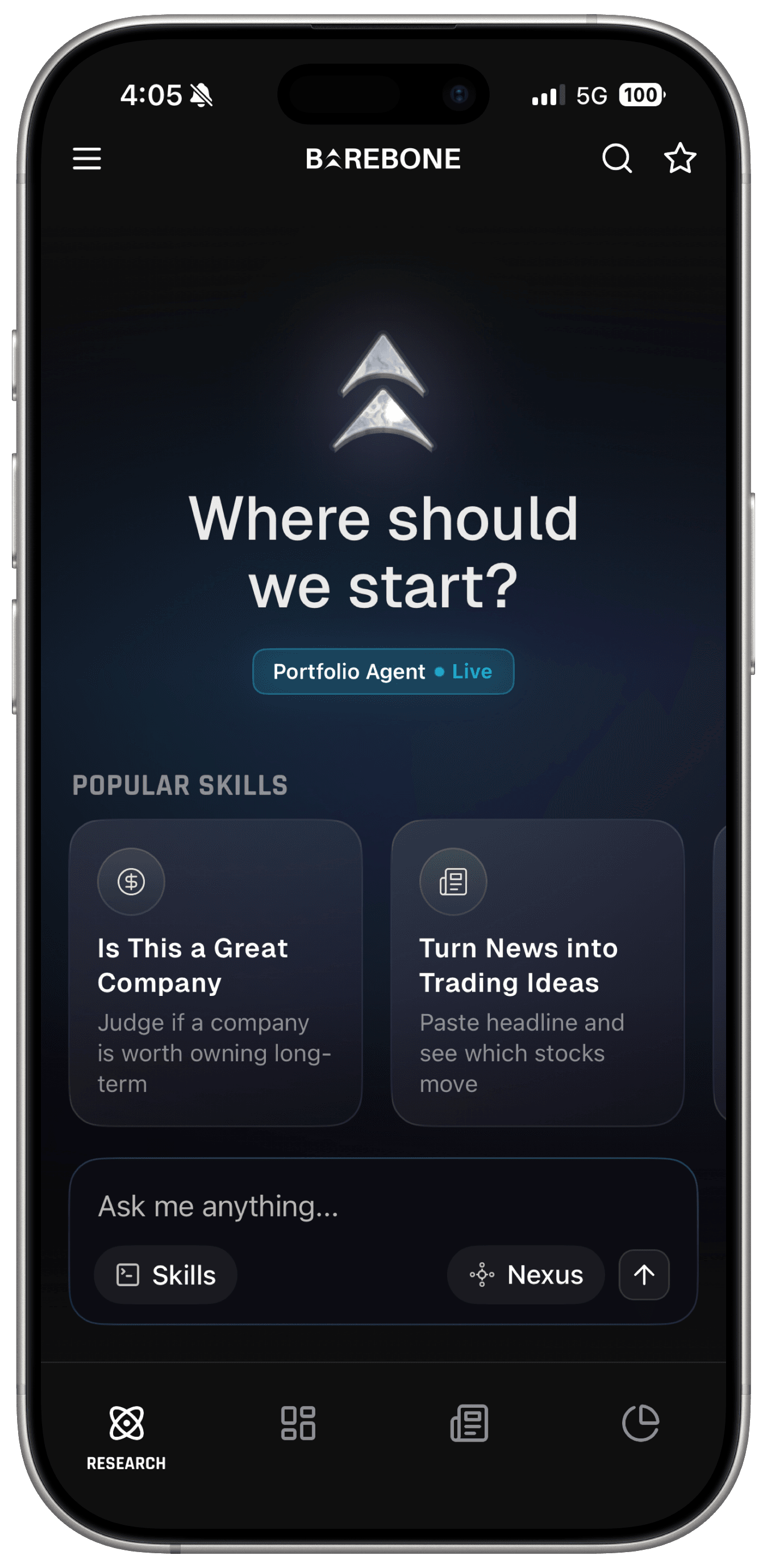
Barebone AI is an AI investment research app for iOS and Android - rated 4.8/5 on the Apple App Store, a Top 10 Google Play Finance app within 60 days of launch, and trusted by a 100,000+ community of investors across its app and social platforms. It was bootstrapped by a former Goldman Sachs investment banker and a former Hanson Robotics engineer to do one job: the research half of a Terminal, automated.
What it does well
- The AI does the analysis. Ask any question in plain English - "Is NVDA stretched after this run?" - and 20+ specialized research skills return institutional-grade analysis in seconds: fundamentals, valuation, technical levels with algorithmically derived entries, exits, and stop-losses, analyst and retail sentiment side by side, and AI-scored news across 10 global regions. On a Terminal, that's an afternoon of function codes.
- Smart-money tracking built in. Insider activity from SEC Form 4 filings, Congressional trade disclosures, and super-investor 13F tracking - plus earnings analysis with prediction-market odds.
- Live data, verified. Real-time market data, and every figure the AI cites is verified against underlying financial data before display.
- Portfolio context. Read-only broker sync powers AI portfolio analysis, watchlists, and alerts.
- No contract, no demo call. You start researching in the app, not after a sales process.
Where it falls short
- No execution and no messaging. It will never route an order, and there's no Instant Bloomberg equivalent. Research only.
- No institutional workflows - compliance surveillance, entitlements, audit trails.
- Mobile-first. There's no desktop terminal yet.
- US-market depth is strongest. Bloomberg's global multi-asset coverage has no consumer rival, here or anywhere on this list.
Verdict: the research layer of a Terminal, AI-automated for individual investors - the best match between what individuals actually use and what they pay for.
2. Koyfin - Best Bloomberg-Style Dashboards
Koyfin is the closest an individual gets to the Terminal's look and feel: customizable dashboards, advanced charting, and market and macro monitors.
What it does well
- A genuinely useful free tier - two years of financials, watchlists, dashboards, and charting.
- Fair paid ladder. Plus at $39/month and Premium at $79/month (annual saves up to 30%) unlock 10-year financials, estimates, and full transcripts.
Where it falls short
- You are still the analyst. Koyfin presents excellent data; it doesn't produce analysis.
- No AI research automation, no algorithmic entry/exit levels, no measured retail sentiment, no Congress-trade tracking.
Verdict: the best DIY data terminal for investors who want Bloomberg's feel and plan to do the work themselves.
3. TIKR - Best Deep Fundamentals Data
TIKR is a fundamentals terminal: financials, estimates, valuation tools, and screening across 100,000+ global stocks, with data sourced from S&P Global's Capital IQ.
What it does well
- Data depth and history that embarrasses most consumer tools, with a free tier for US stocks.
- Cheap relative to what it carries. Plus at $24.95/month and Pro at $54.95/month (annual billing runs about 30% less).
Where it falls short
- Numbers, not answers. TIKR's pitch is data: no AI doing the analysis, and reviewers note it does little to guide you.
- Thin beyond fundamentals: basic charting, no sentiment, insider, or news intelligence.
Verdict: Bloomberg-grade fundamental data at retail prices, for investors who enjoy spreadsheet work.
4. Fiscal.ai - Best AI Copilot for Filings
Fiscal.ai (formerly FinChat) pairs long financial histories and segment-level KPIs with an AI copilot that answers from filings.
What it does well
- Filings-grounded answers - segment economics with figures tied to source documents.
- Honest freemium: a free plan with 10 years of annual financials; Pro at $39/month billed annually, Max at $79/month.
Where it falls short
- One lane. A fundamentals tool - no technical levels, no sentiment measurement, no insider or Congress tracking, no portfolio sync.
- Web-first, built for desk sessions, not your pocket.
Verdict: the best way to interrogate filings with AI - a complement to a research platform more than a replacement for one.
5. AlphaSense - The Enterprise Alternative
AlphaSense is market-intelligence search for institutions: filings, transcripts, broker research, news, and a huge expert-call library, with AI summarization on top.
What it does well
- Document search at scale. For a research team asking "what has every company said about pricing power this quarter?", it's the category leader.
- Content you can't get elsewhere as an individual, including aggregated broker research.
Where it falls short
- Enterprise pricing, enterprise process. No free tier, no public list price; actual customer spend data puts seats at roughly $10,000 - $20,000 per year, with median contracts around $18,375. That's a Bloomberg-class decision, not a consumer one.
Verdict: the serious Terminal alternative for institutions - wrong tool, wrong price for an individual.
6. TradingView - Best for Charts
TradingView claims 100 million users and has become the retail internet's default charting layer.
What it does well
- Charting without peer: hundreds of built-in indicators, community scripts, multi-chart layouts, alerts, paper trading, and broker integrations.
- Reasonable ladder. On annual billing, Essential runs $12.95/month up to Ultimate at $199.95/month; a free tier exists with one chart per tab, two indicators, and delayed data.
Where it falls short
- The chart is most of the picture. Fundamentals are thin, with no AI analysis, no measured sentiment, no smart-money tracking - reviewers describe it as a charting platform first. Full comparison: Barebone AI vs TradingView.
Verdict: if charting is the job, buy this; it isn't a research department.
7. Seeking Alpha - Best for Reading Human Theses
Seeking Alpha is the web's largest crowdsourced equity-research library, with Premium at $299 per year.
What it does well
- Long-form human argument - sharp bull and bear cases on the same ticker, plus a deep earnings-transcript archive and quant ratings.
Where it falls short
- You do the synthesis, article quality varies by author, and theses age from publication day. A reading subscription, not a terminal. Full comparison: Barebone AI vs Seeking Alpha - or see Seeking Alpha alternatives.
Verdict: the best opinion library in finance; the furthest thing on this list from a Bloomberg replacement.
When Nothing but the Terminal Will Do
If you execute institutional orders, live in Instant Bloomberg chat, trade global fixed income or derivatives, or need compliance-grade infrastructure - keep the seat. That's what the $32K buys, and no consumer tool, mine included, replaces it.
The Bottom Line
The Bloomberg Terminal bundles four businesses: research, execution, messaging, and compliance. Individuals only ever needed the first one. In 2026 that research layer no longer requires a five-figure seat - with Barebone AI automating the analysis itself, and Koyfin, TIKR, and Fiscal.ai (from $0 to $80 a month) serving investors who'd rather drive the data manually. For the wider landscape, see the best AI investing apps, the is Barebone AI legit? breakdown, or the FAQ.
Frequently Asked Questions
How much does a Bloomberg Terminal cost in 2026?
Roughly $31,980 per year for a single seat, or about $28,320 per seat for firms with multiple terminals, typically on a two-year contract. Bloomberg does not publish list pricing publicly - you request a demo and negotiate - but multiple 2026 industry trackers converge on these figures.
What is the best Bloomberg Terminal alternative for individual investors?
For most individuals, Barebone AI - it automates the research half of a Terminal with AI: fundamentals, valuation, technical levels, sentiment, insider and Congress trades, 13F tracking, and scored news, on mobile. It does not replace execution, Bloomberg messaging, or institutional workflows. For DIY data terminals, Koyfin and TIKR are the strongest picks.
Is there a free Bloomberg Terminal alternative?
Several tools are genuinely usable at $0. Koyfin, TIKR, and Fiscal.ai all offer real free tiers with limited data history, and TradingView's free plan covers basic charting. Barebone AI automates the research layer with AI on mobile. Nothing free - or paid, at consumer prices - replicates the full Terminal.
Can any alternative fully replace a Bloomberg Terminal?
No. The Terminal's execution routing, Instant Bloomberg messaging network, compliance infrastructure, and global multi-asset data depth have no consumer-grade rival, which is why institutions keep paying. What alternatives genuinely replace is the research workflow - and for individual investors, that is usually the only part of the Terminal they would ever use.
Is AlphaSense cheaper than a Bloomberg Terminal?
Usually per seat, yes - actual customer spend data puts AlphaSense around $10,000 to $20,000 per seat annually versus Bloomberg's roughly $32,000 - but it is still enterprise software with no free tier and sales-negotiated contracts. It targets research teams and institutions, not individual investors researching a personal portfolio.
Barebone AI is a research and analysis tool, not a financial advisor or broker. Nothing here is investment advice.