The Moment That Started Everything
I'm going to tell you something that most people in finance won't say out loud.
The system is not designed for you. It never was. I know this because I was part of it.
I sat on the trading floor at Goldman Sachs and watched how information actually moves through markets. Not how they teach you in textbooks. How it actually works.
A piece of news breaks. Within seconds, a team of analysts is pulling the data, running the models, cross-referencing the filings, mapping the second and third-order effects across sectors and geographies. By the time you read the headline on your phone, the institutions have already made their moves. The price has already shifted. You're reacting to information that's already been priced in by people who had it before you did.
That's not a conspiracy. It's just infrastructure. Goldman Sachs employs thousands of analysts. They have Bloomberg terminals that cost $25,000 a year per seat. They have proprietary data feeds, direct market access, and research budgets in the hundreds of millions. Of course they're faster. They've spent a century building that advantage.
But here's what changed: AI made all of that replicable. Not in five years. Not in theory. Right now.
That realization is why Barebone exists.
What Barebone Actually Is
Barebone is not another finance app. It's not a chatbot with a stock ticker bolted on. It's not a news aggregator with a pretty UI.
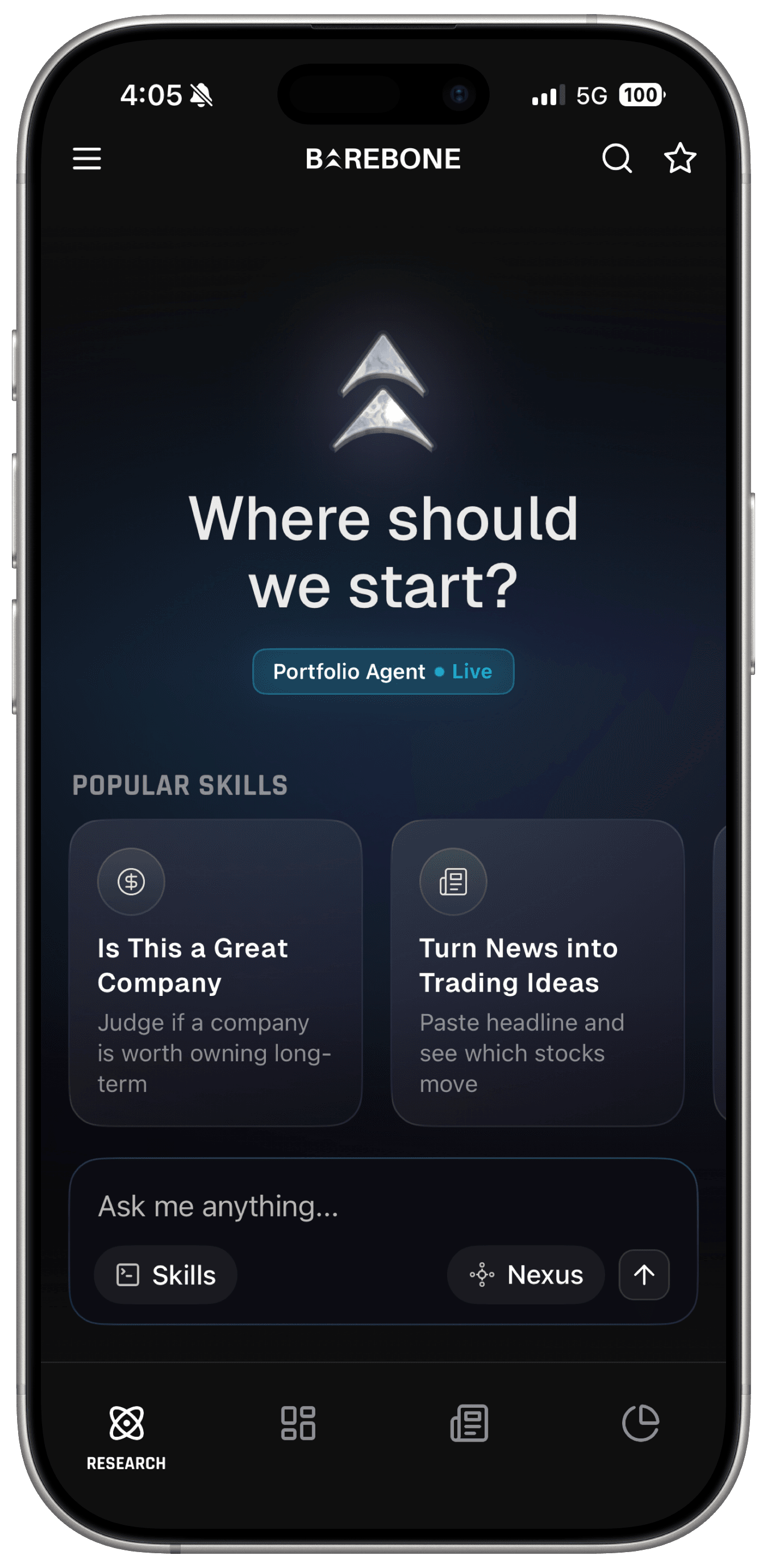
Barebone is a team of AI financial analysts that live in your pocket. Each one is a specialized agent - trained on specific financial methodologies, connected to real institutional-grade data sources, and designed to do one type of analysis exceptionally well.
When you ask Barebone a question - anything from "Should I buy NVIDIA?" to "What happens to semiconductor stocks if China invades Taiwan?" - you're not getting a generic AI response scraped from the internet. You're triggering a full research engine. Real financial data gets pulled from dozens of institutional-grade feeds. Proprietary algorithms run. A team of specialized AI agents collaborates. And within seconds, you get the same caliber of analysis that a team of human analysts would take days to produce.
Charts. Ratings. Technical levels. Valuation models. Sentiment data from Wall Street analysts and Reddit simultaneously. Entry points, exit targets, and stop-losses calculated by algorithms that read the market from multiple angles at once. All of it personalized to your investment style, your risk tolerance, your portfolio.
A community of more than 100,000 investors across our app and social platforms is already here. Not because we have the biggest marketing budget. Because the product speaks for itself.
The 20 Analysts In Your Pocket
Here's where it gets specific. Barebone isn't one AI doing everything. It's a library of 20+ specialized research Skills - each one a dedicated AI analyst purpose-built for a different type of financial analysis.
"Is This a Great Company" runs a Warren Buffett-style deep value analysis. It pulls your target company's income statements, financial ratios, analyst ratings, and key metrics, then evaluates across four dimensions: growth potential, business quality, financial health, and valuation. It even runs a fact-checker against the raw data to make sure every number it cites is accurate. You get a rated scorecard with a full investment thesis - the kind of thing a junior analyst at a bank would spend a week putting together.
"When to Buy and Sell" is where we get surgical. This isn't some basic moving average crossover. We built a proprietary algorithm that reads each stock across multiple views of the market at once - from short-term price action to longer-term structure - and refuses to call a level valid until it's been independently confirmed across them. When the chart runs out of history, like a stock at all-time highs, it switches to projection-based targets instead of going silent. It adapts entry aggressiveness to current momentum conditions. It wraps every level in a volatility-aware buffer zone sized to how the stock actually trades. You get a specific entry price, a take-profit target, a stop-loss, and a confidence score from 0 to 100. No hand-waving. Just math. (The exact parameters? Those stay in the vault.)
"Turn News into Trading Ideas" is the one that really shows the power of AI. Paste any headline - "US announces 25% tariffs on Chinese semiconductors" - and the AI gets to work. It maps sector-level impact across direct, indirect, and secondary effects, screens the entire market for the specific stocks exposed to each one, and sorts everything into primary and secondary impact groups with named categories. You go from reading a headline to having an actionable trade thesis in under thirty seconds.
"What Investors Are Saying" pulls sentiment from every angle simultaneously - institutional analyst ratings, Reddit trending data from WallStreetBets and r/investing, insider trading patterns, and news sentiment - and shows you where the smart money and the crowd agree, and more importantly, where they diverge. Because divergences are where the real opportunities hide.
And that's just four of them. There's head-to-head stock comparison with radar charts. DCF valuation models with margin of safety calculations. Multi-year outlook assessments. Bull vs. bear scenario analysis with probability weighting. High-volume scanners that catch institutional activity. Earnings reaction trackers. Dividend screeners. ETF recommenders. Portfolio X-rays that scan every holding for hidden risks. Each one is a dedicated analyst with its own data sources, its own methods, and its own way of showing you the results.
What Happens When You Ask a Question
Every time you ask a question, the research streams to your screen in real-time - and you watch it build:
First, the AI identifies your intent, extracts any ticker symbols, and plans its analysis approach. You see it thinking. Second, you get a quick summary - a rapid-fire answer so you're oriented before the deep dive. Third, the system pulls live financial data: current prices, key metrics, interactive charts. Fourth, it searches the web for relevant news and maps it on a timeline. Fifth, the deep analysis renders - this is where the charts, ratings, gauges, tables, and structured insights appear. And sixth, it suggests three to five follow-up questions so you can keep drilling deeper without starting over.
The whole thing takes seconds. And every element is backed by real data from real financial APIs - not hallucinated, not approximated, not pulled from a training dataset that's two years stale.
It's Not Just Research - It's a Complete Intelligence Platform
The Research tab is the core, but Barebone is built as a full market intelligence system.
The Dashboard gives you a morning briefing that would make a hedge fund PM jealous. Thirty-plus market indicators across US equities, global markets, commodities, forex, crypto, and Treasury yields - all real-time. An AI-generated hourly news brief that scores sentiment and identifies affected tickers. Reddit trending stock data with rank changes and AI analysis of why each stock is buzzing. Top gainers and losers with AI-generated explanations. Insider trades pulled directly from SEC Form 4 filings. Congressional stock trades with party affiliation and timing. Earnings calendars with EPS estimates. Economic event calendars with CPI, jobs data, and Fed decisions.
The Headlines tab aggregates financial news across ten global regions - US, China, Japan, Australia, Hong Kong, Europe, Middle East, Latin America, and crypto - and every single article gets an AI market impact score from 0 to 10, a list of affected stocks with bullish or bearish direction and rationale, a full AI breakdown with trading implications, and a personalized section that tells you what it means for your specific portfolio. And if you want to go deeper, you tap "Dig Deeper" and it opens a full research session with the news context pre-loaded.
The Portfolio tab connects to your actual brokerage account through a secure, read-only broker sync - or you enter holdings manually - and tracks everything in real-time. But the real magic is the AI Portfolio Analysis, which evaluates your portfolio from several independent angles at once - growth, risk, income, sector balance, and momentum. It might flag that you're 65% concentrated in tech, suggest dividend positions for stability, or warn that three of your holdings just broke below key support levels. You get a comprehensive report that reads like it came from a private bank's research team.
The Part That Matters Most
The AI learns you.
This isn't a generic tool that gives the same answer to everyone. Barebone has a personalization engine that runs deep. You set your proficiency level - beginner, intermediate, or advanced - and the AI adjusts its entire communication style. A beginner gets a patient financial mentor who explains every concept. An advanced user gets analysis written as if they're sitting at the head of the global trading desk at Goldman Sachs - penetrating, contrarian, quantified, immediately actionable.
You set your risk tolerance, your investment strategies, your preferred asset classes, your industry focus down to specific sub-sectors, your geographic markets. And then there's the memory system. Every question you ask, every company you research, every pattern in your behavior - the AI tracks it and builds an evolving profile of who you are as an investor. Over time, the analysis gets sharper, more relevant, more tuned to how you think.
You can see everything it's learned about you. You can delete any of it. Full transparency, full control. But the result is an AI that actually knows you - not in a creepy way, but in the way a trusted analyst who's worked with you for years would know what to prioritize and how to frame things.
Why This Matters
I want to be direct about what's at stake here.
Every cycle, the same thing happens. A massive opportunity emerges - AI, crypto, clean energy, whatever it is - and the institutions see it first because they have the infrastructure to see it first. They position early. And by the time the average investor hears about it, the easy money has been made. The information asymmetry isn't malicious. It's structural. And it's been this way for a hundred years.
We built Barebone because we believe that's over now. Not because of good intentions - because of technology. AI is the great equalizer. The same analysis that required a team of twenty analysts and millions in data subscriptions can now be replicated by an AI agent running on your phone. The same pattern recognition. The same multi-source cross-referencing. The same structured, rigorous, data-backed reasoning.
A community of more than 100,000 investors across our app and social platforms has already made the switch. They're not waiting for permission. They're not hoping the institutions will share their research. They're generating their own.
The institutions had their century. This one is yours. We're making sure of it.