The 3-Minute Window
When breaking news hits - a surprise tariff announcement, an FDA drug approval, a CEO resignation, a geopolitical escalation - the market moves fast. The first 3 minutes after a major headline determine who profits and who chases.
Professional traders at hedge funds have dedicated news terminals, alert systems, and sector analysts sitting in the room ready to map any event to its market impact. They know instantly that a new chip export restriction affects NVIDIA, ASML, Applied Materials, and Taiwan Semiconductor. They know that an airline strike impacts not just the airline but also hotel chains, travel platforms, and jet fuel demand.
Individual investors? They read the headline, think "that's interesting," and by the time they figure out which stocks are affected, the move has already happened.
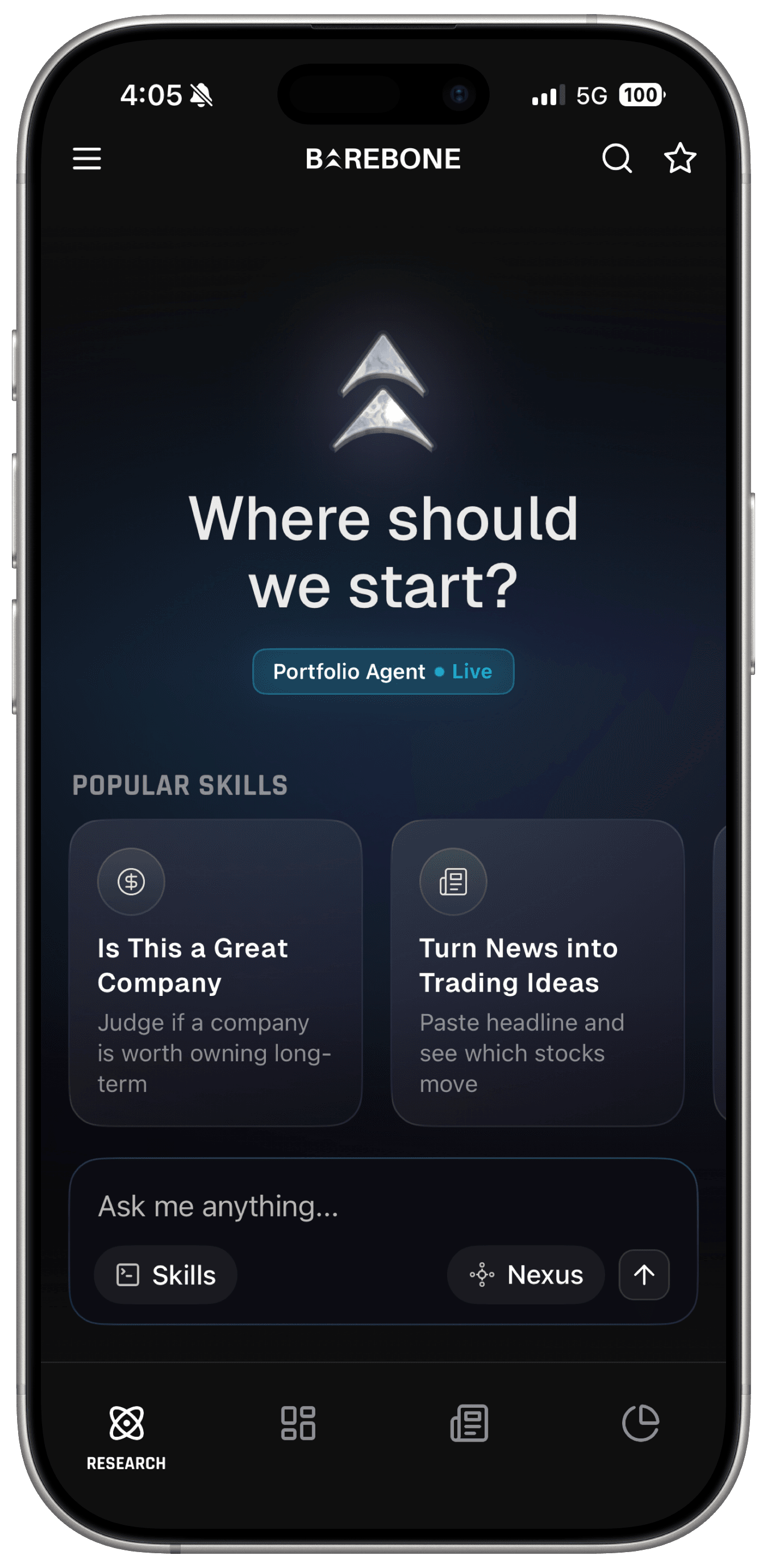
Barebone AI's "Turn News into Trading Ideas" Skill bridges this gap. You paste any headline or describe any event, and the AI identifies the stocks that will be most impacted - in under 30 seconds.
How the AI Turns a Headline into Tickers
This isn't a language model guessing which stocks might be affected. It's structured, systematic analysis:
It Maps the Event to Sectors
The AI decomposes the event into its fundamental components and maps each component to affected sectors. A headline like "U.S. announces 25% tariff on Chinese electric vehicles" gets decomposed into:
- Direct impact: Chinese EV manufacturers, U.S. EV companies (potential beneficiaries)
- Supply chain impact: Battery manufacturers, lithium miners, rare earth suppliers
- Indirect impact: Traditional automakers, charging infrastructure companies, automotive dealers
- Macro impact: Trade-exposed sectors, companies with China revenue concentration
It Screens the Whole Market, Not a Watchlist
The AI then screens the full universe of listed companies against institutional financial data for matches in each affected sector and sub-sector. This isn't keyword matching - it's systematic screening by sector classification, revenue exposure, and geographic operations.
For the tariff example, that screen would surface:
- Companies classified in the EV/automotive sector
- Companies with >20% revenue from China
- Battery and component manufacturers by SIC/NAICS code
- Infrastructure companies in EV charging
It Sorts Stocks by How Directly They're Hit
The discovered stocks are categorized into PRIMARY and SECONDARY impact groups:
- PRIMARY: Companies directly named in or most immediately affected by the event. These are the stocks that will move first and most.
- SECONDARY: Companies indirectly affected through supply chain relationships, competitive dynamics, or sector correlation. These are the second-order effects that sophisticated traders look for.
For each stock, the AI provides:
- Direction of impact (bullish or bearish)
- Magnitude estimate (high, medium, low)
- Specific reasoning for why this company is affected
- Whether fundamental or technical analysis is more relevant for trading the move
The News Intelligence Layer
Simultaneously, the AI runs a deep semantic news search for corroborating intelligence. This surfaces:
- Previous reporting on the same topic
- Analyst commentary or research notes related to the event
- Historical precedents - how markets reacted to similar events in the past
- Counter-narratives that might limit the expected impact
This context prevents knee-jerk analysis. If the AI finds that markets have already priced in similar tariff expectations based on prior reporting, it adjusts its impact assessment accordingly.
From Headlines to AI Research
The real power is what happens next. Once you see the affected stocks, you can tap any ticker to launch a full AI research session. From a single headline, you can:
- Run "Is This a Great Company" on any PRIMARY impact stock to determine if the event changes the long-term investment thesis
- Run "When to Buy and Sell" to get precise entry points if you want to trade the move
- Run "What Investors Are Saying" to see whether Wall Street analysts and Reddit are aligned on the impact direction
- Run "Valuation Check" to see if the post-news price creates a valuation opportunity
This is the workflow institutional event-driven hedge funds use - decompose the event, identify affected securities, analyze the best opportunities, and execute. The difference is they have 20-person teams. You have an AI that does it in 30 seconds.
Real Examples
Event: "Apple announces new M4 Max chip with 2x AI performance"
- PRIMARY: Apple (direct), TSMC (sole manufacturer)
- SECONDARY: Qualcomm (competitive pressure), AMD (laptop competition), Intel (further behind), Arm Holdings (architecture provider - bullish), Samsung (DRAM supplier)
Event: "FDA approves Eli Lilly's new Alzheimer's drug"
- PRIMARY: Eli Lilly (direct beneficiary), Biogen (competitive pressure on existing Alzheimer's drugs)
- SECONDARY: Other Alzheimer's pipeline companies (validation of the mechanism), Healthcare ETFs, Long-term care facility companies
Event: "Major cybersecurity breach at Fortune 500 company"
- PRIMARY: The breached company (bearish), CrowdStrike and Palo Alto Networks (beneficiary - demand surge)
- SECONDARY: Other cybersecurity firms, Cyber insurance providers, IT consulting firms, Competitor companies that might win displaced customers
Headlines Tab Integration
Barebone's Headlines tab already does this passively for every major news story. Each article in the Headlines feed includes:
- AI market impact score (0-10) with color-coded severity
- Affected tickers with bullish/bearish direction
- AI-generated rationale for each affected stock
- "Dig Deeper" button to launch full research sessions
The "Turn News into Trading Ideas" Skill lets you do it actively - paste any headline from any source and get the same institutional-grade impact analysis on demand.
Why This Beats Searching Google
When you Google "stocks affected by tariff announcement," you get:
- News articles from 3 hours ago (too late)
- Generic listicles that name obvious stocks (TSLA, NIO) and miss second-order effects
- No real-time price data, no technical levels, no fundamental analysis
- No way to instantly dive deeper on any identified stock
When you use Barebone AI, you get:
- Immediate identification of both primary and secondary impact stocks
- Cross-referenced with real-time financial data
- Each stock tagged with direction and magnitude
- One tap to full AI analysis on any ticker
- The entire process takes 30 seconds
The market doesn't wait for you to do research. Neither should your research tools.