The Honest Answer
I build an AI investment platform, so you might expect me to say "absolutely, AI is the future of investing." And I do believe that - but the honest answer is more nuanced.
AI is transforming investment research the same way spreadsheets transformed accounting. It doesn't replace judgment. It makes the analytical process faster, more comprehensive, and more accessible. Whether that translates into better investment returns depends entirely on how you use it.
Here's what the data actually shows.
What AI Does Well for Investors
Speed of Analysis
The most measurable advantage is speed. A comprehensive fundamental analysis that takes a human analyst 3-5 days takes AI 30 seconds. This isn't an incremental improvement - it's a category change.
For individual investors, speed matters because:
- You can evaluate more opportunities before committing capital
- You can respond to breaking news with analysis instead of gut reactions
- You can compare multiple stocks before narrowing your decision
Breadth of Data Access
Institutional investors have always had an information edge. Bloomberg terminals, FactSet subscriptions, proprietary data feeds - the infrastructure of professional investing costs $50,000-$100,000+ per year.
AI platforms like Barebone AI aggregate dozens of institutional-grade data feeds - financial statements, real-time prices, analyst ratings, SEC filings, insider trades, Congressional stock disclosures, Reddit sentiment, news feeds, economic indicators - and make them accessible to individual investors on a phone.
This doesn't mean you have the same edge as a Goldman Sachs trading desk. But the gap between individual and institutional data access has narrowed from a canyon to a crack.
Consistency
Human analysis suffers from:
- Recency bias - overweighting the most recent data
- Confirmation bias - seeking information that supports existing beliefs
- Anchoring - being influenced by irrelevant reference points
- Fatigue - the quality of analysis declining after hours of work
AI runs the same analysis with the same rigor on the 50th stock as on the 1st. Every metric is calculated, every data source is checked, every timeframe is analyzed. The quality doesn't degrade.
Multi-Dimensional Analysis
When humans analyze a stock, they typically focus on 1-2 dimensions - the ones they're most comfortable with. A value investor looks at P/E ratios. A technical trader looks at chart patterns. A growth investor looks at revenue trends.
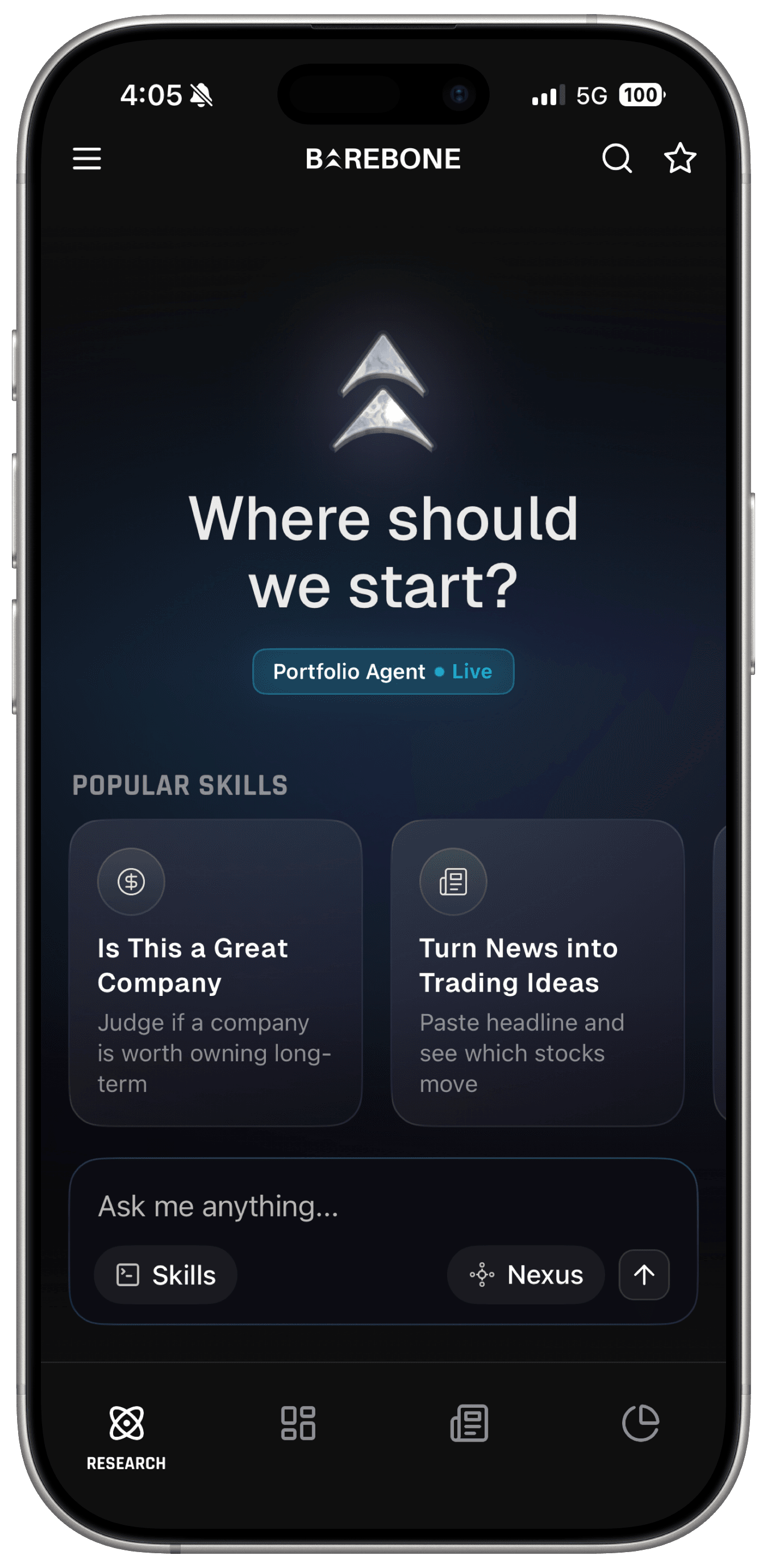
AI can evaluate all dimensions simultaneously. Barebone's "Is This a Great Company" Skill analyzes growth potential, business quality, financial health, AND valuation in a single pass, producing a rating on each dimension that would require a team of specialists to replicate manually.
What AI Doesn't Do Well (Yet)
Predicting the Future
Let's be clear: no AI can predict stock prices. Anyone claiming AI can tell you where a stock will be in 6 months is selling snake oil.
What AI can do is:
- Calculate what a stock should be worth based on current fundamentals (intrinsic value)
- Identify statistically significant technical levels where buying/selling pressure concentrates
- Aggregate what informed market participants (analysts, insiders, institutions) expect
- Surface risks and opportunities from the data
This is research, not prediction. The distinction matters.
Understanding Novel Situations
When something truly unprecedented happens - a new type of financial crisis, a technological disruption without historical precedent, a geopolitical event unlike any before - AI struggles. Its analysis is grounded in patterns from historical data. Genuine black swan events, by definition, don't have historical patterns to reference.
Human judgment, creativity, and intuition remain essential for navigating truly novel situations.
Assessing Management Quality
Is the CEO trustworthy? Can this management team execute? Are they building for long-term value or extracting short-term gains?
These questions require reading between the lines of earnings calls, understanding corporate culture, and making judgment calls about human character. AI can surface data points (insider trading patterns, compensation structure, historical guidance accuracy), but the ultimate assessment is still a human call.
The Evidence from 2025-2026
Several developments have validated AI's role in investment research:
-
Institutional adoption: Every major bank - Goldman Sachs, JPMorgan, Morgan Stanley, Bank of America - is investing billions in AI research tools. They're not doing this as an experiment. They're doing it because AI-augmented analysts produce more research, faster, with fewer errors.
-
Data quality improvement: The explosion of commercial real-time financial data APIs - alongside free regulatory sources like SEC EDGAR - has made it possible for AI platforms to access the same data that Bloomberg terminal users see, at a fraction of the cost.
-
User adoption: A 100,000+ community of investors across Barebone AI's app and social platforms now trusts it for research. The retention rates indicate the product delivers value beyond novelty - users who try AI research continue using it because it measurably improves their process.
-
Research speed democratization: Individual investors using AI tools can now evaluate as many investment opportunities per week as a junior analyst at a bulge-bracket bank. That's a structural shift in who has the capacity for comprehensive research.
The Right Way to Use AI for Investing
Based on working with a 100,000+ community of investors, here's how the most successful users integrate AI:
Use AI for Research, Not Decisions
AI generates analysis. You make the decision. The investors who struggle are the ones who want AI to tell them "buy AAPL at $180 and sell at $220." The investors who succeed use AI to build a comprehensive understanding and then apply their own judgment.
Combine Multiple AI Analyses
Don't run one Skill and act on it. Use the fundamental analysis Skill to understand the business, the technical analysis Skill to identify entry points, the sentiment Skill to gauge market positioning, and the valuation Skill to understand whether the price is justified. Layer these perspectives.
Verify and Cross-Reference
AI makes mistakes. Barebone has a built-in fact-checker that cross-references every cited number against raw financial data, but no system is perfect. When an AI analysis suggests something surprising, verify it. Check the underlying data. Read the actual SEC filing.
Use AI to Expand Your Universe
Most individual investors research the same 20-30 stocks they already know. AI's speed advantage lets you explore sectors, industries, and companies you've never considered. Use the screener Skills, the event-driven discovery Skill, and the trending analysis to find opportunities outside your comfort zone.
The Competitive Landscape
For investors evaluating AI tools in 2026:
- General AI (ChatGPT, Perplexity, Copilot): Good for explanations and general questions. No real-time financial data, no specialized algorithms, no portfolio integration.
- Bloomberg AI features: Best-in-class for institutional professionals. $25,000/year. Desktop only.
- Barebone AI: 20+ specialized research skills, dozens of institutional-grade data feeds, proprietary technical analysis, an AI analyst team for portfolio review, mobile-first.
- Other fintech AI apps: Various, but most are wrappers around general LLMs without specialized financial infrastructure.
The Bottom Line
Should you use AI for investing? Yes - but as a research multiplier, not a decision maker.
The investors who will outperform in the next decade are not the ones with the best intuition. They're the ones with the best research process. AI makes your research process faster, more comprehensive, and more consistent.
That's not a prediction. That's the same logic that drove every institutional investor to adopt quantitative tools, data terminals, and algorithmic analysis over the past 40 years. The only difference is that now individual investors have access to the same capabilities.
The gap between individual and institutional investors is closing. AI is closing it. The question isn't whether to use AI for investing - it's whether you can afford not to.