The Man in the Leather Jacket
Once a year, a 63-year-old man in a leather jacket walks onto a stage in San Jose and moves billions of dollars.
His name is Jensen Huang. He runs NVIDIA - currently the most valuable semiconductor company on earth, worth over $4 trillion. And every March at GTC, NVIDIA's annual technology conference, he spends about two hours doing something no other CEO does: he tells you, in plain sight, exactly where the AI industry is going next.
Not vaguely. Not in corporate-speak. He gets on stage, holds up hardware, drops product names, and spends his time on the things that matter. The trick is that where Jensen spends his time is the signal. The things he talks about more than last year? That's where the money flows. The things he stops talking about? Already priced in. Move on.
Most people watch GTC for the product announcements. We watched it for the money.
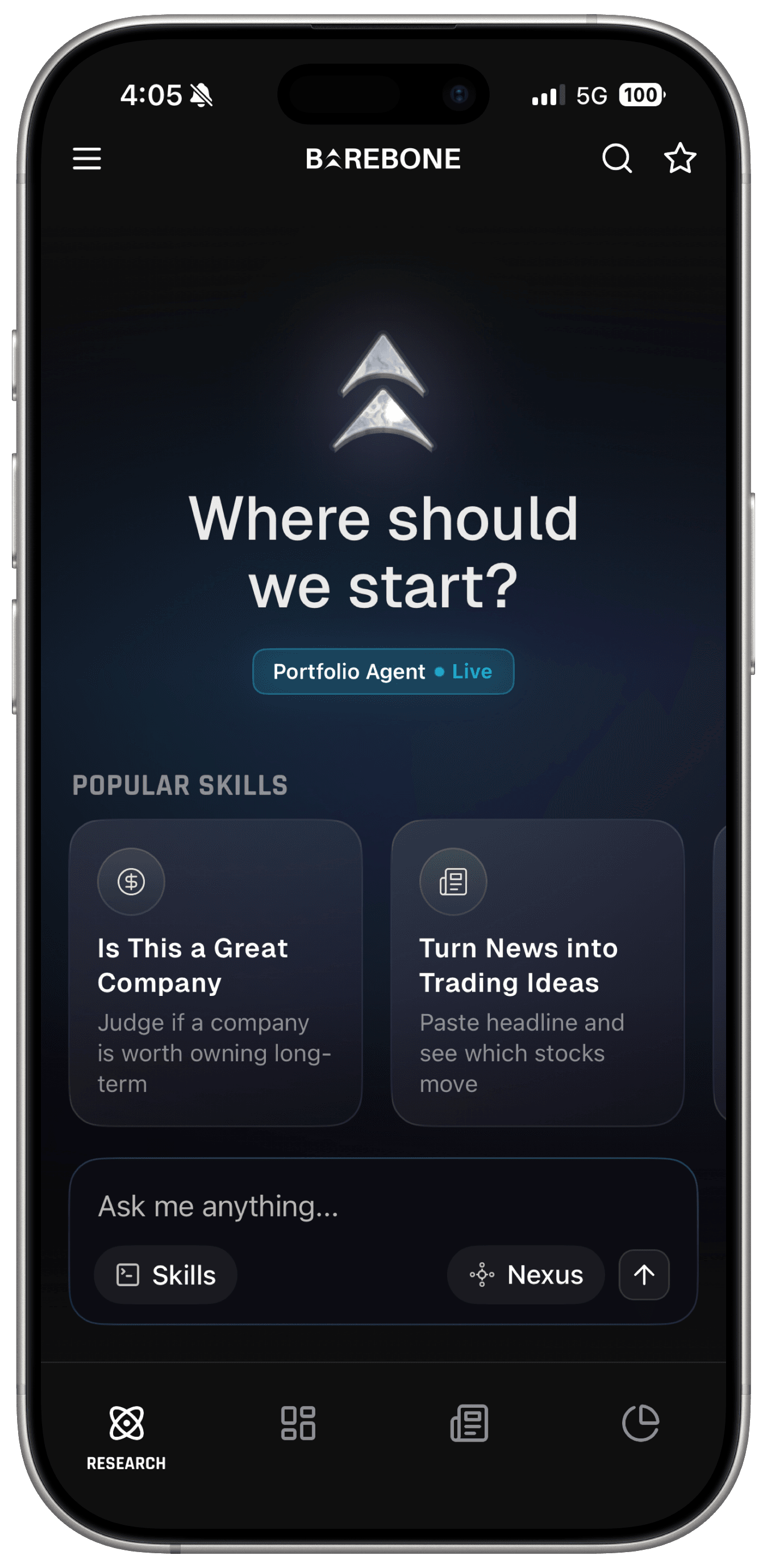
We used Barebone AI to do something that would normally take a research team days: a complete word-by-word breakdown of both the GTC 2025 and GTC 2026 keynote transcripts. Every keyword tracked. Every emphasis shift measured. Then we pulled a year of stock data for every company tied to Jensen's 2025 themes and answered the only question that matters - did listening to him actually make you money?
Vertiv +205%. TSMC +95%. Broadcom +68%. Arista +62%. Those are the 12-month returns on the stocks that mapped to what Jensen emphasized most at GTC 2025. We'll show you the receipts. But first - here's what he just told us this week.
What Jensen Is Saying Now (And What He Stopped Saying)
The trick isn't just listening to what Jensen says. It's noticing what he says more - and what he says less. When he spends 10 minutes on a topic, he's telling the market what NVIDIA's customers will be spending on next. When he stops talking about something, that growth phase is over. It's priced in.
Here's what shifted between 2025 and 2026:
| Term | GTC 2025 | GTC 2026 | Change | What it means |
|---|---|---|---|---|
| Inference | ~5 | ~21 | +320% | "It's way past training now" |
| Agent / agentic | ~13 | ~38 | +192% | The new frontier |
| Reasoning | ~19 | ~41 | +116% | From buzzword to actual workload |
| Physical AI | ~5 | ~9 | +80% | Growing, but not the main event |
| Vera Rubin | ~12 | ~19 | +58% | NVIDIA's next-gen AI supercomputer platform |
| Silicon photonics / CPO | ~6 | ~9 | +50% | Last year's surprise. This year: "in full production" |
| Copper / interconnect | ~8 | ~11 | +38% | Copper is NOT going away |
| Tokens | ~87 | ~46 | -47% | No longer needs explaining |
| Robotics | ~44 | ~26 | -41% | Less evangelizing, more real partners |
| Blackwell | ~22 | ~12 | -45% | Last year's flagship AI chip. Already shipping. Old news |
| Enterprise | ~24 | ~9 | -63% | The sale was already made |
| DGX | ~13 | ~2 | -85% | NVIDIA's personal AI computer line. Quietly shelved |
| Groq (LPU) | 0 | ~12 | NEW | Inference-specific chip from an acquired startup |
| OpenClaw | 0 | ~13 | NEW | NVIDIA's open-source framework for building AI agents |
Jensen's Emphasis Shift: GTC 2025 → 2026
Keyword mention change between keynotes. What he talks about more = where demand is heading next.
See the pattern? Everything Jensen was selling last year - Blackwell (NVIDIA's current flagship AI chip), enterprise adoption, DGX (NVIDIA's line of personal AI supercomputers) - he's barely mentioning now. That stuff shipped. It's done. The new emphasis is on agents, inference, and entirely new product lines that didn't exist 12 months ago.
Three massive shifts jump out from this data. Let's break them down.
The Agent Takeover
Last year, Jensen spent his keynote convincing the world that "tokens" are the new commodity - the unit of AI output, like barrels of oil or kilowatt-hours. AI data centers are "AI factories" that produce tokens. Your revenue equals how many tokens you can generate per second.
This year? He barely mentioned tokens. The audience already gets it. Instead, he spent his time on something much bigger: agents.
Not chatbots. Not the AI that answers your questions. Agents - AI systems that actually do things. They browse the web. They write code. They manage workflows. They make decisions. Every SaaS company, Jensen declared, will become a "GaaS" company - agent-as-a-service.
He introduced OpenClaw, NVIDIA's new open-source framework for building agents, and compared it to Linux, HTTP, and Kubernetes. If you know what those are, you know that's not a small comparison. If you don't - those are the foundational technologies that the entire internet and cloud computing industry was built on. Jensen is saying agents will be that big.
Then came the math. Agents consume 10 - 100x more compute per task than a chatbot. Multiply by 100x more usage, and you get a one-million-times increase in compute demand over two years. That number is almost certainly aspirational. But even 1% of it means today's infrastructure isn't remotely close to enough.
Jensen closed this section with a question to the audience: "What's your OpenClaw strategy?" When the CEO of the most valuable semiconductor company on earth asks you that, he's not curious. He's telling you what every enterprise will be buying next.
Inference Took Over
Here's a word most people outside tech don't think about much: inference. In AI, there are two phases. Training is when you teach the model - it's expensive, it takes months, and only a handful of companies do it (Google, OpenAI, Meta, Anthropic, etc.). Inference is when the model is used - every time you ask ChatGPT a question, every time an AI agent runs a task, that's an inference workload.
Last year, Jensen pitched inference as "one of the most important workloads of the next decade." It was forward-looking. A setup.
This year, his tone was completely different: "It's way past training now - it's in the field of inference." The word went from 5 mentions to 21. Training was barely discussed. NVIDIA even introduced a pricing framework for inference tokens - from a $0 free tier to $150 per million tokens at the premium end. Jensen talked about "token budgets" for employees the way companies currently budget for cloud computing.
Why does this matter for investors? Because training and inference have very different economics. Training is capital expenditure for maybe five hyperscale companies - Google, Microsoft, Amazon, Meta, Oracle. Inference is operating expenditure for everyone. Every company running AI workloads, 24/7, forever. The total addressable market goes from 5 buyers to every enterprise on the planet.
The companies positioned for inference - not just training - are the ones to watch.
Chips Are Dead. Long Live AI Factories.
Last year, Jensen talked about Blackwell - NVIDIA's current-generation AI chip, the one powering most of the world's AI data centers right now - the way Intel used to talk about Pentium. It was a chip. Here are the specs. Here's the performance. Buy it.
This year, he introduced its successor: Vera Rubin - named after the astronomer who proved dark matter exists. And he described it not as a chip but as "7 chips, 5 rack-scale computers, one AI supercomputer." He announced DSX, a platform for designing and operating entire AI data centers using digital twin simulations. He unveiled the Kyber rack - a completely new physical rack format with 144 GPUs connected via copper. He even announced a data center designed for space.
The punchline: a 1-gigawatt AI factory costs approximately $40 billion before you even put compute in it. Jensen said he sees "$1 trillion through 2027" in AI factory spending. NVIDIA doesn't just want to sell you the GPU anymore. They want to sell you the networking, the cooling design, the factory simulation software, and the operational tools to run the whole thing.
This is how you keep growing when you already own 80%+ of the GPU market: you sell more of the stack around the GPU.
The 4 Investment Signals
So those are the shifts. Here's where they lead - the four concrete investment themes Jensen just telegraphed for the next 12 - 18 months.
Signal 1: Agentic AI Infrastructure (Highest Conviction)
"Agents" went from 13 mentions to 38. OpenClaw was introduced as "the Linux of agents." NemoClaw was announced for enterprise deployment.
This is the demand story. Every agent deployed is a continuous inference workload consuming tokens around the clock. The companies building the infrastructure for agents - orchestration, memory, tool use, safety guardrails - are where the next wave of value creation happens.
Who benefits: NVIDIA (more inference demand), cloud providers deploying agentic workloads (Amazon, Microsoft, Google), enterprise software companies that successfully pivot to agent-as-a-service (ServiceNow, Salesforce, Palantir), and the entire inference compute supply chain underneath.
Signal 2: Inference-Specific Silicon (The Groq/LPU Play)
Here's something that flew under the radar. NVIDIA acquired a company called Groq - a startup that built a completely different kind of AI chip called an LPU (Language Processing Unit), designed specifically for running AI models fast and cheap rather than training them. Now NVIDIA is launching it as a new product line. The LP30 ships Q3 via Samsung. LP35 and LP40 are on the roadmap.
The architecture is clever - Vera Rubin handles the "thinking" part of inference (prefill), and the Groq LPU handles the "speaking" part (decode). Different silicon optimized for different parts of the same workload.
Why does this matter? NVIDIA is admitting that inference needs different hardware than training. And by building their own inference-specific chip, they're preempting competitors - Google's TPU, Amazon's Trainium, and the custom chips that Broadcom and Marvell build for hyperscalers.
Who benefits: Samsung (manufacturing the LP30 - making them a new NVIDIA fab partner alongside TSMC), NVIDIA (expanding the portfolio). Worth watching: If NVIDIA's integrated Vera Rubin + Groq solution is compelling enough, hyperscalers might stop commissioning custom ASICs - which would be a headwind for Broadcom and Marvell.
Signal 3: AI Factory Construction at Scale
Jensen said the magic words: $1 trillion through 2027. A single 1-gigawatt AI factory costs $40 billion. Vera Rubin requires 100% liquid cooling with 45-degree hot water. The new Kyber rack demands entirely new physical infrastructure.
The bottleneck isn't chips. It's everything around the chips - power, cooling, construction, and the electrical grid. Jensen explicitly said AI factories are power-limited. This is the exact same signal that made Vertiv a +205% winner off GTC 2025 - and he's doubling down.
Who benefits: Vertiv (already +205% - is there more?), power utilities and grid infrastructure companies, data center developers, liquid cooling specialists, and the companies in NVIDIA's new DSX ecosystem who help design and simulate these facilities (Siemens, Cadence, PTC, Dassault).
Signal 4: Copper AND Optics - Both Win
This one matters if you follow the data center supply chain. The market has been debating whether NVIDIA's future networking would be copper-based or optical-based - treating it as a zero-sum competition. Jensen killed that narrative dead:
"There's a lot of conversation about - is NVIDIA going to copper scale-up or optical scale-up? We're going to do both."
Then he showed the roadmap. Current systems use copper for connecting GPUs within a rack and optical for connecting racks to each other. Future systems will use both - plus a new technology called co-packaged optics (CPO), where fiber connects directly to the chip, eliminating bulky transceivers that waste power and cost $6,000 per GPU.
Last year, CPO was Jensen's dramatic surprise reveal - his Steve Jobs "one more thing" moment. He held the hardware on stage, fumbled with cables, spent 10 minutes on the physics. This year? Three minutes, matter-of-fact: "We're the only one in production with it today." CPO went from bet to moat in 12 months.
His closing statement: "We need a lot more capacity for copper. We need a lot more capacity for optics. We need a lot more capacity for CPO." Not either/or. All of the above.
Who benefits: TSMC (the sole foundry for NVIDIA's CPO - a monopoly position), copper suppliers like TE Connectivity and Amphenol (copper is confirmed not going away), and optical component companies across the photonics supply chain.
The Dead Themes: What Jensen Stopped Selling
Equally important - if you're still investing based on any of these themes, Jensen has moved on:
| Theme | 2025 → 2026 | What happened |
|---|---|---|
| Sovereign AI | 0 → 3 mentions | Dead. The "every nation needs AI" pitch is over |
| DGX personal computers | 13 → 2 mentions | Never became the breakout Jensen hoped for |
| Digital twins | 9 → 3 mentions | Quietly folded into DSX, not standalone anymore |
| Enterprise adoption | 24 → 9 mentions | Enterprise already bought in. No need to pitch |
| Gaming/GeForce | Minimal → nostalgic | NVIDIA is an AI company now. Gaming is a side gig |
These aren't necessarily bad businesses. They're just not where the next wave of spending is going. Chasing last year's GTC theme is like buying Vertiv after it already ran +205%. The signal has been consumed.
But Does This Actually Work? The 2025 Scorecard
Everything above is forward-looking. Here's why we think it's worth acting on.
At GTC 2025, Jensen hammered three themes above all else: power and cooling are the bottleneck, chip fabrication capacity is critical, and data center networking needs to scale dramatically. We mapped those themes to stocks and measured what happened over the following 12 months:
| Ticker | Company | Jensen's 2025 Theme | GTC 2025 Open (Mar 17) | Current (Mar 19, 2026) | Return |
|---|---|---|---|---|---|
| VRT | Vertiv | Power & cooling | $86.82 | $264.71 | +205% |
| TSM | TSMC | Chip fabrication | $173.95 | $339.57 | +95% |
| AVGO | Broadcom | Networking | $188.05 | $315.93 | +68% |
| ANET | Arista | Networking | $83.88 | $136.07 | +62% |
| NVDA | NVIDIA | Everything | $122.74 | $180.40 | +47% |
| MRVL | Marvell | Optical networking | $68.75 | $87.62 | +27% |
| ARM | ARM | CPU architecture | $118.06 | $128.36 | +9% |
| SMCI | Super Micro | Server assembly | $42.68 | $30.35 | -29% |
GTC 2025 Theme Stocks: 12-Month Returns
Stocks mapped to Jensen's 2025 emphasis themes. Infrastructure around NVIDIA beat NVIDIA itself.
Look at that. The companies around NVIDIA - the ones supplying power, cooling, fabrication, and networking - crushed NVIDIA itself. Vertiv tripled. TSMC nearly doubled. Broadcom and Arista both beat the S&P 500 by a mile. Jensen told you what his customers needed, and the companies meeting those needs returned 2 - 4x more than NVIDIA's own stock.
The one exception: Super Micro, which fell 29% despite being in the "AI server" theme. Company-specific issues - accounting concerns, delisting risk - overwhelmed the sector tailwind. The lesson is important: Jensen tells you the technology, not the company. Being in the right theme isn't enough. Quality, execution, and governance still pick the winners and losers.
We also checked whether the specific technologies Jensen championed at GTC 2025 actually showed up in production:
| Technology | What Jensen said in 2025 | What actually happened | Verdict |
|---|---|---|---|
| Blackwell Ultra | Shipping 2H 2025 | Shipping. Already old news at GTC 2026 | Yes |
| Co-packaged optics | "One more thing" surprise reveal | "In full production" with TSMC | Yes |
| Dynamo (inference OS) | Open-sourced at GTC | Core to the Vera Rubin + Groq stack | Yes |
| DGX Spark | Major announcement with MediaTek | Barely mentioned (2 times at GTC 2026) | No |
| Groot N1 robots | Emotional keynote climax | Part of ecosystem, not breakout | Partial |
| Vera Rubin | Named, targeting 2H 2026 | First rack running at Microsoft Azure | Yes - ahead of schedule |
4 out of 6 confirmed. 1 de-prioritized. 1 partial. That's a strong hit rate. And GTC week itself was actually sell-the-news - most stocks dipped during the event. The real returns came in the months after, as the capital Jensen was describing actually got deployed. The play isn't timing the keynote. It's positioning before the spending arrives.
What This All Means
Jensen Huang isn't a stock analyst. He's not giving you ticker symbols. But he is doing something arguably more valuable: he's showing you, in real time, where hundreds of billions of dollars in AI infrastructure spending will flow over the next 12 - 18 months. And the data shows he's been remarkably accurate.
The playbook is simple. Identify what Jensen emphasizes most. Find the companies positioned to benefit from those themes. Focus on quality - the right theme with the wrong company still loses (ask SMCI shareholders). And be patient. The returns don't come during GTC week. They come in the months after, as the capex actually deploys.
The 2026 signals are clear. Agentic AI infrastructure. Inference-specific silicon. AI factory construction at massive scale. Copper and optics coexisting, not competing.
The question isn't whether these themes will attract capital. Jensen's track record suggests they will. The question is whether you're positioned before the capital arrives - or after.
Data: Barebone | Sources: NVIDIA GTC 2025 & 2026 keynote transcripts, institutional historical stock data (March 2025 - March 2026)