No - AI cannot predict the stock market, and any tool that claims it can is making a promise the evidence does not support. What AI does well is research: pulling live data, computing valuations, reading filings, and tracking sentiment in seconds. That is genuinely valuable. Prediction is a different claim, and it is the one regulators warn investors about most.
Barebone AI is our own product, so the temptation would be to overstate what AI can do. This piece does the opposite, because the honest answer is better for you and better for the long-term credibility of every serious tool in this space, ours included.
The Short Answer, and Why It's Short
Can AI predict the stock market? No - not reliably, not consistently, and not in the way "prediction" is usually sold.
This isn't pessimism about AI. It's a statement about markets. A price already reflects what's currently known. The next move depends on what becomes known next - an earnings surprise, a Fed decision, a war, a tweet - and that information does not yet exist in any dataset an AI could have trained on. You cannot compute your way to tomorrow's news.
So the question quietly splits in two:
- Can AI predict prices? No.
- Can AI make you a far better-informed investor? Yes - and that's the part worth your attention.
Why Prediction Specifically Fails
Three structural reasons, none of which a bigger model fixes:
- Markets price in what's known. If a pattern reliably forecast returns, traders would act on it until the edge disappeared. Durable, public, free prediction power is self-erasing - the moment it's known, it's gone.
- Markets adapt. A signal that worked in one regime stops working when conditions shift or when enough participants exploit it. A model fit to the last decade has explained that decade, not pre-loaded the next one.
- The future isn't in the training data. This is the simplest and most fatal. An AI's knowledge is assembled from things that already happened. New information - the only thing that moves prices - arrives from outside the dataset, by definition.
This is also why the accuracy numbers are sobering. On the Vals AI Finance Agent benchmark, no frontier model clears 58% on entry-level financial-analyst tasks over real, already-public filings as of the June 2026 run. If the best models can't reliably do a first-year analyst's homework on known data, "predict the market" is not the next milestone - it's a category error.
"AI That Predicts Stocks" Is a Known Fraud Pattern
Here's the part that matters most for your money. The promise of predictive AI isn't just unsupported - it's a recurring scam template.
The SEC, NASAA, and FINRA jointly warn investors about AI-themed investment pitches - "AI washing," bots promising guaranteed or outsized returns, and schemes that wrap old fraud in new buzzwords. When a product says its AI knows where a stock is going, the claim isn't impressive; it's the red flag itself.
A practical filter when you see a prediction claim:
- "95% accuracy" / "AI-picked winners" - measured by whom, over what period, against what baseline? Unaudited hit rates describe a marketing team, not a model.
- "Guaranteed returns" - markets don't offer guarantees, and neither can software sitting on top of them.
- "Our algorithm beats the market" - backtests fit the past. Ask for audited, forward, after-cost results. They rarely exist.
If a tool leads with forecasts instead of data you can check, that ordering tells you what it's really selling.
But Don't Overcorrect: AI Is Genuinely Useful Here
"AI can't predict the market" is true. "AI is useless for investing" is the lazy overcorrection, and it's also false. The honest middle is where all the value lives.
What grounded AI research tools actually do well, in seconds:
- Assemble the facts. Pull live prices, financials, and filings at the moment you ask - not from stale training memory.
- Compute, don't guess. Run valuation, technical levels, and ratio analysis from the actual numbers, where a division can be checked rather than vibed.
- Read faster than you can. Summarize earnings calls, 10-Ks, and news; aggregate analyst consensus and retail sentiment into one view.
- Surface what you'd miss. Flag concentration risk, unusual insider activity, or a level a stock just broke - the things that hide in the data.
None of that is prediction. All of it is research - the unglamorous work that makes a decision better-informed. The output isn't "buy NVDA"; it's a clear, sourced picture so you can decide. We make the distinction concrete in Can You Trust AI for Investment Research? and quantify the accuracy side in How Accurate Is AI Stock Analysis?.
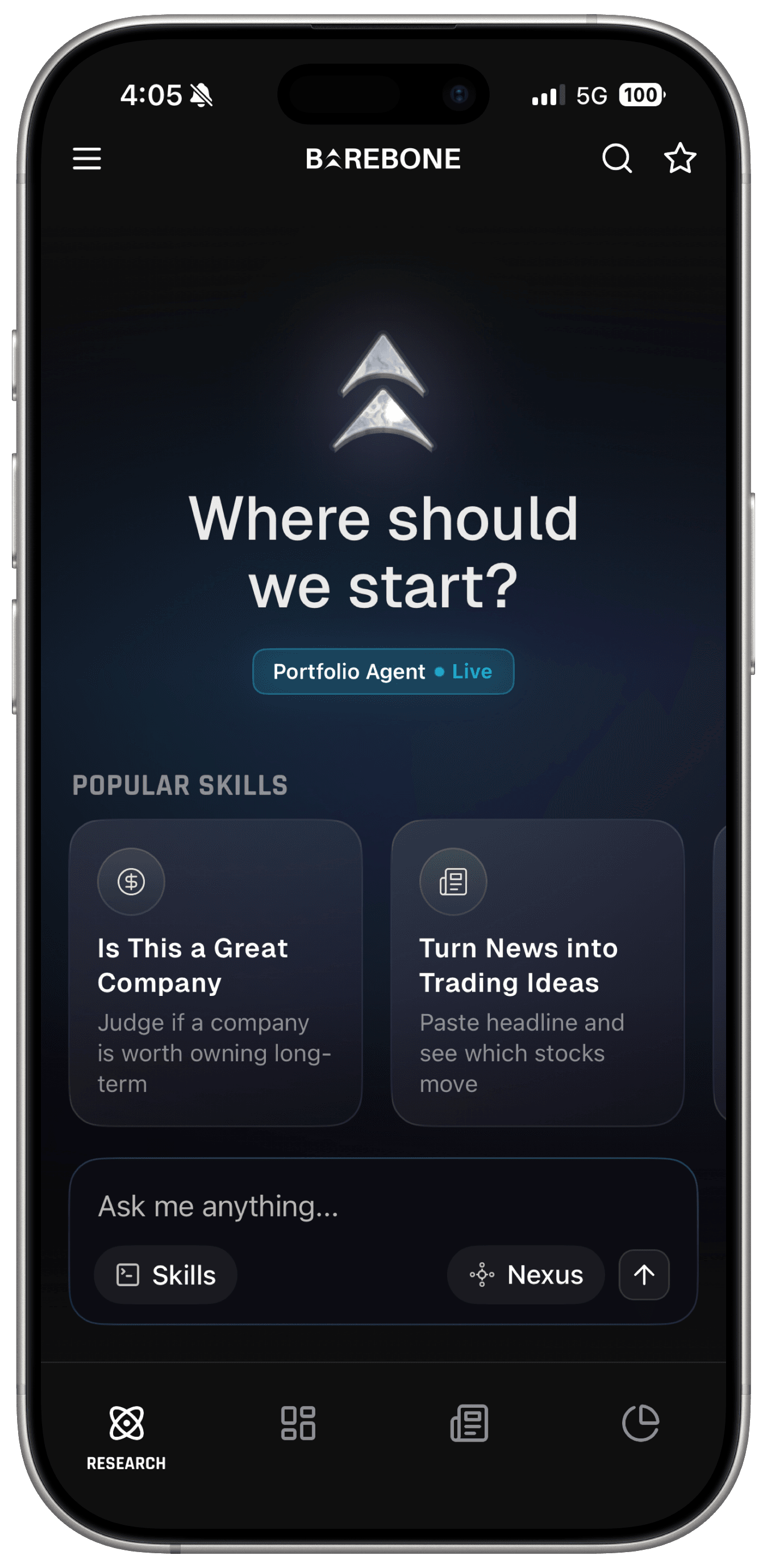
Barebone AI is built squarely in this research category. It does not predict prices and does not promise returns - every figure it cites is verified against underlying financial data before display, and it shows the charts and numbers so you can audit the work. That's the standard worth holding any tool to, ours included: help you see reality clearly, don't ask you to believe a forecast.
What About Quant Funds - Don't They Use AI to Predict?
Reasonable question, because the answer looks like a contradiction and isn't. Quantitative funds use machine learning to find small, statistical edges - tiny probabilistic tilts spread across thousands of simultaneous positions, wrapped in heavy risk management. Even then, a successful quant strategy might be right only slightly more than half the time on any individual bet; the profit comes from scale, diversification, and discipline, not from knowing where any one stock is headed.
That is a fundamentally different activity from a consumer app claiming it can tell you whether a single stock goes up next week. The fund edge is statistical, diversified, costly to build, and constantly decaying. It is not a crystal ball, and it doesn't become one when repackaged for a phone screen.
The Bottom Line
Can AI predict the stock market? No - and the tools claiming otherwise are the ones to walk away from. Prices move on tomorrow's information, which no model has. What AI can do is collapse hours of research into minutes: gather live data, verify it, compute the analysis, and surface the risks, so the decision you make is better-informed. Used that way, AI is one of the most useful things to happen to individual investors in a generation. Used as a fortune-teller, it's just the newest costume on an old con.
If you want the practical follow-up - which tools are actually worth using, and for what - see What's the Best AI to Ask About Stocks? and our FAQ.