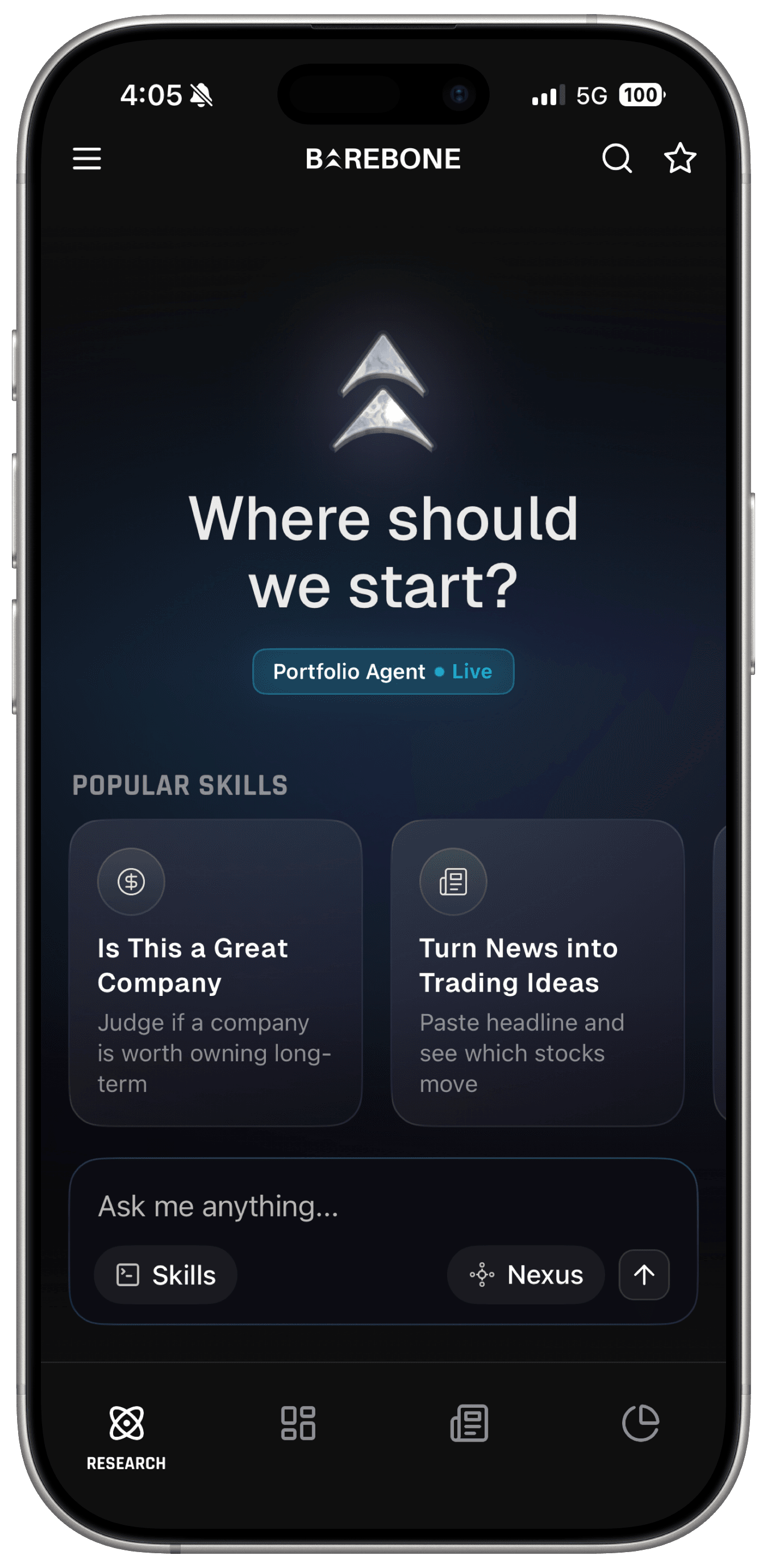
Beginners need three things from an AI trading app: plain-English explanations, a real free tier, and guardrails. Barebone AI leads in 2026 because its analysis adapts to your proficiency level (it's research-only - bring your own brokerage). Moomoo and Webull add free paper trading; Magnifi, Aime, Prospero, and Incite round out the field.
One cautionary data point before the list: when journalists handed real money to AI stock-picking setups, the results swung wildly - AI can do excellent research work, but it doesn't make risk disappear.
What "Beginner-Friendly" Actually Means
I scored every app against five tests:
- Explains, doesn't lecture. Terms like P/E or stop-loss should be explained in context, not assumed.
- A free tier you can live in. Not a 7-day teaser before a paywall.
- Guardrails. Paper trading, no pressure toward margin or options, no countdown-timer upsells.
- No jargon walls. You should never need a glossary tab open to read the analysis.
- Grows with you. The app should still be useful in year three.
The Picks at a Glance
| Rank | App | Type | Price | Why beginners like it |
|---|---|---|---|---|
| 1 | Barebone AI | AI research | Research on mobile | Output adapts to your level |
| 2 | Moomoo | Brokerage + AI | Free | $1M virtual paper trading |
| 3 | Webull | Brokerage + AI | Free (paid AI add-on) | Paper trading + clean UX |
| 4 | Magnifi | AI assistant | Free; $14/mo | Plain-English portfolio Q&A |
| 5 | AInvest (Aime) | AI assistant | Free; $12.99+/mo | Mentor-style chat |
| 6 | Prospero.ai | Signals | Free | Two-minute daily check-in |
| 7 | Incite AI | AI chat | Free; $19.99/mo | Fast answers, low setup |
1. Barebone AI - Best Overall for Beginners
Most finance apps are written for people who already speak finance. Barebone AI was built around the opposite assumption: you pick a proficiency level - beginner, intermediate, or advanced - and every analysis is written for that level. That's the differentiator. On beginner mode, asking "should I be worried about NVDA's valuation?" gets you a patient, plain-English walk-through of what the numbers mean; flip to advanced two years later and the same question returns desk-grade output.
What it does well
- Proficiency-adaptive output - the app meets you where you are instead of flattening everyone to one tone.
- Verified figures. Every number the AI cites is checked against the underlying financial data before display, which matters doubly for beginners who can't yet smell a wrong number.
- Full research toolkit when you're ready: 20+ specialized research skills covering fundamentals, valuation, technical levels with algorithmically derived entries, exits and stop-losses, analyst and retail sentiment, insider and Congress trade tracking, earnings analysis, and AI-scored news - plus read-only broker sync, watchlists, and alerts.
- Rated 4.8/5 on the Apple App Store; Top 10 in Google Play Finance within 60 days of launch; trusted by a 100,000+ community of investors across its app and social platforms.
Where it falls short
It's a research tool, not a brokerage - no trade execution and no paper-trading simulator, so pair it with a broker (the next two picks work). Mobile-first means no desktop terminal yet, and data depth is strongest for US markets.
Verdict: The only app on this list that genuinely adjusts to a beginner - use it as the brain, your brokerage as the hands.
2. Moomoo - Best Paper Trading Plus AI
Moomoo is a commission-free brokerage (4.7/5 from roughly 36K US App Store ratings) whose two beginner assets are a serious simulator and a built-in AI helper.
What it does well
- Paper trading with up to $1 million in virtual funds - make your rookie mistakes with fake money.
- Moomoo AI answers market questions conversationally and explains concepts step-by-step, with follow-up questions supported.
- $0 commissions on US stocks, ETFs, and options.
Where it falls short
The interface is dense - it's a pro-leaning platform, and new users routinely describe it as overwhelming. The AI assistant explains well but doesn't produce the layered research a dedicated platform does, and the app's natural gravity is toward trading more, not learning more.
Verdict: The best free practice environment; bring patience for the interface.
3. Webull - Cleanest Brokerage On-Ramp
Webull (4.7/5 from 336K US App Store ratings) pairs $0-commission trading and free paper trading with its Vega AI suite.
What it does well
- Paper trading included free, with a cleaner, less intimidating layout than Moomoo.
- Vega's free tier surfaces AI insights on your watchlist and portfolio; Vega Analyst, a paid add-on, generates on-demand stock reports - about 30 per month on a credit system.
Where it falls short
Vega launched in late 2025, so its track record is short, and the deeper AI analysis sits behind the paid add-on. As with every brokerage, remember the business model: the platform earns when you trade, which is not always when you should trade.
Verdict: The smoothest place to learn order mechanics; treat the AI as a helper, not a reason to trade.
4. Magnifi - Easiest Plain-English Q&A
Magnifi lets you connect existing accounts (Fidelity, Robinhood, Schwab) and ask questions about your whole financial picture in normal sentences.
What it does well
- Genuinely conversational - "what am I actually invested in?" is exactly the question beginners need answered, and Magnifi answers it well.
- Fair pricing: free tier, then $14/month or $8.25/month billed annually.
Where it falls short
Its 3.9/5 App Store rating (377 ratings) is the weakest here, reflecting rough edges. Analysis stays shallow - good for orientation, light for decisions.
Verdict: A friendly first AI layer over accounts you already have; you'll outgrow it.
5. AInvest (Aime) - Mentor-Style Chat
AInvest's Aime (4.3/5, 173 US ratings) positions itself as an investing mentor: ask why a stock moved, what a term means, or whether your portfolio is concentrated, and it answers conversationally with broker sync for context.
What it does well
- Approachable chat plus useful starter screens (dividend lists, analyst favorites) in one app.
Where it falls short
Upsells toward its $12.99 - $19.99/month tiers are persistent, and depth varies by feature. Its marketing language runs looser than its output quality - verify before you act.
Verdict: A decent free mentor with a pushy sales floor.
6. Prospero.ai - Simplest Free Signals
Prospero.ai (4.4/5, 57 US ratings) compresses institutional-style data into a few plain-number signals, free.
What it does well
- Zero cost, two-minute daily check-in, no jargon wall - a gentle way to build a market-watching habit.
Where it falls short
Signals arrive with little explanation, so you won't learn the why from this app alone, and its performance claims are self-reported. Small user base.
Verdict: A fine free sidecar; never your only input.
7. Incite AI - Fast Answers, Use with Skepticism
Incite AI (4.8/5 from 113 US ratings) gives quick, conversational reads on stocks and crypto from live data. Free to start, $19.99/month for Pro.
What it does well
- The lowest-friction Q&A here: type a ticker, get a clear directional summary in seconds.
Where it falls short
It advertises a 95% prediction accuracy figure that I could find no independent audit for - beginners are exactly the audience such claims work on, so I'm flagging it plainly. It's also iPhone-only, with Android still under development, and depth is thin beyond the headline read.
Verdict: Convenient second opinion; don't let an unaudited accuracy number set your position size.
Bottom Line
Start free, learn on fake money, and let the AI explain rather than decide: Barebone AI for research that speaks your level, Moomoo or Webull for paper trading and execution, and the rest as situational extras. When you're ready to go deeper, the agent-style tools in our AI investment agents ranking are the natural next step, and if you arrived here searching for free "advisor" apps, read what free AI investment advisor apps actually give you first. Questions about how Barebone works are answered in our FAQ and in the hands-on Barebone AI review.
Frequently Asked Questions
What is the best AI trading app for a complete beginner? Barebone AI is the strongest starting point in 2026 because its output adapts to your level - set it to beginner and every analysis is explained in plain English, with figures verified against underlying data. It is rated 4.8/5 on the App Store. Note it's research-only: pair it with a beginner-friendly brokerage to actually place trades.
Do I need to pay for an AI trading app as a beginner? No. Most apps on this list have a meaningful free tier: Prospero.ai's free signals, and the free AI features inside Moomoo and Webull brokerage accounts. Pay only after a free tier limits you in a way you can articulate. Beginners who start by paying $200+ a year usually fund features they never open.
Is AI trading safe for beginners? AI removes busywork, not risk. A good AI tool gives you verified data and clear explanations, but the market doesn't care how clean the analysis looked. Protect yourself with the basics: paper trade first, position sizes small enough to sleep, no leverage, no options until you understand them, and treat every accuracy claim you can't verify as marketing.
Should beginners let AI execute trades automatically? I'd say no. A few apps now place trades from a chat message, which compresses the gap between impulse and order to one sentence. As a beginner you learn from the friction - checking the thesis, sizing the position, placing the order yourself. Automate research first; automate execution never, or at least not until you've survived a full market cycle.
What is paper trading and why does it matter? Paper trading is practice trading with virtual money on live market prices. Moomoo and Webull both include it free - Moomoo's simulator gives up to $1 million in virtual funds. It matters because your first ten trades will teach you about your own psychology, and those lessons are dramatically cheaper when the money isn't real.
Barebone AI is a research and analysis tool, not a financial advisor or broker. Nothing here is investment advice.