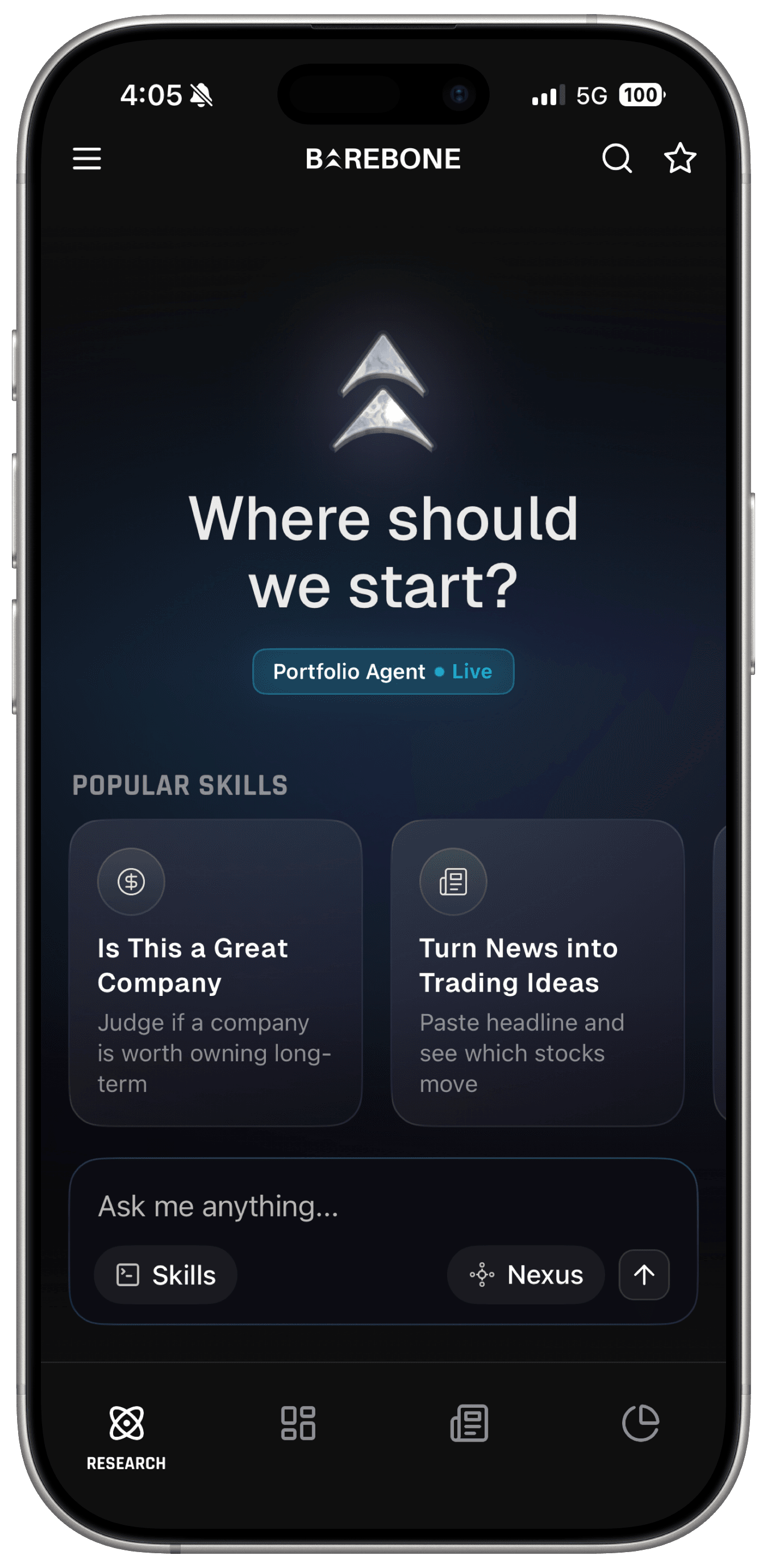
You Don't Need a Finance Degree to Invest Smarter
Here's something Wall Street doesn't want you to know: most of what professional analysts do isn't magic. It's process. They pull financial data, calculate ratios, read news, check what other analysts think, and synthesize it into a view.
The magic was always in access - access to the data, access to the analytical tools, access to the time needed to do it properly. In 2026, AI has made all of that accessible to anyone with a smartphone.
This guide is for people who are new to investing or new to using AI for investment research. No jargon. No assumptions. Just a clear path from "I have no idea where to start" to "I'm making informed investment decisions."
What AI Investment Research Actually Is
Think of AI investment research as having a team of financial analysts in your pocket. When you ask "Is Apple a good stock to buy?", here's what happens behind the scenes:
- Data collection: The AI pulls Apple's financial statements, stock price, analyst ratings, insider trades, news, and social media sentiment - all in real-time
- Analysis: Specialized algorithms evaluate Apple across multiple dimensions - growth, profitability, financial health, valuation
- Visualization: Charts, ratings, and tables appear showing you the key findings
- Synthesis: A written analysis explains what the data means in plain English
- Next steps: The AI suggests follow-up questions to help you research deeper
The entire process takes about 30 seconds.
Getting Started with Barebone AI
Step 1: Download the App
Barebone AI is available on iOS (App Store) and Android (Google Play). Download it and create an account.
Step 2: Set Up Your Research DNA
Before your first research query, the app asks you to configure your investment profile:
Proficiency Level
- Beginner: Every financial term gets explained. The AI acts like a patient mentor.
- Intermediate: Financial terms are used with brief context.
- Advanced: Professional-grade analysis with no hand-holding.
Start with Beginner. You can always increase it later as you learn.
Risk Tolerance
- Conservative: Focused on preserving capital, lower volatility
- Balanced: Mix of growth and stability
- Growth: Willing to accept more volatility for higher potential returns
- Aggressive: Comfortable with high volatility for maximum growth potential
If you're not sure, pick Balanced.
Investment Strategy Choose up to 3 approaches that interest you:
- Value Investing - buying undervalued stocks
- Growth Investing - buying fast-growing companies
- Income Investing - focusing on dividends
- Momentum - following price trends
- And others: Options, Day Trading, Swing Trading, ESG, Crypto, Forex, Commodities, Real Estate, Penny Stocks
Don't worry if you're not sure yet. The AI adapts as it learns your behavior.
Step 3: Ask Your First Question
Type any financial question into the search bar:
- "What should a beginner invest in?"
- "Is the S&P 500 a good investment?"
- "Explain ETFs to me"
- "Is Tesla overvalued?"
The AI will stream a comprehensive analysis. Read through it - at the Beginner level, every concept is explained as it comes up.
Understanding the Key Concepts (AI Will Explain These Too)
Stocks
A stock represents partial ownership of a company. When you buy Apple stock, you own a tiny piece of Apple. If Apple does well, the stock price tends to rise. If it does poorly, the price tends to fall.
ETFs (Exchange-Traded Funds)
A basket of stocks bundled together. Instead of buying 500 individual stocks, you can buy one S&P 500 ETF and own a piece of all 500 companies. ETFs offer instant diversification and are often recommended for beginners.
Fundamental Analysis
Evaluating a stock based on the company's actual business - revenue, profits, growth rate, debt levels. This answers: "Is this a good business?"
Technical Analysis
Evaluating a stock based on its price and volume patterns. This answers: "Is now a good time to buy or sell?"
Valuation
Determining whether a stock's price is justified by the company's financials. A great company can still be a bad investment if you pay too much for it.
Diversification
Spreading your investments across different stocks, sectors, and asset types so that poor performance in one area doesn't devastate your entire portfolio.
The 5 Best Skills for Beginners
Barebone AI has 20+ specialized research agents (called Skills). Here are the 5 most useful for beginners:
1. "Is This a Great Company"
Why: This is the most comprehensive single analysis. It evaluates a company across growth, quality, financial health, and valuation, giving you a complete picture.
Try: Enter any company you're curious about - Apple, Google, Netflix, Nike, Starbucks.
2. "Long-Term ETFs"
Why: ETFs are often the best starting point for new investors. This Skill recommends ETFs based on expense ratios, diversification, and historical performance.
Try: Ask "What are the best ETFs for long-term investing?"
3. "Which Stock is Better"
Why: When you're deciding between two companies, this Skill runs a head-to-head comparison across every dimension with visual radar charts.
Try: Enter two companies you're considering, like "Apple vs Microsoft."
4. "Best Case & Worst Case"
Why: Every investment has upside and downside. This Skill presents both scenarios so you understand the range of possible outcomes.
Try: Enter a stock you're thinking of buying.
5. "Valuation Check"
Why: Helps you understand whether a stock is cheap, expensive, or fairly priced relative to its fundamentals.
Try: Enter any stock to see its intrinsic value vs. market price.
Building Your First Portfolio
Start with the Dashboard
Before buying anything, spend a few days using Barebone's Dashboard to understand the market:
- Watch the 30+ market indicators to see how different asset classes move
- Read the AI-generated hourly news briefs to understand what drives the market
- Browse Reddit Trending Stocks to see what other investors are discussing
- Check the Top Gainers and Losers to understand daily market dynamics
Research Before You Buy
For every stock or ETF you're considering:
- Run "Is This a Great Company" for a comprehensive fundamental view
- Run "Valuation Check" to see if the price is reasonable
- Run "What Investors Are Saying" to understand market sentiment
- Run "When to Buy and Sell" to find a good entry point
Track with Portfolio
Once you start buying, add your holdings to Barebone's Portfolio tab. This gives you:
- Real-time tracking of your portfolio value
- Daily and lifetime profit/loss
- Risk metrics (volatility, Sharpe ratio, beta, maximum drawdown)
- AI Portfolio Analysis - 5 specialized agents that review your entire portfolio
Use the Watchlist
Add stocks you're interested in but not ready to buy. The Watchlist provides real-time price streaming so you can monitor them without committing capital.
Common Beginner Mistakes (and How AI Helps Avoid Them)
Mistake 1: Buying Based on Tips
Someone on Twitter says "buy XYZ!" Without research, you buy. AI alternative: Run a 30-second fundamental analysis first. Is the company actually good? Is the price reasonable?
Mistake 2: Panic Selling
Your stock drops 10% and you sell in fear. AI alternative: Run "Best Case & Worst Case" to understand whether the drop changes the investment thesis. Often it doesn't.
Mistake 3: No Diversification
You put everything in one stock. AI alternative: Use "Risk Assessment" on your portfolio. It will flag concentration risk and suggest diversification improvements.
Mistake 4: Ignoring Valuation
You buy a great company at a terrible price. AI alternative: "Valuation Check" shows you the margin of safety. A 30% overvaluation means you're paying a premium that limits your upside.
Mistake 5: Trading Too Frequently
Reacting to every piece of news. AI alternative: The AI's analysis has a stabilizing effect - when you see the full picture (fundamentals, technicals, sentiment), you're less likely to react emotionally to any single data point.
The AI Memory Advantage
As you research, Barebone AI's memory system learns your patterns:
- Which sectors you research most
- Your typical time horizon
- Your risk appetite (revealed by your questions, not just your stated preference)
- Your preferred analysis depth
After a few weeks, every analysis is subtly personalized to your emerging investment style. The AI becomes a research tool that understands you.
Your First Week: A Suggested Plan
Day 1: Download Barebone AI. Set up your Research DNA. Explore the Dashboard.
Day 2: Run "Is This a Great Company" on 3 companies you already know (Apple, Amazon, etc.). Read the analysis at Beginner level. Learn what the ratings mean.
Day 3: Try "Long-Term ETFs" to discover index funds and sector ETFs. Learn about expense ratios and diversification.
Day 4: Use "Which Stock is Better" to compare two companies side by side. Notice how the radar chart makes trade-offs visible.
Day 5: Explore the Headlines tab. Read AI-analyzed news articles and see how events affect specific stocks.
Day 6: Run "When to Buy and Sell" on a stock you're interested in. Learn about support, resistance, and entry points.
Day 7: Add some stocks to your Watchlist. Start monitoring prices and continue researching before making any purchases.
By the end of week one, you'll have more investment knowledge than most people accumulate in months - because the AI accelerates learning by showing you real data, real analysis, and real-time market dynamics from day one.
Welcome to smarter investing.